 VIPSolutions
Give step-by-step solution with explanation and final answer:We are designing a mini city whose watershed area is 200 acres. We want to build the following components inside the city: * downtown areas (20 acres) * one industrial park (40 acres, mostly concrete) * suburban residential areas (60 acres) * playgrounds (8 acres) ® parks (40 acres) * drives and walks (20 acres) ® unimproved areas (12 acres) The rainfall intensity is 1.3 inches per hour. Calculate the composite runoff coefficient and runoff discharge in cubic feet per second (cfs). Use the average runoff coefficient for each land cover. Show your work for full credits.
Question:
Give step-by-step solution with explanation and final answer: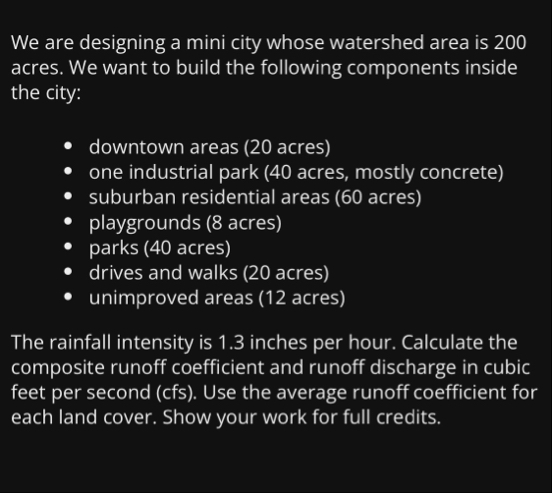 We are designing a mini city whose watershed area is 200
acres. We want to build the following components inside
the city:
* downtown areas (20 acres)
* one industrial park (40 acres, mostly concrete)
* suburban residential areas (60 acres)
* playgrounds (8 acres)
® parks (40 acres)
* drives and walks (20 acres)
® unimproved areas (12 acres)
The rainfall intensity is 1.3 inches per hour. Calculate the
composite runoff coefficient and runoff discharge in cubic
feet per second (cfs). Use the average runoff coefficient for
each land cover. Show your work for full credits.
This is AI generated Response.
Asked by: VARRI NAVEEN
Created at: 2025-09-26 21:12:41
Asked by: VARRI NAVEEN
Created at: 2025-09-26 21:12:41
Final Answer:
Rendered
Raw Text
Did you like this answer?
Let's solve the problem step by step:
---
## **Step 1: Assign Average Runoff Coefficients (C)**
Typical values (for US cities):
| Land Cover | Area (acres) | Runoff Coefficient (C) |
|---------------------------|--------------|------------------------|
| Downtown | 20 | .85 |
| Industrial Park | 40 | .80 |
| Suburban Residential | 60 | .35 |
| Playgrounds | 8 | .20 |
| Parks | 40 | .15 |
| Drives and Walks | 20 | .60 |
| Unimproved Areas | 12 | .05 |
---
## **Step 2: Calculate Composite Runoff Coefficient (Cᶜ)**
\[
C_c = \frac{\sum (C_i \cdot A_i)}{\sum A_i}
\]
Plug in the values:
\[
C_c = \frac{
(.85 \times 20) +
(.80 \times 40) +
(.35 \times 60) +
(.20 \times 8) +
(.15 \times 40) +
(.60 \times 20) +
(.05 \times 12)
}{200}
\]
Calculate numerator:
- \(.85 \times 20 = 17\)
- \(.80 \times 40 = 32\)
- \(.35 \times 60 = 21\)
- \(.20 \times 8 = 1.6\)
- \(.15 \times 40 = 6\)
- \(.60 \times 20 = 12\)
- \(.05 \times 12 = .6\)
Sum: \(17 + 32 + 21 + 1.6 + 6 + 12 + .6 = 90.2\)
\[
C_c = \frac{90.2}{200} = .451
\]
---
## **Step 3: Calculate Runoff Discharge (Q) in cfs**
The Rational Method formula is:
\[
Q = C \cdot I \cdot A
\]
Where:
- \(Q\) = runoff (cfs)
- \(C\) = runoff coefficient (dimensionless)
- \(I\) = rainfall intensity (in/hr)
- \(A\) = area (acres)
**Convert area to acres** (already done), and use \(I = 1.3\) in/hr.
**Standard Rational Method Conversion:**
\[
Q = C \cdot I \cdot A
\]
where result is in cfs if:
- \(C\) is dimensionless,
- \(I\) in inches/hour,
- \(A\) in acres.
\[
Q = .451 \times 1.3 \times 200
\]
\[
Q = .451 \times 260 = 117.26 \text{ cfs}
\]
---
## **Step 4: Final Answers**
### **Composite Runoff Coefficient:**
\[
\boxed{.45}
\]
### **Runoff Discharge (Q):**
\[
\boxed{117.3\ \text{cfs}}
\]
---
### **Summary Table**
| Step | Value |
|----------------|------------|
| Composite C | .45 |
| Q (cfs) | 117.3 |
---
**All calculations are shown above. Let me know if you need further explanation!**
📢 Instructions:
- Ask anything relatd to above question only.
- For new Question goto :