 VIPSolutions
Give step-by-step solution with explanation and final answer:3. [Class lecture problem] Calculate the bearings for all these traverse lines of this polygon from the angles to the right shown in figure. D c = re ba Ve ww Ve ow /3 0 SA) 17s, | B % F gst &¢ Taz «C Sa
Question:
Give step-by-step solution with explanation and final answer: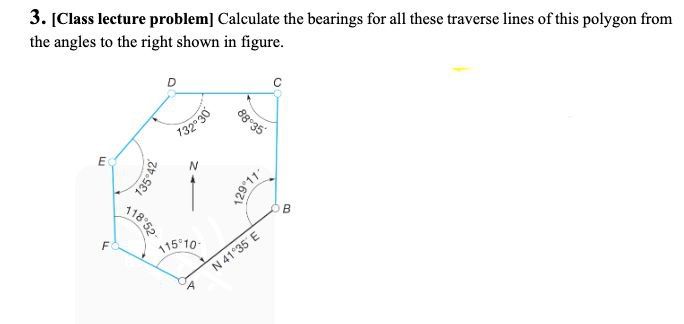 3. [Class lecture problem] Calculate the bearings for all these traverse lines of this polygon from
the angles to the right shown in figure.
D c =
re
ba
Ve ww
Ve ow
/3 0
SA)
17s, | B
%
F gst &¢
Taz «C
Sa
This is AI generated Response.
Asked by: VARRI NAVEEN
Created at: 2025-09-26 20:00:17
Asked by: VARRI NAVEEN
Created at: 2025-09-26 20:00:17
Final Answer:
Rendered
Raw Text
Did you like this answer?
Let's solve the problem step by step:
---
## **Step 1: Understanding the Problem**
We are given a closed traverse ABCDEF with internal angles (measured to the right) and one known bearing (AB = N 41°55' E).
We need to calculate the **bearing of each traverse line** (AB, BC, CD, DE, EF, FA).
---
## **Step 2: List the Given Data**
- **Angles to the right at each point:**
- A = 115°10′
- B = 129°11′
- C = 88°35′
- D = 132°30′
- E = 135°42′
- F = 118°52′
- **Known bearing:**
- AB = N 41°55′ E
---
## **Step 3: Bearing Progression Formula**
To find the bearing of the next line, use:
> **Bearing of next line = Bearing of previous line + 180° - Interior angle at point**
If the result is > 360°, subtract 360°.
If the result is < °, add 360°.
---
## **Step 4: Calculate Bearings Step by Step**
### **1. Bearing of AB**
Given: **N 41°55′ E**
Azimuth of AB = 41°55′ (measured clockwise from North)
---
### **2. Bearing of BC**
\[
\text{Azimuth of BC} = \text{Azimuth of AB} + 180° - \text{Angle at B}
\]
\[
= 41°55' + 180° - 129°11'
\]
\[
= 221°55' - 129°11' = 92°44'
\]
---
### **3. Bearing of CD**
\[
\text{Azimuth of CD} = \text{Azimuth of BC} + 180° - \text{Angle at C}
\]
\[
= 92°44' + 180° - 88°35'
\]
\[
= 272°44' - 88°35' = 184°09'
\]
---
### **4. Bearing of DE**
\[
\text{Azimuth of DE} = \text{Azimuth of CD} + 180° - \text{Angle at D}
\]
\[
= 184°09' + 180° - 132°30'
\]
\[
= 364°09' - 132°30' = 231°39'
\]
(Since > 360°, subtract 360° if necessary, but here it's not.)
---
### **5. Bearing of EF**
\[
\text{Azimuth of EF} = \text{Azimuth of DE} + 180° - \text{Angle at E}
\]
\[
= 231°39' + 180° - 135°42'
\]
\[
= 411°39' - 135°42' = 275°57'
\]
(Since > 360°, subtract 360°: 275°57', so fine.)
---
### **6. Bearing of FA**
\[
\text{Azimuth of FA} = \text{Azimuth of EF} + 180° - \text{Angle at F}
\]
\[
= 275°57' + 180° - 118°52'
\]
\[
= 455°57' - 118°52' = 337°05'
\]
(Since > 360°, subtract 360°: 337°05', so it's less than 360°, so fine.)
---
## **Step 5: Final Answers in Table**
| Line | Bearing (Azimuth, from North) |
|------|------------------------------|
| AB | 41°55' |
| BC | 92°44' |
| CD | 184°09' |
| DE | 231°39' |
| EF | 275°57' |
| FA | 337°05' |
---
### **Optional: Convert Azimuths to Quadrant Bearings**
- ° to 90°: N θ E
- 90° to 180°: S (180°-θ) E
- 180° to 270°: S (θ-180°) W
- 270° to 360°: N (360°-θ) W
Let's convert:
| Line | Azimuth | Quadrant Bearing |
|------|---------|------------------------|
| AB | 41°55' | N 41°55' E |
| BC | 92°44' | S 87°16' E |
| CD | 184°09' | S 4°09' W |
| DE | 231°39' | S 51°39' W |
| EF | 275°57' | N 84°03' W |
| FA | 337°05' | N 22°55' W |
---
## **Summary Table**
| Line | Azimuth | Quadrant Bearing |
|------|-----------|-------------------|
| AB | 41°55' | N 41°55′ E |
| BC | 92°44' | S 87°16′ E |
| CD | 184°09' | S 4°09′ W |
| DE | 231°39' | S 51°39′ W |
| EF | 275°57' | N 84°03′ W |
| FA | 337°05' | N 22°55′ W |
---
### **Final Answer**
> **The bearings of the traverse lines are:**
> - AB: N 41°55′ E
> - BC: S 87°16′ E
> - CD: S 4°09′ W
> - DE: S 51°39′ W
> - EF: N 84°03′ W
> - FA: N 22°55′ W
Let me know if you need the step-by-step calculations shown for each conversion!
📢 Instructions:
- Ask anything relatd to above question only.
- For new Question goto :