 VIPSolutions
Give step-by-step solution with explanation and final answer:1 Question1 A continuous time signal x(¢) is shown in Figure 1. Sketch and label carefully each of the following signals Figure 1: x(¢) 1. x(t-2) and x(t +2) 2. x(-8),x(1 -t) and x(~1-£) 3. x(31), 3x(t) and x(3t + 1) 4. x(t/2),x(t/2 + Vand x(-t/2 +2) 5. (x(0) + x(-0)u(t-1) 6. X(0)[8(-3) + 5(¢ + 2)] 7. Write a Matlab code to draw the signal x(t) 1
Question:
Give step-by-step solution with explanation and final answer: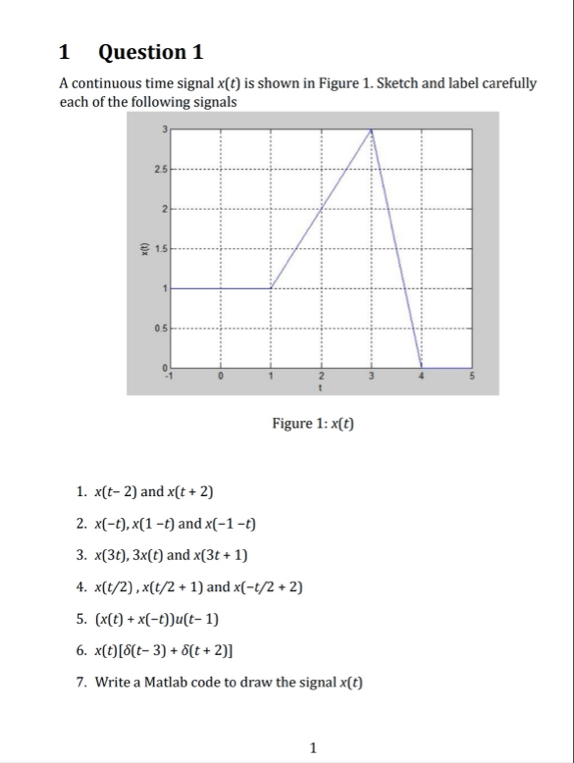 1 Question1
A continuous time signal x(¢) is shown in Figure 1. Sketch and label carefully
each of the following signals
Figure 1: x(¢)
1. x(t-2) and x(t +2)
2. x(-8),x(1 -t) and x(~1-£)
3. x(31), 3x(t) and x(3t + 1)
4. x(t/2),x(t/2 + Vand x(-t/2 +2)
5. (x(0) + x(-0)u(t-1)
6. X(0)[8(-3) + 5(¢ + 2)]
7. Write a Matlab code to draw the signal x(t)
1
This is AI generated Response.
Asked by: kavya
Created at: 2025-09-25 18:31:29
Asked by: kavya
Created at: 2025-09-25 18:31:29
Final Answer:
Rendered
Raw Text
Did you like this answer?
Let's solve **Question 1** step by step:
---
## **Given Signal \( x(t) \)**
From the graph:
- Defined from \( t = 1 \) to \( t = 4 \).
- At \( t = 1 \), \( x(1) = 1 \)
- Increases linearly to \( x(3) = 3 \)
- Decreases linearly to \( x(4) = \)
---
### **1. Time Shifting: \( x(t-2) \) and \( x(t+2) \)**
#### **a. \( x(t-2) \)**
- This **shifts the signal right** by 2 units.
- Original \( x(t) \) is nonzero for \( t \in [1, 4] \), so \( x(t-2) \) is nonzero for \( t-2 \in [1, 4] \implies t \in [3, 6] \).
#### **b. \( x(t+2) \)**
- This **shifts the signal left** by 2 units.
- Nonzero for \( t+2 \in [1, 4] \implies t \in [-1, 2] \).
---
#### **Summary Table:**
| Signal | Nonzero for \( t \) | Description |
|-------------|---------------------|------------------|
| \( x(t-2) \) | \( 3 \leq t \leq 6 \) | Shift right by 2 |
| \( x(t+2) \) | \( -1 \leq t \leq 2 \) | Shift left by 2 |
---
### **2. Time Reversal and Shifting**
#### **a. \( x(-t) \)**
- **Time reversal**: Flip signal about \( t = \).
- Nonzero for \( -t \in [1, 4] \implies t \in [-4, -1] \)
#### **b. \( x(1-t) \)**
- **Reverse and shift**: Substitute \( t \leftarrow 1-t \)
- Nonzero for \( 1-t \in [1, 4] \implies -t \in [, 3] \implies t \in [-3, ] \)
#### **c. \( x(-1-t) \)**
- **Reverse and shift**: Substitute \( t \leftarrow -1-t \)
- Nonzero for \( -1-t \in [1, 4] \implies -t \in [2, 5] \implies t \in [-5, -2] \)
---
#### **Summary Table:**
| Signal | Nonzero for \( t \) |
|----------------|---------------------|
| \( x(-t) \) | \( -4 \leq t \leq -1 \) |
| \( x(1-t) \) | \( -3 \leq t \leq \) |
| \( x(-1-t) \) | \( -5 \leq t \leq -2 \) |
---
### **3. Time Scaling and Shifting**
#### **a. \( x(3t) \)**
- **Compresses** the signal by a factor of 3.
- Nonzero for \( 3t \in [1, 4] \implies t \in [1/3, 4/3] \)
#### **b. \( 3x(t) \)**
- **Amplitude scaling**: Multiply all values by 3, support is unchanged (\( t \in [1, 4] \))
#### **c. \( x(3t+1) \)**
- **Scale and shift**: Let \( \tau = 3t+1 \)
- Nonzero for \( 3t+1 \in [1, 4] \implies 3t \in [, 3] \implies t \in [, 1] \)
---
#### **Summary Table:**
| Signal | Nonzero for \( t \) | Description |
|------------------|---------------------|---------------------|
| \( x(3t) \) | \( 1/3 \leq t \leq 4/3 \) | Compressed |
| \( 3x(t) \) | \( 1 \leq t \leq 4 \) | Amplitude scaled |
| \( x(3t+1) \) | \( \leq t \leq 1 \) | Compressed/shifted |
---
### **4. Time Scaling and Shifting**
#### **a. \( x(t/2) \)**
- **Expands** the signal by a factor of 2.
- Nonzero for \( t/2 \in [1, 4] \implies t \in [2, 8] \)
#### **b. \( x(t/2+1) \)**
- **Expand and shift**: \( t/2 + 1 \in [1, 4] \implies t/2 \in [, 3] \implies t \in [, 6] \)
#### **c. \( x(-t/2+2) \)**
- **Expand, reverse, and shift**: \( -t/2 + 2 \in [1, 4] \implies -t/2 \in [-1, 2] \implies t/2 \in [-2, 1] \implies t \in [-4, 2] \)
---
#### **Summary Table:**
| Signal | Nonzero for \( t \) |
|----------------------|---------------------|
| \( x(t/2) \) | \( 2 \leq t \leq 8 \) |
| \( x(t/2+1) \) | \( \leq t \leq 6 \) |
| \( x(-t/2+2) \) | \( -4 \leq t \leq 2 \) |
---
### **5. Addition with Step Function**
#### \( [x(t) + x(-t)]u(t-1) \)
- \( x(t) + x(-t) \): Add the original and time-reversed signals.
- \( u(t-1) \): **Zero for \( t < 1 \)**, one for \( t \geq 1 \).
- So, output is for \( t < 1 \), and for \( t \geq 1 \), it's the sum.
---
### **6. Delta Function Expression**
#### \( x(t)[\delta(t-3) + \delta(t+2)] \)
- This is nonzero only at \( t = 3 \) and \( t = -2 \) (because delta function is zero everywhere except its argument zero).
- At \( t = 3 \): Output is \( x(3) \).
- At \( t = -2 \): Output is \( x(-2) \), but from the graph, \( x(t) \) is only defined for \( t \in [1,4] \); so \( x(-2) = \).
---
### **7. MATLAB Code to Draw \( x(t) \)**
```matlab
t = [1 3 4];
x = [1 3 ];
figure;
plot([1 3 4],[1 3 ],'b','LineWidth',2);
xlabel('t');
ylabel('x(t)');
title('Signal x(t)');
grid on;
axis([ 5 3]);
```
---
## **Summary Table**
| Part | Key Step/Result | Support (t values) |
|--------------|------------------------------------------------------|------------------------|
| 1 | Time shift ±2 | [3,6] and [-1,2] |
| 2 | Time reversal and shifts | [-4,-1], [-3,], [-5,-2]|
| 3 | Scaling/compression/shifting | [1/3,4/3], [1,4], [,1]|
| 4 | Expanding and shifting | [2,8], [,6], [-4,2] |
| 5 | Add x(t) and x(-t), zero for t<1 | t ≥ 1 |
| 6 | Impulse at t=3 (value 3), t=-2 (value ) | t=3, t=-2 |
| 7 | MATLAB code | |
---
If you need **plots/sketches** for each transformation or further details for any specific part, let me know!
📢 Instructions:
- Ask anything relatd to above question only.
- For new Question goto :