 VIPSolutions
Give step-by-step solution with explanation and final answer: Act like a helpful tutor and exlain me : explain in detail with explanation of correct and incorrect options alsoeam] Topic [ Question ~~ T ~~ PossibleAnswes | FO FOR -
Question:
Give step-by-step solution with explanation and final answer:
Act like a helpful tutor and exlain me :
explain in detail with explanation of correct and incorrect options also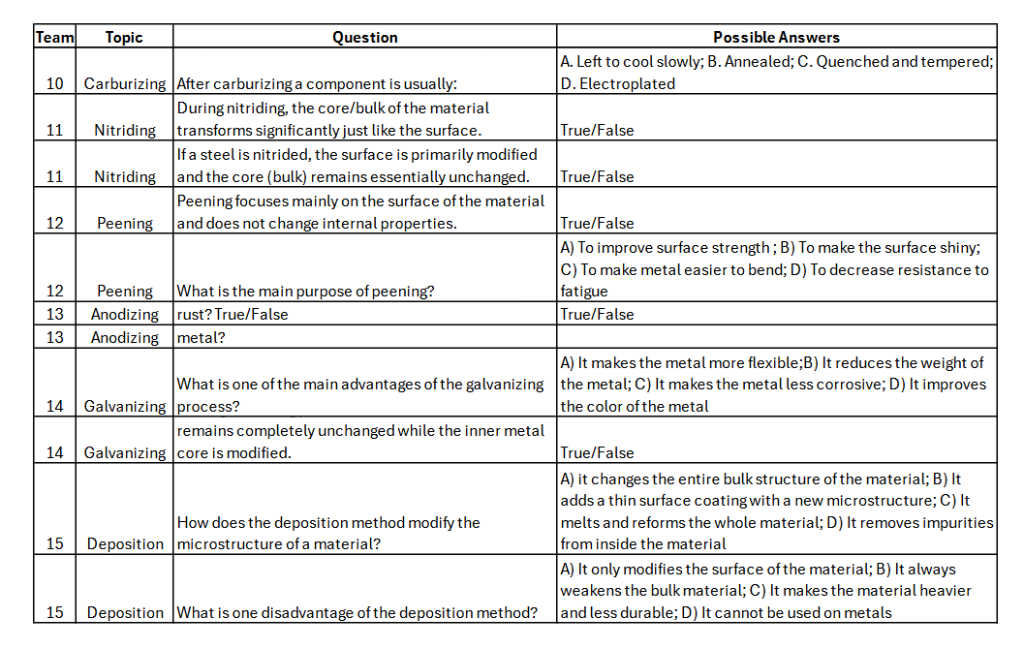 eam] Topic [ Question ~~ T ~~ PossibleAnswes |
FO FOR -
This is AI generated Response.
Asked by: manish kumar
Created at: 2025-09-25 09:40:02
Asked by: manish kumar
Created at: 2025-09-25 09:40:02
Final Answer:
Rendered
Raw Text
Did you like this answer?
Sure! Let's go through each question step by step.
### 1. Carburizing
**Question:** After carburizing a component is usually:
- **Options:**
- A) Left to cool slowly
- B) Annealed
- C) Quenched and tempered
- D) Electroplated
**Correct Answer:** C) Quenched and tempered
**Explanation:**
- Carburizing is a heat treatment process that hardens the surface of steel. After carburizing, the component is often quenched and tempered to achieve the desired hardness and toughness.
- **A) Left to cool slowly:** This would not achieve the hardness required after carburizing.
- **B) Annealed:** This is used to soften the material, contrary to the goal of carburizing.
- **D) Electroplated:** This refers to coating the surface with metal, unrelated to carburizing.
### 2. Nitriding
**Question:** During nitriding, the core/bulk of the material transforms significantly just like the surface.
- **Options:** True/False
**Correct Answer:** False
**Explanation:**
- Nitriding primarily affects the surface, enriching it with nitrogen to enhance hardness while the core remains largely unchanged.
### 3. Nitriding
**Question:** If a steel is nitrided, the surface is primarily modified and the core (bulk) remains essentially unchanged.
- **Options:** True/False
**Correct Answer:** True
**Explanation:**
- Nitriding is a surface hardening process that enhances the surface properties without significantly affecting the core.
### 4. Peening
**Question:** Peening focuses mainly on the surface of the material and does not change internal properties.
- **Options:** True/False
**Correct Answer:** True
**Explanation:**
- Peening is used to improve surface properties, such as stress relief, without altering the internal structure.
### 5. Peening
**Question:** What is the main purpose of peening?
- **Options:**
- A) To improve surface strength
- B) To make the surface shiny
- C) To make metal easier to bend
- D) To decrease resistance to fatigue
**Correct Answer:** A) To improve surface strength
**Explanation:**
- Peening increases surface strength and resistance to fatigue by inducing compressive stresses.
- **B) To make the surface shiny:** Peening is not primarily for appearance.
- **C) To make metal easier to bend:** Incorrect, as peening increases hardness.
- **D) To decrease resistance to fatigue:** It actually increases resistance to fatigue.
### 6. Anodizing
**Question:** Anodizing rust? True/False
**Correct Answer:** False
**Explanation:**
- Anodizing enhances corrosion resistance and does not cause rust.
### 7. Anodizing
**Question:** What is one of the main advantages of the anodizing process?
- **Options:**
- A) It makes the metal more flexible
- B) It reduces the weight of the metal
- C) It makes the metal less corrosive
- D) It improves the color of the metal
**Correct Answer:** C) It makes the metal less corrosive
**Explanation:**
- Anodizing forms a protective oxide layer, enhancing corrosion resistance.
- **A) It makes the metal more flexible:** Not related to flexibility.
- **B) It reduces the weight of the metal:** No significant weight change.
- **D) It improves the color of the metal:** This can be true, but corrosion resistance is a primary advantage.
### 8. Galvanizing
**Question:** What is one of the main advantages of the galvanizing process?
- **Options:**
- A) It makes the metal more flexible
- B) It reduces the weight of the metal
- C) It makes the metal less corrosive
- D) It improves the color of the metal
**Correct Answer:** C) It makes the metal less corrosive
**Explanation:**
- Galvanizing coats the metal with zinc, which provides corrosion protection.
- **A) It makes the metal more flexible:** Incorrect, no effect on flexibility.
- **B) It reduces the weight of the metal:** Not true; it may add slight weight.
- **D) It improves the color of the metal:** Not the main purpose.
### 9. Galvanizing
**Question:** The surface remains completely unchanged while the inner metal core is modified.
- **Options:** True/False
**Correct Answer:** False
**Explanation:**
- Galvanizing primarily affects the surface by adding a zinc layer for protection.
### 10. Deposition
**Question:** How does the deposition method modify the microstructure of a material?
- **Options:**
- A) It changes the entire bulk structure of the material
- B) It adds a thin surface coating with a new microstructure
- C) It melts and reforms the whole material
- D) It removes impurities from inside the material
**Correct Answer:** B) It adds a thin surface coating with a new microstructure
**Explanation:**
- Deposition involves adding a coating, altering surface properties.
- **A) It changes the entire bulk structure:** Incorrect, affects only the surface.
- **C) It melts and reforms the whole material:** Incorrect, typically non-melting.
- **D) It removes impurities:** Not the primary function.
### 11. Deposition
**Question:** What is one disadvantage of the deposition method?
- **Options:**
- A) It only modifies the surface of the material
- B) It always weakens the bulk material
- C) It makes the material heavier and less durable
- D) It cannot be used on metals
**Correct Answer:** A) It only modifies the surface of the material
**Explanation:**
- Since deposition affects mainly the surface, any internal weaknesses remain unchanged.
- **B) It always weakens the bulk material:** Not true.
- **C) It makes the material heavier and less durable:** Not inherently true.
- **D) It cannot be used on metals:** Incorrect, often used on metals.
I hope this detailed explanation helps! Let me know if you have any other questions.
📢 Instructions:
- Ask anything relatd to above question only.
- For new Question goto :