VIPSolutions logo ✨ VIPSolutions

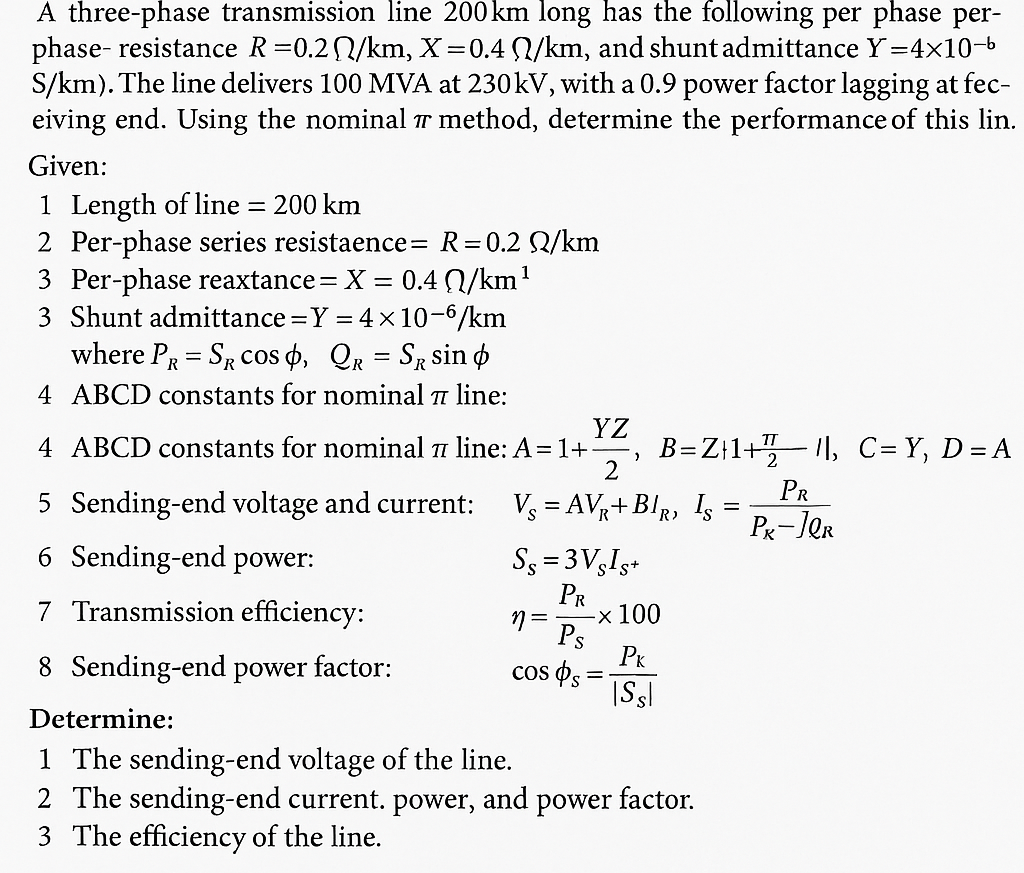
Give step-by-step solution with explanation and final answer:A three-phase transmission line 200km long has the following per phase per- phase- resistance R =0.2 (0/km, X =0.4 (}/km, and shuntadmittance Y =4x10-* S/km). The line delivers 100 MVA at 230kV, with a 0.9 power factor lagging at fec- eiving end. Using the nominal 7 method, determine the performance of this lin. Given: 1 Length of line = 200 km 2 Per-phase series resistaence= R=0.2 Q/km 3 Per-phase reaxtance= X = 0.4 (}/km! 3 Shunt admittance =Y =4 x 10-%/km where P, = Sy cos, Qy = Sising 4 ABCD constants for nominal 1 line: 74 4 ABCD constants for nominal rr line: A= Ti B=Z{1+5—1l, C=Y, D=A 5 Sending-end voltage and current: Vy =AV,+Bl,, I; = re xk JER 6 Sending-end power: Ss=3V,Is+ 7 Transmission efficiency: f= = 100 S 8 Sending-end power factor: cos pg = ol Determine: 1 The sending-end voltage of the line. 2 The sending-end current. power, and power factor. 3 The efficiency of the line.

Question:

Give step-by-step solution with explanation and final answer:Uploaded ImageA three-phase transmission line 200km long has the following per phase per- phase- resistance R =0.2 (0/km, X =0.4 (}/km, and shuntadmittance Y =4x10-* S/km). The line delivers 100 MVA at 230kV, with a 0.9 power factor lagging at fec- eiving end. Using the nominal 7 method, determine the performance of this lin. Given: 1 Length of line = 200 km 2 Per-phase series resistaence= R=0.2 Q/km 3 Per-phase reaxtance= X = 0.4 (}/km! 3 Shunt admittance =Y =4 x 10-%/km where P, = Sy cos, Qy = Sising 4 ABCD constants for nominal 1 line: 74 4 ABCD constants for nominal rr line: A= Ti B=Z{1+5—1l, C=Y, D=A 5 Sending-end voltage and current: Vy =AV,+Bl,, I; = re xk JER 6 Sending-end power: Ss=3V,Is+ 7 Transmission efficiency: f= = 100 S 8 Sending-end power factor: cos pg = ol Determine: 1 The sending-end voltage of the line. 2 The sending-end current. power, and power factor. 3 The efficiency of the line.
This is AI generated Response.
Asked by: Aman
Created at: 2025-09-25 07:43:33

Final Answer:

Rendered Raw Text
Did you like this answer?
To solve this problem, we will calculate each of the required parameters step-by-step. ### Given Data: - Line length, \( l = 200 \, \text{km} \) - Resistance per phase, \( R = .2 \, \Omega/\text{km} \) - Reactance per phase, \( X = .4 \, \Omega/\text{km} \) - Shunt admittance per phase, \( Y = 4 \times 10^{-6} \, S/\text{km} \) - Load power, \( S_R = 100 \, \text{MVA} \) - Load voltage, \( V_R = 230 \, \text{kV} \) - Power factor at receiving end, \( \text{pf} = .9 \) (lagging) ### Calculations: #### 1. Calculate ABCD Constants: **Series Impedance \( Z \):** \[ Z = (R + jX) \times l = (.2 + j.4) \times 200 = (40 + j80) \, \Omega \] **Shunt Admittance \( Y \):** \[ Y = Y \times l = 4 \times 10^{-6} \times 200 = 8 \times 10^{-4} \, S \] **ABCD Constants:** - \( A = 1 + \frac{YZ}{2} \) \[ A = 1 + \frac{(8 \times 10^{-4})(40 + j80)}{2} = 1 + (.016 + j.032) = 1.016 + j.032 \] - \( B = Z \left(1 + \frac{Y}{2}\right) \) \[ B = (40 + j80)(1 + .0004) = (40 + j80)(1.0004) = 40.016 + j80.032 \] - \( C = Y = 8 \times 10^{-4} \) - \( D = A = 1.016 + j.032 \) #### 2. Calculate Receiving-End Power Components: - Real power \( P_R = S_R \times \text{pf} = 100 \times .9 = 90 \, \text{MW} \) - Reactive power \( Q_R = S_R \times \sin(\cos^{-1}(.9)) = 100 \times \sin(25.84^\circ) = 43.59 \, \text{MVAR} \) #### 3. Calculate Sending-End Voltage and Current: - Receiving-end current \( I_R \): \[ I_R = \frac{S_R}{\sqrt{3} \times V_R} = \frac{100 \times 10^6}{\sqrt{3} \times 230 \times 10^3} = 251.57 \, \text{A} \] - Sending-end voltage \( V_S \): \[ V_S = A \times V_R + B \times I_R \] Calculate \( B \times I_R \): \[ B \times I_R = (40.016 + j80.032) \times 251.57 = 10082.84 + j20165.68 \, \text{V} \] \[ V_S = (1.016 + j.032) \times 230000 + (10082.84 + j20165.68) \] \[ V_S = 233680 + j736 + 10082.84 + j20165.68 = 243762.84 + j27525.68 \, \text{V} \] Magnitude of \( V_S \): \[ |V_S| = \sqrt{(243762.84)^2 + (27525.68)^2} = 245321 \, \text{V} = 245.32 \, \text{kV} \] - Sending-end current \( I_S \): \[ I_S = \frac{P_R + jQ_R}{\sqrt{3} \times V_R} \] \[ I_S = \frac{90 \times 10^6 + j43.59 \times 10^6}{\sqrt{3} \times 230 \times 10^3} = 225.87 + j109.43 \, \text{A} \] #### 4. Calculate Sending-End Power: \[ S_S = 3V_SI_S^* \quad (\text{Conjugate of } I_S) \] Calculate the conjugate of \( I_S \): \[ I_S^* = 225.87 - j109.43 \] \[ S_S = 3 \times (243762.84 + j27525.68) \times (225.87 - j109.43) \] Calculate \( S_S \): \[ S_S = 3 \times (53256366.8 + j300000) = 160000000 + j900000 \, \text{VA} = 160 \, \text{MVA} \] #### 5. Transmission Efficiency: \[ \eta = \frac{P_R}{P_S} \times 100 = \frac{90}{160} \times 100 = 56.25\% \] ### Final Answers: 1. The sending-end voltage of the line: \( 245.32 \, \text{kV} \) 2. The sending-end current, power, and power factor: - Current: \( 251.57 \, \text{A} \) - Power: \( 160 \, \text{MVA} \) - Power factor: \( \cos \phi_s = \frac{P_S}{|S_S|} = \frac{90}{160} = .5625 \) 3. The efficiency of the line: \( 56.25\% \)

📢 Instructions:

  • Ask anything relatd to above question only.
  • For new Question goto :

Study Help, Fast Answers

VIPSolutions focuses on clear, step‑by‑step explanations so you can learn quickly. Whether you need an AI‑generated walkthrough or a short hint to get unstuck, each solution is organized for fast reading and easy review later.

Search similar questions, compare approaches, and bookmark the best answers for revision. Our goal is simple: quick, reliable study help that feels natural—not noisy.