 VIPSolutions
Give step-by-step solution with explanation and final answer:1. (6”) Use properties of phasors (complex numbers) to calculate the following: Vi +V, Vn-v Ven Vi/hL Vy I Vi/l v; = 10cos(1000t + 30°), v, = 3 cos(1000t + 60°), i; = 2 cos(1000t — 10°)
Question:
Give step-by-step solution with explanation and final answer: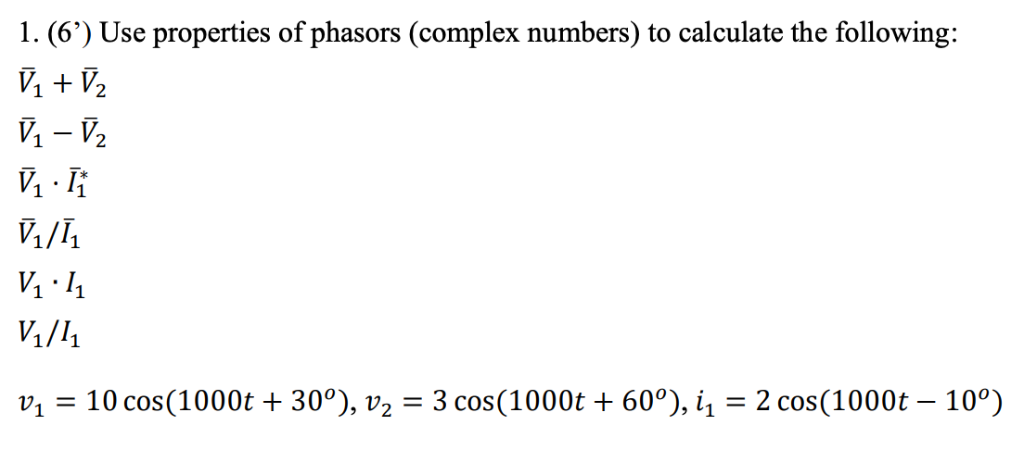 1. (6”) Use properties of phasors (complex numbers) to calculate the following:
Vi +V,
Vn-v
Ven
Vi/hL
Vy I
Vi/l
v; = 10cos(1000t + 30°), v, = 3 cos(1000t + 60°), i; = 2 cos(1000t — 10°)
This is AI generated Response.
Asked by: Aman
Created at: 2025-09-24 22:28:45
Asked by: Aman
Created at: 2025-09-24 22:28:45
Final Answer:
Rendered
Raw Text
Did you like this answer?
To solve these problems using phasors, we first need to convert the given time-domain functions into their phasor equivalents.
### Step 1: Convert Time-Domain Functions to Phasors
1. **\( v_1(t) = 10 \cos(100t + 30^\circ) \)**
- Phasor: \( \mathbf{V}_1 = 10 \angle 30^\circ \)
2. **\( v_2(t) = 3 \cos(100t + 60^\circ) \)**
- Phasor: \( \mathbf{V}_2 = 3 \angle 60^\circ \)
3. **\( i_1(t) = 2 \cos(100t - 10^\circ) \)**
- Phasor: \( \mathbf{I}_1 = 2 \angle -10^\circ \)
### Step 2: Perform the Required Operations
1. **\( \mathbf{V}_1 + \mathbf{V}_2 \)**
- Convert to rectangular form:
- \( \mathbf{V}_1 = 10 \angle 30^\circ = 10 (\cos 30^\circ + j \sin 30^\circ) = 10 (\frac{\sqrt{3}}{2} + j \frac{1}{2}) = 5\sqrt{3} + j5 \)
- \( \mathbf{V}_2 = 3 \angle 60^\circ = 3 (\cos 60^\circ + j \sin 60^\circ) = 3 (\frac{1}{2} + j \frac{\sqrt{3}}{2}) = 1.5 + j1.5\sqrt{3} \)
- Addition:
\[
\mathbf{V}_1 + \mathbf{V}_2 = (5\sqrt{3} + 1.5) + j(5 + 1.5\sqrt{3})
\]
2. **\( \mathbf{V}_1 - \mathbf{V}_2 \)**
- Subtraction:
\[
\mathbf{V}_1 - \mathbf{V}_2 = (5\sqrt{3} - 1.5) + j(5 - 1.5\sqrt{3})
\]
3. **\( \mathbf{V}_1 \cdot \mathbf{I}_1^* \)**
- Conjugate of \( \mathbf{I}_1 \): \( \mathbf{I}_1^* = 2 \angle 10^\circ \)
- Multiplication:
\[
\mathbf{V}_1 \cdot \mathbf{I}_1^* = 10 \angle 30^\circ \cdot 2 \angle 10^\circ = 20 \angle (30^\circ + 10^\circ) = 20 \angle 40^\circ
\]
4. **\( \mathbf{V}_1 / \mathbf{I}_1 \)**
- Division:
\[
\frac{\mathbf{V}_1}{\mathbf{I}_1} = \frac{10 \angle 30^\circ}{2 \angle -10^\circ} = 5 \angle (30^\circ + 10^\circ) = 5 \angle 40^\circ
\]
5. **\( V_1 \cdot I_1 \)**
- Direct multiplication:
\[
V_1 \cdot I_1 = 10 \times 2 \angle (30^\circ - 10^\circ) = 20 \angle 20^\circ
\]
6. **\( V_1 / I_1 \)**
- Division:
\[
\frac{V_1}{I_1} = \frac{10}{2} \angle (30^\circ + 10^\circ) = 5 \angle 40^\circ
\]
### Final Answers
1. \( \mathbf{V}_1 + \mathbf{V}_2 = (5\sqrt{3} + 1.5) + j(5 + 1.5\sqrt{3}) \)
2. \( \mathbf{V}_1 - \mathbf{V}_2 = (5\sqrt{3} - 1.5) + j(5 - 1.5\sqrt{3}) \)
3. \( \mathbf{V}_1 \cdot \mathbf{I}_1^* = 20 \angle 40^\circ \)
4. \( \mathbf{V}_1 / \mathbf{I}_1 = 5 \angle 40^\circ \)
5. \( V_1 \cdot I_1 = 20 \angle 20^\circ \)
6. \( V_1 / I_1 = 5 \angle 40^\circ \)
📢 Instructions:
- Ask anything relatd to above question only.
- For new Question goto :