 VIPSolutions
Give step-by-step solution with explanation and final answer:1. (6”) Use properties of phasors (complex numbers) to calculate the following: Vi +V, Vn-v Ven Vi/hL Vy I Vi/l v; = 10cos(1000t + 30°), v, = 3 cos(1000t + 60°), i; = 2 cos(1000t — 10°)
Question:
Give step-by-step solution with explanation and final answer: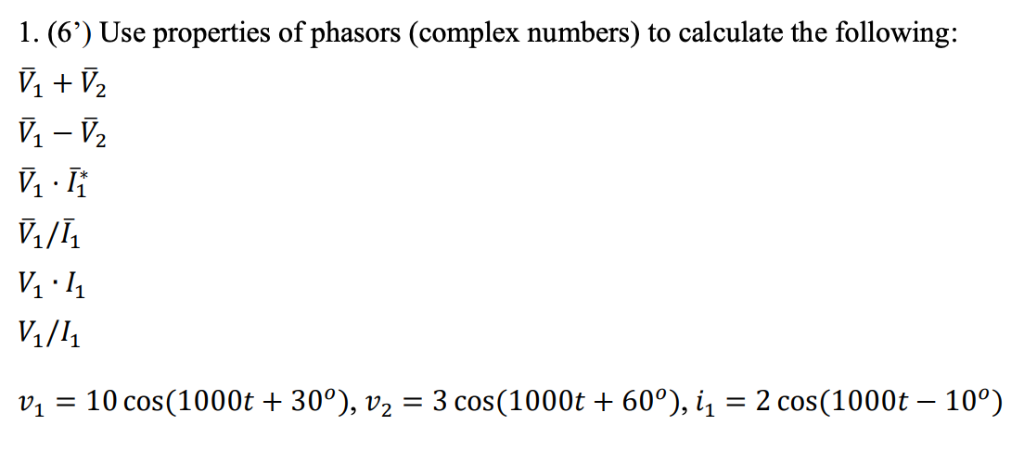 1. (6”) Use properties of phasors (complex numbers) to calculate the following:
Vi +V,
Vn-v
Ven
Vi/hL
Vy I
Vi/l
v; = 10cos(1000t + 30°), v, = 3 cos(1000t + 60°), i; = 2 cos(1000t — 10°)
This is AI generated Response.
Asked by: Aman
Created at: 2025-09-24 22:22:29
Asked by: Aman
Created at: 2025-09-24 22:22:29
Thought Process:
Rendered
Raw Text
**Calculating with phasors**
I need to create a step-by-step solution using phasors and complex numbers based on the given question. First, overbars represent phasors, so I'll be handling calculations like V̅1 + V̅2, V̅1 - V̅2, and V̅1 times I̅1*. I also see V1 and I1 treated as time-domain signals, which indicates that the last two lines are indeed asking for the product and ratio of these signals, without overbars. So, I need to clarify and calculate accordingly!**Clarifying sinusoidal relationships**
I see that they specified small v1, v2, and i1 as time-domain sinusoids with cosine. I’m thinking about the relationship between time-domain multiplication and phasor operations; multiplication translates to the half-sum of cosine arguments. In terms of phasors, I know that addition or subtraction of sinusoids of the same frequency corresponds to phasor addition or subtraction. They might want me to compute operations like V̅1 + V̅2, V̅1 - V̅2, and V̅1 multiplied by I̅1*. The last two lines likely refer to direct time-domain operations as well!**Examining notation and calculations**
I'm noticing a mix-up with uppercase V1 and I1 in contrast to the lowercase v1 and i1 for time-domain functions. This suggests a possible distinction, maybe indicating RMS values. I remember we used bar notation for phasors earlier. So, the capital letters could denote RMS values, while the capital letters without a bar might relate to magnitudes. The question asks for operations like V̅1 + V̅2, and it seems I need to calculate these by converting the time-domain sinusoidal functions into phasors first!**Working on phasor calculations**
I’m considering whether "V1 · I1" is asking for the multiplication of just phasor magnitudes, or if the capital letters without bars denote RMS complex numbers. Traditionally, uppercase complex amplitudes represent phasors, while the overbar might indicate complex conjugates. I’ll treat lowercase v1(t) as time-domain cosines with real amplitudes. For example, I can represent V̅1 as 10∠30°, V̅2 as 3∠60°, and Ī1 as 2∠-10°. I’ll convert these to rectangular form for the calculations!**Conducting phasor calculations**
Let’s compute the sum V̅1 + V̅2, which gives (8.660 + 1.5) + j(5 + 2.598) = 10.160 + j7.598. Converting to polar, the magnitude is approximately 12.688, and the angle is around 36.87°. For the difference V̅1 − V̅2, I find 7.160 + j2.402, with a magnitude of around 7.55 and an angle of 18.6°.
Now, about the product V̅1 · Ī1*: I compute it with the conjugate as 10∠30° × 2∠10°, resulting in 20∠40°. Then, dividing V̅1 by Ī1, I get 5∠40°. As for V1 and I1, they likely represent RMS phasors, so I’ll calculate their products and ratios from those values.**Refining phasor calculations**
I’m computing details with higher precision. For the calculations:
- V̅1 results in approximately 8.660254 + j5.
- V̅2 becomes 1.5 + j2.598076.
- I1 is around 1.9696155 − j0.3472964.
For the sum, I calculate the real and imaginary parts, yielding 10.160254 + j7.598076, with a magnitude of about 12.689 and an angle of 36.87°. For the difference, I get 7.160254 + j2.402, with a magnitude of approximately 7.551 and an angle of 18.57°.
Next, I multiply V̅1 and Ī1*, producing a real part around 15.321 and an imaginary part near 12.853, leading to a magnitude of 20 at an angle of 40°. The division V̅1/Ī1 results in 5∠40°, matching earlier computations.
Finally, applying RMS values for V1 and I1 gives me results that consolidate my understanding of the relationships between peak and RMS phasors. I'll present these results neatly for clarity!
Final Answer:
Rendered
Raw Text
Did you like this answer?
# Phasor calculations from the given sinusoids
Given time-domain signals (cosine reference):
- v1(t) = 10 cos(1000 t + 30°)
- v2(t) = 3 cos(1000 t + 60°)
- i1(t) = 2 cos(1000 t − 10°)
Convention used:
- Peak (amplitude) phasor: x̅ = Xm ∠ φ (overbar).
- RMS phasor: X = (Xm/√2) ∠ (plain capital).
- Complex conjugate: (A∠α)* = A∠(−α).
If your convention differs, only the √2 changes; angles are unchanged.
## Step 1 — Convert to phasors
Peak (overbar) phasors:
- V̅1 =10∠30°
- V̅2 = 3∠60°
- Ī1 = 2∠(−10°)
RMS phasors:
- V1 = (10/√2)∠30° = 7.071∠30°
- I1 = (2/√2)∠(−10°) = 1.414∠(−10°)
For addition/subtraction it is convenient to use rectangular form:
- V̅1 = 10(cos30 + j sin30) = 8.660 + j5.000
- V̅2 = 3(cos60 + j sin60) = 1.500 + j2.598
- Ī1 = 2(cos(−10) + j sin(−10)) = 1.970 − j0.347
## Step 2 — Compute requested quantities
### 1) V̅1 + V̅2
Rule: add rectangular components: (a+jb) + (c+jd) = (a+c) + j(b+d).
- Sum = (8.660+1.500) + j(5.000+2.598) = 10.160 + j7.598
- Polar: |·| = 12.689, ∠ = tan⁻¹(7.598/10.160) = 36.87°
- Result: V̅1 + V̅2 = 12.689∠36.87°
- Time-domain equivalent: 12.689 cos(1000 t + 36.87°)
### 2) V̅1 − V̅2
Rule: subtract rectangular components.
- Difference = (8.660−1.500) + j(5.000−2.598) = 7.160 + j2.402
- Polar: |·| = 7.551, ∠ = 18.57°
- Result: V̅1 − V̅2 = 7.551∠18.57°
- Time-domain equivalent: 7.551 cos(1000 t + 18.57°)
### 3) V̅1 · Ī1*
Rule in polar: (A∠α)(B∠β) = (AB)∠(α+β); conjugate flips the angle.
- Ī1* = 2∠(+10°)
- Product = (10∠30°)(2∠10°) = 20∠40°
- Rectangular check: 20(cos40 + j sin40) = 15.321 + j12.856
- Result: V̅1 · Ī1* = 20∠40°
### 4) V̅1 / Ī1
Rule in polar: (A∠α)/(B∠β) = (A/B)∠(α−β).
- Quotient = (10/2)∠(30° − (−10°)) = 5∠40°
- Rectangular: 5(cos40 + j sin40) = 3.830 + j3.214
- Result: V̅1 / Ī1 = 5∠40°
### 5) V1 · I1 (RMS phasors)
Rule in polar: multiply magnitudes and add angles.
- (7.071∠30°)(1.414∠−10°) = 10.000∠20°
- Rectangular: 10(cos20 + j sin20) = 9.397 + j3.420
- Result: V1 · I1 = 10∠20°
### 6) V1 / I1 (RMS phasors)
Rule in polar: divide magnitudes and subtract angles.
- (7.071/1.414)∠(30° − (−10°)) = 5∠40°
- Same numerical value as with peak phasors.
- Result: V1 / I1 = 5∠40° = 3.830 + j3.214
## Final answers (polar form)
- V̅1 + V̅2 = 12.689∠36.87°
- V̅1 − V̅2 = 7.551∠18.57°
- V̅1 · Ī1* = 20∠40°
- V̅1 / Ī1 = 5∠40°
- V1 · I1 = 10∠20°
- V1 / I1 = 5∠40°
📢 Instructions:
- Ask anything relatd to above question only.
- For new Question goto :