 VIPSolutions
Give step-by-step solution with explanation and final answer:Problem 4 (24 points): For each system, use the Newton method to find the governing differential equation and natural frequency. Then determine the condition for the stability of the system. © mpmassessrod_ | mL R | | K 3 b L A B
Question:
Give step-by-step solution with explanation and final answer: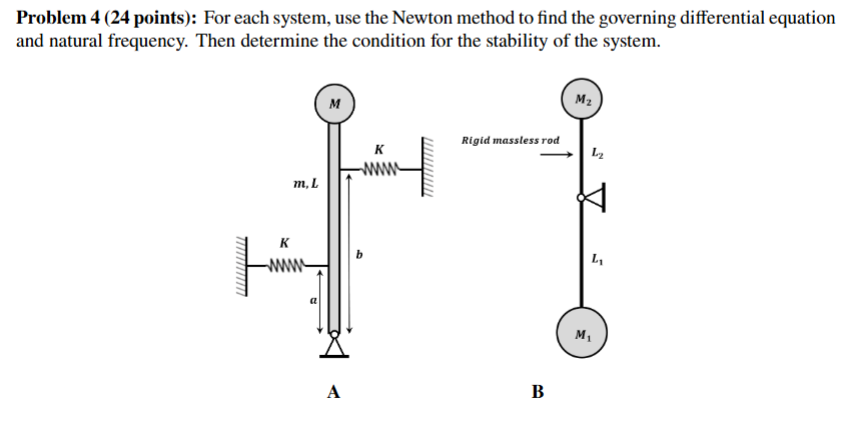 Problem 4 (24 points): For each system, use the Newton method to find the governing differential equation
and natural frequency. Then determine the condition for the stability of the system.
© mpmassessrod_ |
mL R
| |
K
3 b L
A B
This is AI generated Response.
Asked by: gorle prasanth
Created at: 2025-09-24 01:38:24
Asked by: gorle prasanth
Created at: 2025-09-24 01:38:24
Final Answer:
Rendered
Raw Text
Did you like this answer?
Let's solve **System A** step by step using the **Newton (force-balance) method**.
---
# **System A Solution**
### **Step 1: Define the System and Coordinates**
- Vertical rigid rod of length \( L \), mass \( m \) (or just consider mass at the top \( M \)).
- Two springs (stiffness \( K \)) attached at distances \( a \) and \( b \) from the pivot.
- Small angular displacement \( \theta \) (assume small-angle approximations).
### **Step 2: Free-Body Diagram and Forces**
For small \( \theta \), the horizontal displacement of each spring at points \( a \) and \( b \) is:
- At \( a \): \( x_a = a\theta \)
- At \( b \): \( x_b = b\theta \)
Spring forces (restoring, oppose motion):
- At \( a \): \( F_a = -K (a\theta) \)
- At \( b \): \( F_b = -K (b\theta) \)
### **Step 3: Write the Equation of Motion (Torque Balance about Pivot)**
- **Moment of inertia** for a point mass \( M \) at distance \( L \) from pivot: \( I = ML^2 \)
- For distributed rod of mass \( m \): \( I_\text{rod} = \frac{1}{3}mL^2 \)
- Here, let's use \( M \) at the top for simplicity.
Sum torques due to the two springs:
\[
\sum \tau = I \ddot{\theta}
\]
\[
(-K a\theta) \cdot a + (-K b\theta) \cdot b = M L^2 \ddot{\theta}
\]
\[
-K a^2 \theta - K b^2 \theta = M L^2 \ddot{\theta}
\]
\[
-K(a^2 + b^2)\theta = M L^2 \ddot{\theta}
\]
### **Step 4: Rearranging the Equation**
\[
M L^2 \ddot{\theta} + K(a^2 + b^2)\theta = 0
\]
This is the governing differential equation.
### **Step 5: Find the Natural Frequency**
Standard form:
\[
\ddot{\theta} + \left[\frac{K(a^2 + b^2)}{M L^2}\right] \theta = 0
\]
So,
\[
\omega_n^2 = \frac{K(a^2 + b^2)}{M L^2}
\]
\[
\boxed{\omega_n = \sqrt{\frac{K(a^2 + b^2)}{M L^2}}}
\]
### **Step 6: Condition for Stability**
- System is stable if \(\omega_n^2 > 0\)
- \(K > 0\), and \(a^2 + b^2 > 0\) always if \(a, b \neq 0\)
- **So the system is stable for positive spring stiffness and nonzero attachment points.**
---
## **Summary for System A**
### **Governing Differential Equation:**
\[
M L^2 \ddot{\theta} + K(a^2 + b^2)\theta = 0
\]
### **Natural Frequency:**
\[
\boxed{\omega_n = \sqrt{\frac{K(a^2 + b^2)}{M L^2}}}
\]
### **Stability Condition:**
\[
K > 0, \quad a^2 + b^2 > 0
\]
---
## **System B**
### **Step 1: Define the System and Coordinates**
- Two masses (\( M_1, M_2 \)), connected by a rigid, massless rod:
- \( M_1 \) at bottom, \( M_2 \) at top.
- Pivot at distance \( L_2 \) from \( M_2 \), \( L_1 \) from \( M_1 \).
- Small angular displacement \( \theta \).
### **Step 2: Forces and Torques**
The system is essentially an inverted pendulum with mass at both ends.
- **Moment of inertia about the pivot:**
\[
I = M_1 L_1^2 + M_2 L_2^2
\]
- **Restoring torque by gravity:**
- \( M_1 \) at a distance \( L_1 \) below pivot: \( -M_1 g L_1 \sin\theta \)
- \( M_2 \) at a distance \( L_2 \) above pivot: \( +M_2 g L_2 \sin\theta \)
For **small \( \theta \)**, \(\sin\theta \approx \theta\):
\[
\tau = -M_1 g L_1 \theta + M_2 g L_2 \theta
\]
### **Step 3: Equation of Motion**
\[
I \ddot{\theta} = \tau
\]
\[
(M_1 L_1^2 + M_2 L_2^2) \ddot{\theta} = -M_1 g L_1 \theta + M_2 g L_2 \theta
\]
\[
(M_1 L_1^2 + M_2 L_2^2) \ddot{\theta} + [M_1 g L_1 - M_2 g L_2]\theta = 0
\]
### **Step 4: Natural Frequency**
\[
\ddot{\theta} + \frac{M_1 g L_1 - M_2 g L_2}{M_1 L_1^2 + M_2 L_2^2}\theta = 0
\]
So,
\[
\omega_n^2 = \frac{M_1 g L_1 - M_2 g L_2}{M_1 L_1^2 + M_2 L_2^2}
\]
\[
\boxed{\omega_n = \sqrt{\frac{M_1 g L_1 - M_2 g L_2}{M_1 L_1^2 + M_2 L_2^2}}}
\]
### **Step 5: Stability Condition**
- System is stable if \( \omega_n^2 > 0 \):
\[
M_1 g L_1 > M_2 g L_2
\]
or
\[
\boxed{M_1 L_1 > M_2 L_2}
\]
---
## **Summary for System B**
### **Governing Differential Equation:**
\[
(M_1 L_1^2 + M_2 L_2^2) \ddot{\theta} + [M_1 g L_1 - M_2 g L_2]\theta = 0
\]
### **Natural Frequency:**
\[
\boxed{\omega_n = \sqrt{\frac{M_1 g L_1 - M_2 g L_2}{M_1 L_1^2 + M_2 L_2^2}}}
\]
### **Stability Condition:**
\[
\boxed{M_1 L_1 > M_2 L_2}
\]
---
### **Let me know if you want a full derivation for distributed mass in System A, or if you have follow-up questions!**
📢 Instructions:
- Ask anything relatd to above question only.
- For new Question goto :