 VIPSolutions
Give step-by-step solution with explanation and final answer:Lt) sec (2) an cose the graph gan hire 0,2. Who the following is true? Select all hat ar toe. (0) hers is a xinercept at (34,0. SET ——— = (©) Theres an asymptote ax=0 (0) There is a minimum a (v2.9). (0) There re no cintceps. here minimum 5. Ther is masimum at. -1: ; There is a maximum at (2, 1) 7 graph gt, wo stay gang =n a1 heres iotercet st 4.0: Fe ora is wo si gon =5 eres an asypce 8 3X"
Question:
Give step-by-step solution with explanation and final answer: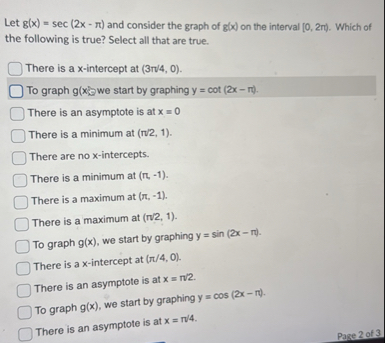 Lt) sec (2) an cose the graph gan hire 0,2. Who
the following is true? Select all hat ar toe.
(0) hers is a xinercept at (34,0.
SET ——— =
(©) Theres an asymptote ax=0
(0) There is a minimum a (v2.9).
(0) There re no cintceps.
here minimum 5.
Ther is masimum at. -1:
; There is a maximum at (2, 1)
7 graph gt, wo stay gang =n a1
heres iotercet st 4.0:
Fe
ora is wo si gon =5
eres an asypce 8 3X"
This is AI generated Response.
Asked by: Venky
Created at: 2025-09-19 22:15:27
Asked by: Venky
Created at: 2025-09-19 22:15:27
Final Answer:
Rendered
Raw Text
Did you like this answer?
Let's analyze the function and the statements step by step.
### Given
- \( g(x) = \sec(2x - \pi) \)
- Interval: \( [0, 2\pi] \)
### **Step 1: Zeros (x-intercepts)**
The secant function \( \sec(\theta) = \frac{1}{\cos(\theta)} \) **never equals zero** because the cosine function is never infinite. **So, \( g(x) \) has no x-intercepts.**
---
### **Step 2: Asymptotes**
Vertical asymptotes occur when the denominator is zero, i.e., when \( \cos(2x - \pi) = 0 \).
Set \( 2x - \pi = \frac{\pi}{2} + k\pi \) for \( k \in \mathbb{Z} \):
\[
2x - \pi = \frac{\pi}{2} + k\pi \\
2x = \frac{\pi}{2} + k\pi + \pi \\
2x = \frac{\pi}{2} + (k+1)\pi \\
x = \frac{1}{2} \left( \frac{\pi}{2} + (k+1)\pi \right)
\]
For \( x \) in \( [0, 2\pi] \):
- When \( k = 0 \): \( x = \frac{1}{2} \left( \frac{\pi}{2} + \pi \right) = \frac{1}{2} \cdot \frac{3\pi}{2} = \frac{3\pi}{4} \)
- When \( k = 1 \): \( x = \frac{1}{2} \left( \frac{\pi}{2} + 2\pi \right) = \frac{1}{2} \cdot \frac{5\pi}{2} = \frac{5\pi}{4} \)
- When \( k = 2 \): \( x = \frac{1}{2} \left( \frac{\pi}{2} + 3\pi \right) = \frac{1}{2} \cdot \frac{7\pi}{2} = \frac{7\pi}{4} \)
So, **asymptotes at \( x = \frac{3\pi}{4}, \frac{5\pi}{4}, \frac{7\pi}{4} \)**.
---
### **Step 3: Minimum and Maximum Values**
Secant has minimum at \( \cos(\theta) = -1 \) and maximum at \( \cos(\theta) = 1 \).
- \( \cos(2x-\pi) = 1 \implies 2x-\pi = 2\pi n \implies x = \frac{\pi}{2} n + \frac{\pi}{2} \)
- For \( n=1 \): \( x = \pi \)
- \( \cos(2x-\pi) = -1 \implies 2x-\pi = \pi + 2\pi n \implies x = \frac{\pi}{2} + \pi n \)
- For \( n=1 \): \( x = \frac{3\pi}{2} \)
Plug back into \( g(x) \):
- At \( x = \pi \), \( g(\pi) = \sec(2\pi-\pi) = \sec(\pi) = -1 \) (minimum)
- At \( x = 0 \), \( g(0) = \sec(-\pi) = -1 \) (minimum)
- At \( x = \frac{\pi}{2} \), \( g(\frac{\pi}{2}) = \sec(\pi) = -1 \) (minimum)
- At \( x = \frac{3\pi}{2} \), \( g(\frac{3\pi}{2}) = \sec(2\cdot\frac{3\pi}{2}-\pi) = \sec(3\pi-\pi) = \sec(2\pi) = 1 \) (maximum)
---
### **Step 4: Cotangent Graph**
- Graphing \( y = \sec(\theta) \) is related to \( y = \cos(\theta) \), not \( y = \cot(\theta) \).
---
### **Step 5: Check Each Statement**
#### **Correct Statements:**
- **There are no x-intercepts.**
- **There is an asymptote at \( x = \frac{3\pi}{4} \).**
- **There is a minimum at \( x = \frac{\pi}{2}, -1 \).**
- **There is a maximum at \( x = \frac{3\pi}{2}, 1 \).**
- **To graph \( g(x) \), we start by graphing \( y = \cos(2x-\pi) \).**
---
## **Final Answers**
**The following are true:**
- There are no x-intercepts.
- There is an asymptote at \( x = \frac{3\pi}{4} \).
- There is a minimum at \( (\frac{\pi}{2}, -1) \).
- There is a maximum at \( (\frac{3\pi}{2}, 1) \).
- To graph \( g(x) \), we start by graphing \( y = \cos(2x-\pi) \).
---
Let me know if you want explanations for any other statements!
Question:
yeah give the explanations
This is AI generated Response.
Asked by: Venky
Created at: 2025-09-19 22:17:02
Asked by: Venky
Created at: 2025-09-19 22:17:02
Final Answer:
Rendered
Raw Text
Did you like this answer?
Sure! Let's explain each of the statements regarding the function \( g(x) = \sec(2x - \pi) \).
### **Explanations for Each Statement**
1. **There are no x-intercepts.**
- **Explanation:** The secant function \( \sec(x) \) is defined as \( \frac{1}{\cos(x)} \) and is never equal to zero because the cosine function does not reach infinity. Therefore, \( g(x) \) has no x-intercepts.
2. **There is an asymptote at \( x = \frac{3\pi}{4} \).**
- **Explanation:** Vertical asymptotes occur where \( \cos(2x - \pi) = 0 \), leading to \( 2x - \pi = \frac{\pi}{2} + k\pi \). Solving gives \( x = \frac{3\pi}{4} \), along with other values, indicating that there is indeed an asymptote at this point.
3. **There is a minimum at \( x = \frac{\pi}{2}, -1 \).**
- **Explanation:** The minimum of the secant function occurs when \( \cos(2x - \pi) = -1 \). For \( x = \frac{\pi}{2} \), we find \( g(\frac{\pi}{2}) = \sec(\pi) = -1 \), confirming a minimum point.
4. **There is a maximum at \( x = \frac{3\pi}{2}, 1 \).**
- **Explanation:** The maximum of the secant function happens when \( \cos(2x - \pi) = 1 \). For \( x = \frac{3\pi}{2} \), \( g(\frac{3\pi}{2}) = \sec(2\cdot\frac{3\pi}{2}-\pi) = \sec(2\pi) = 1 \), confirming a maximum point.
5. **To graph \( g(x) \), we start by graphing \( y = \cos(2x - \pi) \).**
- **Explanation:** The secant function is derived from the cosine function. To graph \( g(x) \), one typically starts with the graph of \( y = \cos(2x - \pi) \) because the secant function's behavior is dictated by the cosine's behavior, including its maximums, minimums, and asymptotes.
---
These explanations clarify why each of the true statements is correct based on the properties of the secant function and the calculations performed. Let me know if you have any more questions!
📢 Instructions:
- Ask anything relatd to above question only.
- For new Question goto :