Give step-by-step solution with explanation and final answer:
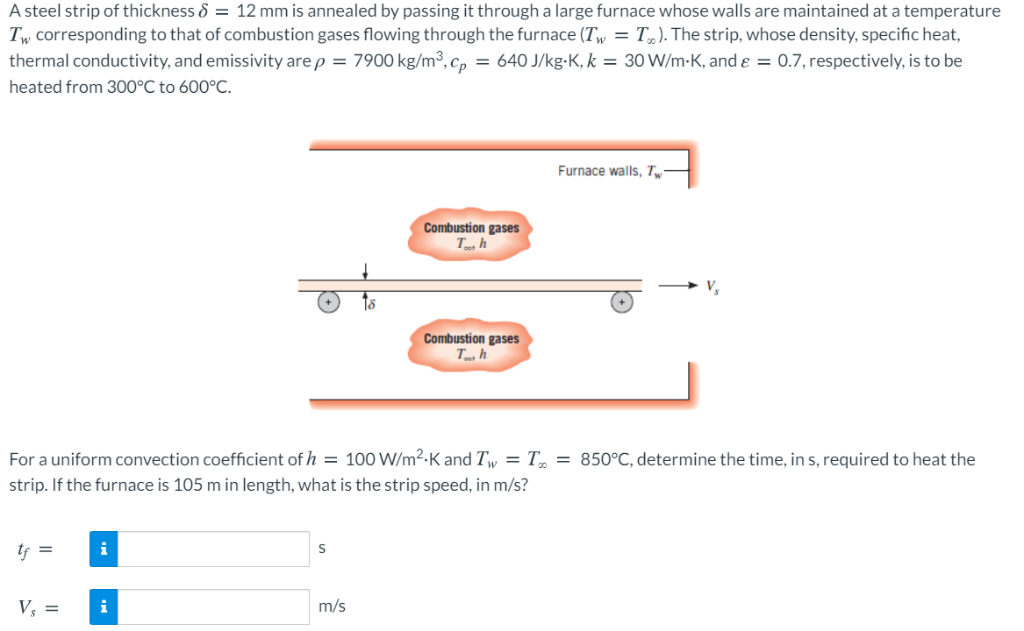
Act like a helpful tutor and exlain me :A steel strip of thickness § = 12 mm is annealed by passing it through a large furnace whose walls are maintained at a temperature
T,, corresponding to that of combustion gases flowing through the furnace (T,, = T.,). The strip, whose density, specific heat,
thermal conductivity, and emissivity are p = 7900 kg/m, c, = 640 J/kg:K,k = 30W/mK,and ¢ = 0.7, respectively, is to be
heated from 300°C to 600°C.
Furnace walls, —
—
ey,
® 18 ®
For a uniform convection coefficient of h = 100 W/m?K and T,, = T,. = 850°C, determine the time, in's, required to heat the
strip. If the furnace is 105 m in length, what is the strip speed, in m/s?
«= A :
V, = B ms
Question:
Give step-by-step solution with explanation and final answer:
Act like a helpful tutor and exlain me :A steel strip of thickness § = 12 mm is annealed by passing it through a large furnace whose walls are maintained at a temperature
T,, corresponding to that of combustion gases flowing through the furnace (T,, = T.,). The strip, whose density, specific heat,
thermal conductivity, and emissivity are p = 7900 kg/m, c, = 640 J/kg:K,k = 30W/mK,and ¢ = 0.7, respectively, is to be
heated from 300°C to 600°C.
Furnace walls, —
—
ey,
® 18 ®
For a uniform convection coefficient of h = 100 W/m?K and T,, = T,. = 850°C, determine the time, in's, required to heat the
strip. If the furnace is 105 m in length, what is the strip speed, in m/s?
«= A :
V, = B ms
This is AI generated Response.
Asked by: manish kumar
Created at: 2025-09-19 20:12:51
Final Answer:
RenderedRaw Text
Did you like this answer?
Let's break down the problem step by step.
---
## **Given Data**
- Strip thickness, \(\delta = 12 \, \text{mm} = 0.012 \, \text{m}\)
- Density, \(\rho = 7900 \, \text{kg/m}^3\)
- Specific heat, \(c_p = 640 \, \text{J/kg·K}\)
- Thermal conductivity, \(k = 30 \, \text{W/m·K}\)
- Emissivity, \(\epsilon = 0.7\)
- Initial temperature, \(T_i = 300^\circ \text{C}\)
- Final temperature, \(T_f = 600^\circ \text{C}\)
- Furnace wall (and combustion gas) temperature, \(T_\infty = T_w = 850^\circ \text{C}\)
- Convection coefficient, \(h = 100 \, \text{W/m}^2\cdot\text{K}\)
- Furnace length, \(L = 105 \, \text{m}\)
---
## **Step 1: Lumped Capacitance Check**
To use the lumped capacitance method, check the Biot number:
\[
\text{Bi} = \frac{h \delta/2}{k}
\]
\[
\text{Bi} = \frac{100 \times 0.012/2}{30} = \frac{100 \times 0.006}{30} = \frac{0.6}{30} = 0.02
\]
Since Bi < 0.1, the lumped capacitance method is valid.
---
## **Step 2: Lumped Capacitance Equation**
For a body heated by convection:
\[
\frac{T(t) - T_\infty}{T_i - T_\infty} = \exp\left(-\frac{hA}{\rho V c_p} t\right)
\]
For heating from \(T_i\) to \(T_f\):
\[
\frac{T_f - T_\infty}{T_i - T_\infty} = \exp\left(-\frac{hA}{\rho V c_p} t_f\right)
\]
Take the natural log:
\[
\ln \left( \frac{T_f - T_\infty}{T_i - T_\infty} \right) = -\frac{hA}{\rho V c_p} t_f
\]
\[
t_f = -\frac{\rho V c_p}{hA} \ln \left( \frac{T_f - T_\infty}{T_i - T_\infty} \right)
\]
Let’s assume the strip is very wide and long compared to its thickness, so we can use area per unit width and volume per unit width:
- \(A\): Surface area per unit width \(= 2 \times \text{length}\) (top + bottom)
- \(V\): Volume per unit width \(= \delta \times \text{length}\)
So, \(\frac{V}{A} = \frac{\delta}{2}\)
\[
t_f = -\frac{\rho c_p \delta}{2h} \ln \left( \frac{T_f - T_\infty}{T_i - T_\infty} \right)
\]
---
## **Step 3: Plug in the Values**
- \(\rho = 7900\, \text{kg/m}^3\)
- \(c_p = 640\, \text{J/kg·K}\)
- \(\delta = 0.012\, \text{m}\)
- \(h = 100\, \text{W/m}^2\cdot\text{K}\)
- \(T_i = 300^\circ \text{C}\)
- \(T_f = 600^\circ \text{C}\)
- \(T_\infty = 850^\circ \text{C}\)
\[
t_f = -\frac{7900 \cdot 640 \cdot 0.012}{2 \cdot 100} \ln \left( \frac{600 - 850}{300 - 850} \right)
\]
Calculate the log argument:
\[
\frac{600 - 850}{300 - 850} = \frac{-250}{-550} = 0.4545
\]
Now calculate the coefficient:
\[
\frac{7900 \cdot 640 \cdot 0.012}{2 \cdot 100} = \frac{7900 \cdot 640 \cdot 0.012}{200}
\]
\[
7900 \cdot 640 = 5,056,000
\]
\[
5,056,000 \cdot 0.012 = 60,672
\]
\[
\frac{60,672}{200} = 303.36
\]
Now, the time:
\[
t_f = -303.36 \cdot \ln(0.4545)
\]
\[
\ln(0.4545) = -0.7894
\]
\[
t_f = -303.36 \cdot (-0.7894) = 239.4 \, \text{seconds}
\]
---
## **Step 4: Calculate Strip Speed \(V_s\)**
The strip spends \(t_f\) seconds in the furnace of length \(L\):
\[
V_s = \frac{L}{t_f}
\]
\[
V_s = \frac{105}{239.4} = 0.438 \, \text{m/s}
\]
---
## **Final Answers**
\[
\boxed{t_f = 239 \;\text{s}}
\]
\[
\boxed{V_s = 0.44 \;\text{m/s}}
\]
---
### **Summary Table**
| Quantity | Value |
|-----------------|--------------|
| Time (\(t_f\)) | 239 s |
| Speed (\(V_s\)) | 0.44 m/s |
---
**If you need to consider radiation as well, let me know!**
VIPSolutions focuses on clear, step‑by‑step explanations so you can learn quickly. Whether you need an AI‑generated walkthrough or a short hint to get unstuck, each solution is organized for fast reading and easy review later.
Search similar questions, compare approaches, and bookmark the best answers for revision. Our goal is simple: quick, reliable study help that feels natural—not noisy.
 VIPSolutions
 A steel strip of thickness § = 12 mm is annealed by passing it through a large furnace whose walls are maintained at a temperature
T,, corresponding to that of combustion gases flowing through the furnace (T,, = T.,). The strip, whose density, specific heat,
thermal conductivity, and emissivity are p = 7900 kg/m, c, = 640 J/kg:K,k = 30W/mK,and ¢ = 0.7, respectively, is to be
heated from 300°C to 600°C.
Furnace walls, —
—
ey,
® 18 ®
For a uniform convection coefficient of h = 100 W/m?K and T,, = T,. = 850°C, determine the time, in's, required to heat the
strip. If the furnace is 105 m in length, what is the strip speed, in m/s?
«= A :
V, = B ms