 VIPSolutions
Give step-by-step solution with explanation and final answer:Question 11 dv 10 pts (03.02 HC) Aight triangle is shown in the graph. wv vi (x,y) t JEN EE SE S—N r x Part A: Use the Pythagorean Theorem to derive the standard equation of the circle with center at (r, s) and a point on the circle at (x, y). Show all necessary math work. (3 points) Part B: If (r, s) = (7, -4) and t = 10, determine the domain and range of the circle. (4 points) Part C: Is the point (9, 1) inside the border of the circle if (r, s) = (7, -4) and t = 10? Explain using mathematical evidence. (3 points) Yong (yy) t s J . B
Question:
Give step-by-step solution with explanation and final answer: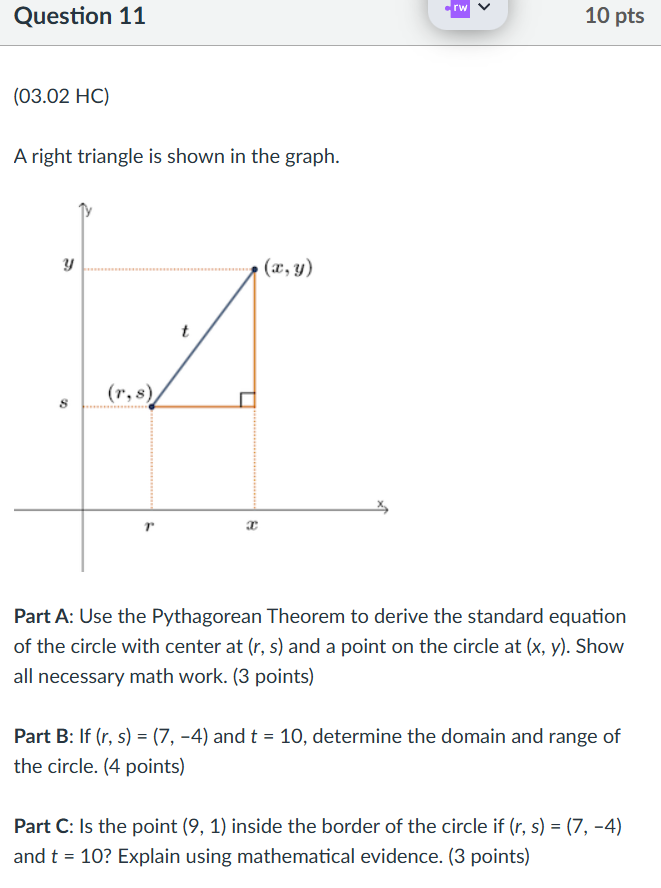
 Question 11 dv 10 pts
(03.02 HC)
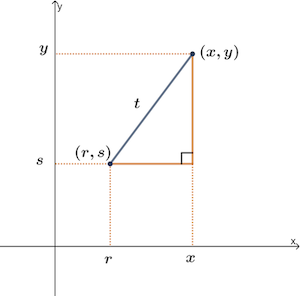
Aight triangle is shown in the graph.
wv
vi (x,y)
t
JEN EE SE S—N
r x
Part A: Use the Pythagorean Theorem to derive the standard equation
of the circle with center at (r, s) and a point on the circle at (x, y). Show
all necessary math work. (3 points)
Part B: If (r, s) = (7, -4) and t = 10, determine the domain and range of
the circle. (4 points)
Part C: Is the point (9, 1) inside the border of the circle if (r, s) = (7, -4)
and t = 10? Explain using mathematical evidence. (3 points)
Yong (yy)
t
s J
. B
This is AI generated Response.
Asked by: Venky
Created at: 2025-09-19 19:08:11
Asked by: Venky
Created at: 2025-09-19 19:08:11
Final Answer:
Rendered
Raw Text
Did you like this answer?
# **Step-by-Step Solution**
---
## **Part A: Deriving the Standard Equation of a Circle**
**Using the Pythagorean Theorem:**
- The distance from the center \((r, s)\) to a point on the circle \((x, y)\) is the radius \(t\).
- By the distance formula (from Pythagorean Theorem):
\[
\text{Distance} = \sqrt{(x - r)^2 + (y - s)^2}
\]
- For any point \((x, y)\) on the circle, this equals the radius \(t\):
\[
\sqrt{(x - r)^2 + (y - s)^2} = t
\]
- Square both sides to get the **standard equation of a circle**:
\[
(x - r)^2 + (y - s)^2 = t^2
\]
---
## **Part B: Domain and Range of the Circle**
Given:
- Center: \((r, s) = (7, -4)\)
- Radius: \(t = 10\)
**Equation:**
\((x - 7)^2 + (y + 4)^2 = 100\)
### **Domain (possible \(x\)-values):**
- The furthest left: \(r - t = 7 - 10 = -3\)
- The furthest right: \(r + t = 7 + 10 = 17\)
**Domain:**
\[
\boxed{[-3, 17]}
\]
### **Range (possible \(y\)-values):**
- The lowest: \(s - t = -4 - 10 = -14\)
- The highest: \(s + t = -4 + 10 = 6\)
**Range:**
\[
\boxed{[-14, 6]}
\]
---
## **Part C: Is the Point (9, 1) Inside the Circle?**
**Given:**
- Center: \((7, -4)\)
- Radius: \(t = 10\)
- Point: \((9, 1)\)
**Plug into the circle equation:**
\[
(x - r)^2 + (y - s)^2 < t^2 \quad \text{(for inside)}
\]
Plug values:
\[
(9 - 7)^2 + (1 - (-4))^2 = (2)^2 + (5)^2 = 4 + 25 = 29
\]
Compare with \(t^2 = 100\):
\[
29 < 100
\]
**Conclusion:**
Since \(29 < 100\), the point \((9, 1)\) is **inside the border of the circle**.
---
## **Final Answers**
### **Part A:**
\[
\boxed{(x - r)^2 + (y - s)^2 = t^2}
\]
### **Part B:**
\[
\text{Domain: } [-3, 17] \quad \text{Range: } [-14, 6]
\]
### **Part C:**
\[
\text{Yes, the point } (9, 1) \text{ is inside the circle because } 29 < 100.
\]
📢 Instructions:
- Ask anything relatd to above question only.
- For new Question goto :