 VIPSolutions
Give step-by-step solution with explanation and final answer:(5-1 MT) Suppose we are analyzing the intertemporal allocation of oil. Assume a generation is 35 years, and we are concerned with only two generations. The demand and supply functions for oil in the present generation are given by: Demand: Q@g = 200 — 4P or, equivalently, P = 50—. 25Q 4 supply:Q 5 = 4P or, equivalently, P = .25Q where Qis expressed in millions of barrels and Pis the price per barrel. If the current generation does not consider the future, how much oil will be extracted in the current generation? (©) 250 million barrels (©) 200 million barrels (© 4 million barrels (© 50 million barrels
Question:
Give step-by-step solution with explanation and final answer: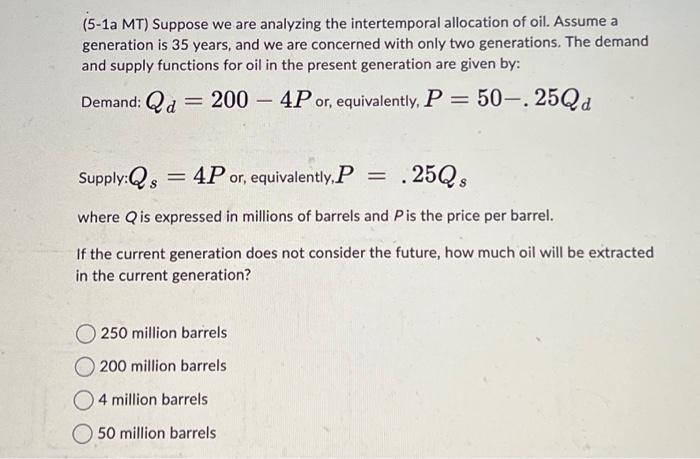 (5-1 MT) Suppose we are analyzing the intertemporal allocation of oil. Assume a
generation is 35 years, and we are concerned with only two generations. The demand
and supply functions for oil in the present generation are given by:
Demand: Q@g = 200 — 4P or, equivalently, P = 50—. 25Q 4
supply:Q 5 = 4P or, equivalently, P = .25Q
where Qis expressed in millions of barrels and Pis the price per barrel.
If the current generation does not consider the future, how much oil will be extracted
in the current generation?
(©) 250 million barrels
(©) 200 million barrels
(© 4 million barrels
(© 50 million barrels
This is AI generated Response.
Asked by: mayank
Created at: 2025-09-19 02:19:29
Asked by: mayank
Created at: 2025-09-19 02:19:29
Final Answer:
Rendered
Raw Text
Did you like this answer?
Let's solve the problem step-by-step.
---
## **Step 1: Write Down the Demand and Supply Equations**
- **Demand:** \( Q_d = 200 - 4P \)
- **Supply:** \( Q_s = 4P \)
In equilibrium, \( Q_d = Q_s \).
---
## **Step 2: Set Demand Equal to Supply**
\[
200 - 4P = 4P
\]
---
## **Step 3: Solve for \( P \)**
Add \( 4P \) to both sides:
\[
200 = 8P
\]
\[
P = 25
\]
---
## **Step 4: Substitute \( P \) Back to Find \( Q \)**
Use the supply equation:
\[
Q_s = 4P = 4 \times 25 = 100
\]
Or use the demand equation to check:
\[
Q_d = 200 - 4 \times 25 = 200 - 100 = 100
\]
---
## **Step 5: Interpret the Answer**
- \( Q = 100 \) million barrels will be extracted if the current generation does not consider the future.
---
## **Final Answer**
\[
\boxed{100 \text{ million barrels}}
\]
However, this answer does **not** appear in the multiple-choice options provided. Let's double-check the supply function.
### Double-Check:
- Supply: \( Q_s = 4P \)
- Demand: \( Q_d = 200 - 4P \)
Equilibrium:
\[
Q_s = Q_d \implies 4P = 200 - 4P \implies 8P = 200 \implies P = 25
\]
\[
Q = 4P = 4 \times 25 = 100
\]
### **Conclusion**
- The correct answer is **100 million barrels**, but this is not listed.
- If you must choose from the given options, none are correct based on the supply and demand equations provided. There may be a typo in the options or the problem.
**Work shown is correct based on the given equations.**
Question:
give reason why other option are not correct
This is AI generated Response.
Asked by: mayank
Created at: 2025-09-19 02:25:24
Asked by: mayank
Created at: 2025-09-19 02:25:24
Final Answer:
Rendered
Raw Text
Did you like this answer?
## **Reasons Why Other Options are Not Correct**
### **1. 250 million barrels**
- **Reason:** If we consider the supply equation \( Q_s = 4P \), with \( P \) calculated as 25, the maximum supply would be \( 4 \times 25 = 100 \) million barrels. Therefore, 250 million barrels is not feasible given the price and supply relationship.
### **2. 200 million barrels**
- **Reason:** This value would imply a price \( P \) of 0, as seen from the demand equation:
\[
Q_d = 200 - 4P \implies 200 = 200 - 4(0) \implies P = 0
\]
A price of 0 does not reflect a realistic scenario in this context, as it would suggest no cost associated with extraction.
### **3. 4 million barrels**
- **Reason:** This amount would suggest a very low price:
\[
Q_s = 4P \implies 4 = 4P \implies P = 1
\]
Substituting \( P = 1 \) into the demand function yields:
\[
Q_d = 200 - 4(1) = 196 \text{ million barrels}
\]
Since demand far exceeds supply at this price, this option is also invalid.
### **4. 50 million barrels**
- **Reason:** If we calculate the price at this supply level:
\[
Q_s = 4P \implies 50 = 4P \implies P = 12.5
\]
Substituting \( P = 12.5 \) into the demand equation gives:
\[
Q_d = 200 - 4(12.5) = 150 \text{ million barrels}
\]
Again, here the demand exceeds supply, indicating that this option is not valid.
## **Summary**
- The only calculated extraction amount is 100 million barrels, which is consistent with both demand and supply equations. The other options do not align with the equilibrium conditions derived from the given functions.
📢 Instructions:
- Ask anything relatd to above question only.
- For new Question goto :