 VIPSolutions
Give step-by-step solution with explanation and final answer:A 0 el 8 - 1 Za A 9p : HE Z.n A (Ph Bari 4: can Sil | a) Using Source transformation and Nodal method, find V1, Va and Vs b) Find Power at the 4Q resistor.
Question:
Give step-by-step solution with explanation and final answer: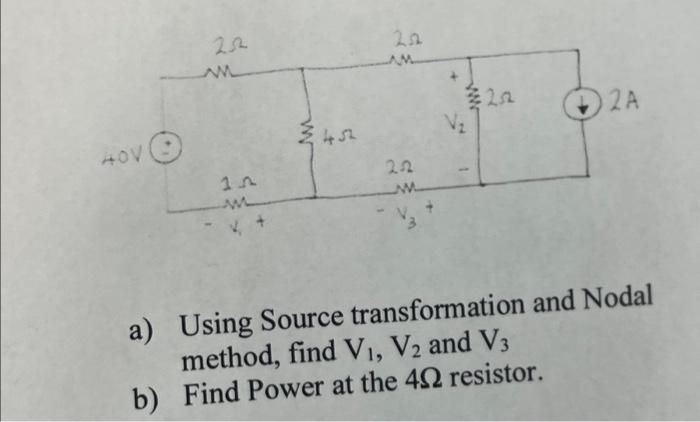 A 0 el 8 - 1
Za A 9p
: HE Z.n A (Ph
Bari 4: can Sil |
a) Using Source transformation and Nodal
method, find V1, Va and Vs
b) Find Power at the 4Q resistor.
This is AI generated Response.
Asked by: M Raju
Created at: 2025-09-17 23:00:51
Asked by: M Raju
Created at: 2025-09-17 23:00:51
Final Answer:
Rendered
Raw Text
Did you like this answer?
Let's solve the circuit **step-by-step**:
### **Given Circuit**
- **Voltage source:** 40V (left)
- **Current source:** 2A (right)
- **Resistors:** As shown
- **Nodes:** \( V_1 \) (bottom left), \( V_2 \) (middle right), \( V_3 \) (bottom right)
---
## **Step 1: Label all nodes and assign ground**
Let the bottommost node be ground (0V).
---
## **Step 2: Nodal Analysis**
Let:
- Node at left of \(1\,\Omega\): \( V_1 \)
- Node at right of \(4\,\Omega\): \( V_2 \)
- Node at left of \(2\,\Omega\) (bottom): \( V_3 \)
---
## **Step 3: Write Nodal Equations**
### **Node 1 (\( V_1 \)):**
\[
\frac{V_1 - 40}{1} + \frac{V_1 - V_2}{4} + \frac{V_1 - V_3}{2} = 0
\]
### **Node 2 (\( V_2 \)):**
\[
\frac{V_2 - V_1}{4} + \frac{V_2}{2} + \frac{V_2 - V_3}{2} = 0
\]
### **Node 3 (\( V_3 \)), with 2A current source:**
Current flows into the node:
\[
2 = \frac{V_3 - V_1}{2} + \frac{V_3 - V_2}{2} + \frac{V_3}{2}
\]
---
## **Step 4: Simplify Each Equation**
### **Equation 1:**
\[
(V_1 - 40) + \frac{V_1 - V_2}{4} + \frac{V_1 - V_3}{2} = 0
\]
Multiply both sides by 4:
\[
4(V_1 - 40) + (V_1 - V_2) + 2(V_1 - V_3) = 0
\]
\[
4V_1 - 160 + V_1 - V_2 + 2V_1 - 2V_3 = 0
\]
\[
(4V_1 + V_1 + 2V_1) - V_2 - 2V_3 = 160
\]
\[
7V_1 - V_2 - 2V_3 = 160
\]
---
### **Equation 2:**
\[
\frac{V_2 - V_1}{4} + \frac{V_2}{2} + \frac{V_2 - V_3}{2} = 0
\]
Multiply both sides by 4:
\[
(V_2 - V_1) + 2V_2 + 2(V_2 - V_3) = 0
\]
\[
V_2 - V_1 + 2V_2 + 2V_2 - 2V_3 = 0
\]
\[
(V_2 + 2V_2 + 2V_2) - V_1 - 2V_3 = 0
\]
\[
5V_2 - V_1 - 2V_3 = 0
\]
\[
- V_1 + 5V_2 - 2V_3 = 0
\]
---
### **Equation 3:**
\[
2 = \frac{V_3 - V_1}{2} + \frac{V_3 - V_2}{2} + \frac{V_3}{2}
\]
Multiply both sides by 2:
\[
4 = (V_3 - V_1) + (V_3 - V_2) + V_3
\]
\[
4 = V_3 - V_1 + V_3 - V_2 + V_3
\]
\[
4 = 3V_3 - V_1 - V_2
\]
\[
3V_3 - V_1 - V_2 = 4
\]
---
## **Step 5: Solve the System**
We have:
1. \( 7V_1 - V_2 - 2V_3 = 160 \)
2. \( -V_1 + 5V_2 - 2V_3 = 0 \)
3. \( -V_1 - V_2 + 3V_3 = 4 \)
---
Let's solve step by step.
### **From Equation 2:**
\[
-V_1 + 5V_2 - 2V_3 = 0 \implies V_1 = 5V_2 - 2V_3
\]
### **Substitute \( V_1 \) into Equations 1 & 3:**
#### **Equation 1:**
\[
7V_1 - V_2 - 2V_3 = 160
\]
\[
7(5V_2 - 2V_3) - V_2 - 2V_3 = 160
\]
\[
35V_2 - 14V_3 - V_2 - 2V_3 = 160
\]
\[
(35V_2 - V_2) + (-14V_3 - 2V_3) = 160
\]
\[
34V_2 - 16V_3 = 160
\]
\[
17V_2 - 8V_3 = 80 \quad (4)
\]
---
#### **Equation 3:**
\[
- V_1 - V_2 + 3V_3 = 4
\]
\[
-(5V_2 - 2V_3) - V_2 + 3V_3 = 4
\]
\[
-5V_2 + 2V_3 - V_2 + 3V_3 = 4
\]
\[
-6V_2 + 5V_3 = 4 \quad (5)
\]
---
Now solve equations (4) and (5):
- (4) \( 17V_2 - 8V_3 = 80 \)
- (5) \( -6V_2 + 5V_3 = 4 \)
Multiply (5) by 8:
\[
-48V_2 + 40V_3 = 32
\]
Multiply (4) by 5:
\[
85V_2 - 40V_3 = 400
\]
Now add:
\[
(85V_2 -40V_) + (-48V_2 + 40V_3) = 400 + 32
\]
\[
V_2 - 48V_2) + (-40V_3 + 40V_3) = 432
\]
\[
37V_ = 432
\]
\[
V_2 = \frac{432}{37} \approx 11.68\,V
\]
Now plug \( V_2 \) into (4):
\[
17V_2 - 8V_3 = 80
\]
\[
17 \times 11.68 - 8V_3 = 80
\]
\[
198.56 - 8V_3 = 80
\]
\[
198.56 - 80 = 8V_3
\]
\[
118.56 = 8V_3
\]
\[
V_3 = \frac{118.56}{8} \approx 14.82\,V
\]
Now plug \( V_2 \) and \( V_3 \) into the earlier expression for \( V_1 \):
\[
V_1 = 5V_2 - 2V_3
\]
\[
= 5 \times 11.68 - 2 \times 14.82
\]
\[
= 58.40 - 29.64 = 28.76\,V
\]
---
## **Step 6: Final Answers**
\[
\boxed{
\begin{align*}
V_1 &\approx 28.76\,V \\
V_2 &\approx 11.68\,V \\
V_3 &\approx 14.82\,V \\
\end{align*}
}
\]
---
## **Step 7: Power in the \(4\,\Omega\) Resistor**
The current through the \(4\,\Omega\) resistor:
\[
I_{4\Omega} = \frac{V_1 - V_2}{4}
\]
\[
= \frac{28.76 - 11.68}{4} = \frac{17.08}{4} \approx 4.27\,A
\]
Power:
\[
P = I^2 R = (4.27)^2 \times 4 \approx 18.23 \times 4 \approx 72.92\,W
\]
---
## **Final Answers (Boxed):**
\[
\boxed{
\begin{align*}
\text{a) } & V_1 \approx 28.76\,V,\quad V_2 \approx 11.68\,V,\quad V_3 \approx 14.82\,V \\
\text{b) } & \text{Power at the } 4\Omega \text{ resistor} \approx 72.92\,W
\end{align*}
}
\]
---
**If you need the source transformation steps, let me know!**
📢 Instructions:
- Ask anything relatd to above question only.
- For new Question goto :