 VIPSolutions
Give step-by-step solution with explanation and final answer:Problem 2: Determine the zero-input response (ZIR) for the following system, v0) +400) + Ty 0) + 6500) + 208) = w(t) ~ we) with initial conditions y@O)=1, yPO)=0, yO) =2 y0O)=0. Make sure your answer has no complex coefficients in it. What is the ZIR’s steady state value? Plot the ZIR for a long enough time to see the plot achieve its steady-state value. Use your plot to estimate the 5% settling time to the steady-state.
Question:
Give step-by-step solution with explanation and final answer: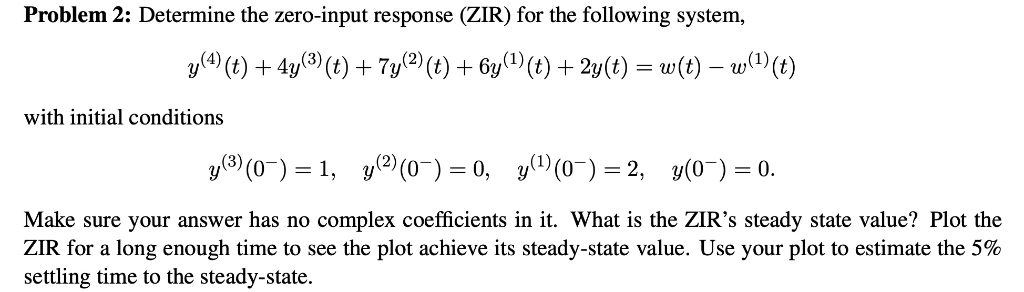 Problem 2: Determine the zero-input response (ZIR) for the following system,
v0) +400) + Ty 0) + 6500) + 208) = w(t) ~ we)
with initial conditions
y@O)=1, yPO)=0, yO) =2 y0O)=0.
Make sure your answer has no complex coefficients in it. What is the ZIR’s steady state value? Plot the
ZIR for a long enough time to see the plot achieve its steady-state value. Use your plot to estimate the 5%
settling time to the steady-state.
This is AI generated Response.
Asked by: M Raju
Created at: 2025-09-17 13:28:23
Asked by: M Raju
Created at: 2025-09-17 13:28:23
Final Answer:
Rendered
Raw Text
Did you like this answer?
Let's walk through this **step-by-step**:
---
### 1. ** the System Equation**
Given:
\[
y^{(4)}(t) + 4y^{(3)}(t) + 7y^{(2)}(t) + 6y^{(1)}(t) + 2y(t) = w(t) - w^{(1)}(t)
\]
**Zero-Input Response (ZIR):**
- Set the input to zero: \( w(t) = 0 \)
- The equation becomes:
\[
y^{(4)}(t) + 4y^{(3)}(t) + 7y^{(2)}(t) + 6y^{(1)}(t) + 2y(t) = 0
\]
---
### 2. **Write Initial Conditions**
\[
y^{(3)}(0^-) = 1, \quad y^{(2)}(0^-) = 0, \quad y^{(1)}(0^-) = 2, \quad y(0^-) = 0
\]
---
### 3. **Solve the Homogeneous Equation**
#### a. **Find Characteristic Equation**
Let \( y(t) = e^{st} \):
\[
s^4 + 4s^3 + 7s^2 + 6s + 2 = 0
\]
#### b. **Factor/Find Roots**
Let's factor or use the rational root theorem or direct factoring. Let's try possible rational roots: ±1, ±2.
Plug \( s = -1 \):
\[
(-1)^4 + 4(-1)^3 + 7(-1)^2 + 6(-1) + 2 = 1 - 4 + 7 - 6 + 2 = 0
\]
So \( s = -1 \) is a root.
Divide \( s^4 + 4s^3 + 7s^2 + 6s + 2 \) by \( (s+1) \):
Use synthetic or polynomial long division:
\[
(s^4 + 4s^3 + 7s^2 + 6s + 2) \div (s+1)
\]
- \( s^4 / s = s^3 \rightarrow s^3(s+1) = s^4 + s^3 \)
- Subtract: \( (4s^3 - s^3) = 3s^3 \)
- \( 3s^3 / s = 3s^2 \rightarrow 3s^2(s+1) = 3s^3 + 3s^2 \)
- Subtract: \( (7s^2 - 3s^2) = 4s^2 \)
- \( 4s^2 / s = 4s \rightarrow 4s(s+1) = 4s^2 + 4s \)
- Subtract: \( (6s - 4s) = 2s \)
- \( 2s / s = 2 \rightarrow 2(s+1) = 2s + 2 \)
- Subtract: \( (2 - 2) = 0 \)
So:
\[
s^4 + 4s^3 + 7s^2 + 6s + 2 = (s+1)(s^3 + 3s^2 + 4s + 2)
\]
Try \( s = -1 \) again in the cubic:
\[
(-1)^3 + 3(-1)^2 + 4(-1) + 2 = -1 + 3 - 4 + 2 = 0
\]
So \( (s+1) \) is a factor again. Divide:
- \( s^3 / s = s^2 \rightarrow s^2(s+1) = s^3 + s^2 \)
- Subtract: \( (3s^2 - s^2) = 2s^2 \)
- \( 2s^2 / s = 2s \rightarrow 2s(s+1) = 2s^2 + 2s \)
- Subtract: \( (4s - 2s) = 2s \)
- \( 2s / s = 2 \rightarrow 2(s+1) = 2s + 2 \)
- Subtract: \( (2 - 2) = 0 \)
So:
\[
s^3 + 3s^2 + 4s + 2 = (s+1)(s^2 + 2s + 2)
\]
Now:
\[
s^4 + 4s^3 + 7s^2 + 6s + 2 = (s+1)^2(s^2 + 2s + 2)
\]
Find roots of \( s^2 + 2s + 2 = 0 \):
\[
s = \frac{-2 \pm \sqrt{4 - 8}}{2} = \frac{-2 \pm \sqrt{-4}}{2} = \frac{-2 \pm 2i}{2} = -1 \pm i
\]
#### **Summary of Roots:**
- \( s_1 = -1 \) (with multiplicity 2)
- \( s_2 = -1 + i \)
- \( s_3 = -1 - i \)
---
### 4. **Write the General Solution**
\[
y(t) = (A + Bt)e^{-t} + Ce^{(-1 + i)t} + De^{(-1 - i)t}
\]
But, to avoid complex coefficients, express complex exponentials as sines and cosines:
\[
Ce^{(-1 + i)t} + De^{(-1 - i)t} = e^{-t}[E \cos t + F \sin t]
\]
So, the general solution is:
\[
\boxed{
y(t) = (A + Bt)e^{-t} + e^{-t}\left[ E \cos t + F \sin t \right]
}
\]
Or,
\[
\boxed{
y(t) = (A + Bt + E \cos t + F \sin t) e^{-t}
}
\]
---
### 5. **Apply Initial Conditions**
Recall:
- \( y(0^-) = 0 \)
- \( y^{(1)}(0^-) = 2 \)
- \( y^{(2)}(0^-) = 0 \)
- \( y^{(3)}(0^-) = 1 \)
First, we need to compute derivatives at \( t = 0 \):
Let’s write:
\[
y(t) = (A + Bt + E \cos t + F \sin t) e^{-t}
\]
Let \( f(t) = A + Bt + E \cos t + F \sin t \), so:
\[
y(t) = f(t) e^{-t}
\]
#### First Derivative:
\[
y'(t) = f'(t)e^{-t} - f(t)e^{-t}
\]
\[
= e^{-t}\left[ f'(t) - f(t) \right]
\]
#### Second Derivative:
\[
y''(t) = \frac{d}{dt}\left( e^{-t}[f'(t) - f(t)] \right)
\]
Product rule again:
\[
= -e^{-t}[f'(t) - f(t)] + e^{-t}[f''(t) - f'(t)]
\]
\[
= e^{-t} \left( f''(t) - 2f'(t) + f(t) \right)
\]
#### Third Derivative:
\[
y'''(t) = \frac{d}{dt} \left( e^{-t}[f''(t) - 2f'(t) + f(t)] \right)
\]
\[
= -e^{-t}[f''(t) - 2f'(t) + f(t)] + e^{-t}[f'''(t) - 2f''(t) + f'(t)]
\]
\[
= e^{-t} [f'''(t) - 3f''(t) + 3f'(t) - f(t)]
\]
#### Fourth Derivative:
\[
y^{(4)}(t) = \frac{d}{dt} ( e^{-t}[f'''(t) - 3f''(t) + 3f'(t) - f(t)] )
\]
\[
= -e^{-t}[f'''(t) - 3f''(t) + 3f'(t) - f(t)] + e^{-t}[f^{(4)}(t) - 3f'''(t) + 3f''(t) - f'(t)]
\]
\[
= e^{-t}[f^{(4)}(t) - 4f'''(t) + 6f''(t) - 4f'(t) + f(t)]
\]
Now, evaluate everything at \( t = 0 \):
- \( e^{-0} = 1 \)
- \( f(0) = A + E \)
- \( f'(t) = B - E \sin t + F \cos t \), so \( f'(0) = B + F \)
- \( f''(t) = -E \cos t - F \sin t \), so at \( t=0 \): \( f''(0) = -E \)
- \( f'''(t) = E \sin t - F \cos t \), so at \( t=0 \): \( f'''(0) = -F \)
- \( f^{(4)}(t) = -E \cos t - F \sin t \), at \( t=0 \): \( f^{(4)}(0) = -E \)
Now, let's fill in the values:
#### At \( t = 0 \):
- \( f(0) = A + E \)
- \( f'(0) = B + F \)
- \( f''(0) = -E \)
- \( f'''(0) = -F \)
- \( f^{(4)}(0) = -E \)
So,
\[
\begin{align*}
y(0) &= f(0) = A + E \\
y'(0) &= f'(0) - f(0) = (B + F) - (A + E) = B + F - A - E \\
y''(0) &= f''(0) - 2f'(0) + f(0) = -E - 2(B + F) + (A + E) = -E - 2B - 2F + A + E = A - 2B - 2F \\
y'''(0) &= f'''(0) - 3f''(0) + 3f'(0) - f(0) \\
&= -F - 3(-E) + 3(B + F) - (A + E) \\
&= -F + 3E + 3B + 3F - A - E \\
&= 3B + 2E + 2F - A
\end{align*}
\]
Now match to initial conditions:
- \( y(0) = 0 \)
- \( y'(0) = 2 \)
- \( y''(0) = 0 \)
- \( y'''(0) = 1 \)
So,
\[
\begin{cases}
A + E = 0 \hspace{2cm} (1) \\
B + F - A - E = 2 \hspace{2cm} (2) \\
A - 2B - 2F = 0 \hspace{2cm} (3) \\
3B + 2E + 2F - A = 1 \hspace{2cm} (4) \\
\end{cases}
\]
Let's solve step by step.
### 6. **Solve for Coefficients**
From (1): \( A = -E \)
Substitute \( A = -E \) into (2), (3), (4):
(2): \( B + F - (-E) - E = 2 \rightarrow B + F + E - E = 2 \rightarrow B + F = 2 \)
(3): \( -E - 2B - 2F = 0 \rightarrow -E = 2B + 2F \rightarrow -E = 2(B + F) \)
But from above, \( B + F = 2 \rightarrow -E = 4 \rightarrow E = -4 \).
Now \( A = -E = 4 \).
Now, \( B + F = 2 \).
Now, substitute \( A = 4 \), \( E = -4 \) into (4):
\( 3B + 2E + 2F - A = 1 \)
\[
3B + 2(-4) + 2F - 4 = 1 \\
3B - 8 + 2F - 4 = 1 \\
3B + 2F - 12 = 1 \\
3B + 2F = 13
\]
Recall \( B + F = 2 \).
Let’s solve:
- \( B + F = 2 \) — (a)
- \( 3B + 2F = 13 \) — (b)
Multiply (a) by 2:
\( 2B + 2F = 4 \)
Subtract from (b):
\( (3B + 2F) - (2B + 2F) = 13 -
📢 Instructions:
- Ask anything relatd to above question only.
- For new Question goto :