 VIPSolutions
Give step-by-step solution with explanation and final answer:Problem 2: Determine the zero-input response (ZIR) for the following system, v0) +400) + Ty 0) + 6500) + 208) = w(t) ~ we) with initial conditions y@O)=1, yPO)=0, yO) =2 y0O)=0. Make sure your answer has no complex coefficients in it. What is the ZIR’s steady state value? Plot the ZIR for a long enough time to see the plot achieve its steady-state value. Use your plot to estimate the 5% settling time to the steady-state.
Question:
Give step-by-step solution with explanation and final answer: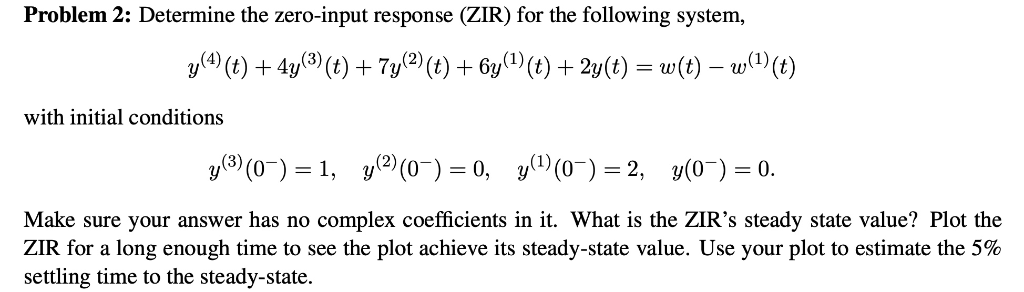 Problem 2: Determine the zero-input response (ZIR) for the following system,
v0) +400) + Ty 0) + 6500) + 208) = w(t) ~ we)
with initial conditions
y@O)=1, yPO)=0, yO) =2 y0O)=0.
Make sure your answer has no complex coefficients in it. What is the ZIR’s steady state value? Plot the
ZIR for a long enough time to see the plot achieve its steady-state value. Use your plot to estimate the 5%
settling time to the steady-state.
This is AI generated Response.
Asked by: kavya
Created at: 2025-09-17 13:27:08
Asked by: kavya
Created at: 2025-09-17 13:27:08
Final Answer:
Rendered
Raw Text
Did you like this answer?
Let's solve the problem **step by step**.
---
## **Step 1: Write the Homogeneous Equation (Zero-Input Response)**
For **zero-input response** (ZIR), we set the input to zero:
\[
y^{(4)}(t) + 4y^{(3)}(t) + 7y^{(2)}(t) + 6y^{(1)}(t) + 2y(t) = 0
\]
---
## **Step 2: Write the Initial Conditions**
\[
y^{(3)}(0^-) = 1, \quad y^{(2)}(0^-) = 0, \quad y^{(1)}(0^-) = 2, \quad y(0^-) = 0
\]
---
## **Step 3: Assume a Solution and Find the Characteristic Equation**
Assume \( y(t) = e^{rt} \):
\[
r^4 + 4r^3 + 7r^2 + 6r + 2 = 0
\]
---
## **Step 4: Factor or Solve the Characteristic Equation**
Let's attempt to factor or use the **Rational Root Theorem** to find real roots.
### Try \( r = -1 \):
\[
(-1)^4 + 4(-1)^3 + 7(-1)^2 + 6(-1) + 2 = 1 - 4 + 7 - 6 + 2 = 0
\]
So, \( r = -1 \) is a root.
Now, divide the polynomial by \( (r + 1) \):
### Polynomial Division
Divide \( r^4 + 4r^3 + 7r^2 + 6r + 2 \) by \( (r + 1) \):
Using synthetic or long division, we get:
\[
r^4 + 4r^3 + 7r^2 + 6r + 2 = (r + 1)(r^3 + 3r^2 + 4r + 2)
\]
Now, factor \( r^3 + 3r^2 + 4r + 2 \).
Try \( r = -1 \) again:
\[
(-1)^3 + 3(-1)^2 + 4(-1) + 2 = -1 + 3 - 4 + 2 = 0
\]
So, \( r = -1 \) is a repeated root.
Now, divide \( r^3 + 3r^2 + 4r + 2 \) by \( (r + 1) \):
\[
r^3 + 3r^2 + 4r + 2 = (r + 1)(r^2 + 2r + 2)
\]
So, the factorization is:
\[
r^4 + 4r^3 + 7r^2 + 6r + 2 = (r + 1)^2(r^2 + 2r + 2)
\]
Now, \( r^2 + 2r + 2 = 0 \) has roots:
\[
r = \frac{-2 \pm \sqrt{4 - 8}}{2} = -1 \pm j
\]
---
## **Step 5: Write the General Solution**
\[
y(t) = (A + Bt) e^{-t} + Ce^{-t} \cos t + D e^{-t} \sin t
\]
---
## **Step 6: Apply Initial Conditions**
First, compute derivatives.
### \( y(t) = (A + Bt)e^{-t} + Ce^{-t}\cos t + D e^{-t}\sin t \)
Let's expand derivatives:
#### \( y(0) \):
\[
y(0) = (A + 0) \cdot 1 + C \cdot 1 \cdot 1 + D \cdot 1 \cdot 0 = A + C
\]
Set \( y(0) = 0 \) (from \( y(0^-) = 0 \)):
\[
A + C = 0 \tag{1}
\]
#### \( y'(t) \):
\[
y'(t) = \frac{d}{dt} \left[ (A + Bt)e^{-t} \right] + \frac{d}{dt}\left[ Ce^{-t}\cos t \right] + \frac{d}{dt}\left[ D e^{-t}\sin t \right]
\]
- \( \frac{d}{dt}\left[(A + Bt) e^{-t}\right] = B e^{-t} + (A + Bt)(-e^{-t}) = B e^{-t} - (A + Bt) e^{-t} = (B - A - Bt) e^{-t} \)
- \( \frac{d}{dt}[C e^{-t}\cos t] = C(-e^{-t}\cos t + e^{-t}(-\sin t)) = C e^{-t}(-\cos t - \sin t) \)
- \( \frac{d}{dt}[D e^{-t}\sin t] = D(-e^{-t}\sin t + e^{-t}\cos t) = D e^{-t}(-\sin t + \cos t) \)
Add all together:
\[
y'(t) = (B - A - Bt) e^{-t} + C e^{-t}(-\cos t - \sin t) + D e^{-t}(-\sin t + \cos t)
\]
At \( t = 0 \):
- \( e^{-0} = 1 \)
- \( \cos 0 = 1 \)
- \( \sin 0 = 0 \)
So,
\[
y'(0) = (B - A) + C(-1 - 0) + D(0 + 1)
= (B - A) - C + D
\]
Set \( y'(0) = 2 \):
\[
B - A - C + D = 2 \tag{2}
\]
#### \( y''(t) \):
Differentiate \( y'(t) \):
\[
y'(t) = (B - A - Bt) e^{-t} + C e^{-t}(-\cos t - \sin t) + D e^{-t}(-\sin t + \cos t)
\]
Let’s compute each term:
- \( \frac{d}{dt}[(B - A - Bt)e^{-t}] = -B e^{-t} + (B - A - Bt)(-e^{-t}) = -B e^{-t} - (B - A - Bt)e^{-t} = (-B - B + A + Bt) e^{-t} = (A + Bt - 2B) e^{-t} \)
Now, \( C e^{-t}(-\cos t - \sin t) \):
- \( \frac{d}{dt}[C e^{-t}(-\cos t - \sin t)] \)
- \( = C \frac{d}{dt} [e^{-t}(-\cos t - \sin t)] \)
- \( \frac{d}{dt}[e^{-t}(-\cos t - \sin t)] = -e^{-t}(-\cos t - \sin t) + e^{-t}(\sin t - \cos t) \)
- \( = e^{-t}(\cos t + \sin t) + e^{-t}(\sin t - \cos t) = e^{-t}(2\sin t) \)
- So the derivative is \( C \cdot 2 e^{-t} \sin t \)
Now, \( D e^{-t}(-\sin t + \cos t) \):
- \( \frac{d}{dt}[D e^{-t}(-\sin t + \cos t)] \)
- \( = D \frac{d}{dt}[e^{-t}(-\sin t + \cos t)] \)
- \( = D(-e^{-t}(-\sin t + \cos t) + e^{-t}(-\cos t - \sin t)) \)
- \( = D( e^{-t}(\sin t - \cos t) + e^{-t}(-\cos t - \sin t) ) \)
- \( = D e^{-t}((\sin t - \cos t) + (-\cos t - \sin t)) \)
- \( = D e^{-t}(-2\cos t) \)
Now sum up:
\[
y''(t) = (A + Bt - 2B) e^{-t} + 2 C e^{-t} \sin t - 2 D e^{-t} \cos t
\]
At \( t = 0 \):
- \( e^{-0} = 1 \)
- \( \sin 0 = 0 \)
- \( \cos 0 = 1 \)
So,
\[
y''(0) = (A + 0 - 2B) + 2C \cdot 0 - 2D \cdot 1 = (A - 2B) - 2D
\]
Set \( y''(0) = 0 \):
\[
A - 2B - 2D = 0 \tag{3}
\]
#### \( y'''(t) \):
Differentiate \( y''(t) \):
- \( \frac{d}{dt}[(A + Bt - 2B) e^{-t}] = (B) e^{-t} + (A + Bt - 2B)(-e^{-t}) = B e^{-t} - (A + Bt - 2B) e^{-t} = (B - A - Bt + 2B) e^{-t} = (3B - A - Bt) e^{-t} \)
- \( \frac{d}{dt}[2C e^{-t} \sin t] = 2C(-e^{-t} \sin t + e^{-t} \cos t) = 2C e^{-t}(\cos t - \sin t) \)
- \( \frac{d}{dt}[-2D e^{-t} \cos t] = -2D(-e^{-t} \cos t + e^{-t}(-\sin t)) = -2D(e^{-t} \cos t + e^{-t} \sin t) = -2D e^{-t} (\cos t + \sin t) \)
Sum up:
\[
y'''(t) = (3B - A - Bt) e^{-t} + 2C e^{-t}(\cos t - \sin t) - 2D e^{-t}(\cos t + \sin t)
\]
At \( t = 0 \):
- \( e^{-0} = 1 \)
- \( \cos 0 = 1 \)
- \( \sin 0 = 0 \)
So,
\[
y'''(0) = (3B - A - 0) + 2C (1-0) - 2D (1+0) = 3B - A + 2C - 2D
\]
Set \( y'''(0) = 1 \):
\[
3B - A + 2C - 2D = 1 \tag{4}
\]
---
## **Step 7: Solve the System of Equations**
From above, we have:
1. \( A + C = 0 \)
2. \( B - A - C + D = 2 \)
3. \( A - 2B - 2D = 0 \)
4. \( 3B - A + 2C - 2D = 1 \)
Let's solve step by step.
### From (1): \( C = -A \)
Plug into the rest:
2. \( B - A - (-A) + D = 2 \implies B - A + A + D = 2 \implies B + D = 2 \)
3. \( A - 2B - 2D = 0 \)
4. \( 3B - A + 2(-A) - 2D = 1 \implies 3B - A - 2A - 2D = 1 \implies 3B - 3A - 2D = 1 \)
Now, we have:
- \( C = -A \)
- \( B + D = 2 \) (a)
- \( A - 2B - 2D = 0 \) (b)
- \( 3B - 3A - 2D = 1 \) (c)
From (a): \( D = 2 - B \)
Plug into (b):
\[
A - 2B - 2(2 - B) = 0 \\
A - 2B - 4 + 2B = 0 \\
A - 4 = 0 \implies A = 4
\]
So, \( C = -A = -4 \)
Now, from (a): \( D = 2 - B \)
Plug these into (c):
\[
3B - 3A - 2D = 1 \\
3B - 3(4) - 2(2 - B) = 1 \\
3B - 12 - 4 + 2B = 1 \\
(3B + 2B) - 16 = 1 \\
5B = 17 \\
B = \frac{17}{5}
\]
Now, \( D = 2 - B = 2 - \frac{17}{5} = \frac{10 - 17}{5} = -\frac{7}{5} \)
So, summarizing:
- \(
📢 Instructions:
- Ask anything relatd to above question only.
- For new Question goto :