 VIPSolutions
Give step-by-step solution with explanation and final answer:4. The diagram below depicts a cascade connection of two linear time-invariant systems, where the first system is a 5-point moving averager and the second system is a first dif- ference. (a) If the input is of the form x[n] = 10+ x; [x], the output y[n] of the overall system will be of the form y[n] = y1[n], where yi [n] is the output due only to xi [n]. Explain why this is true. (b) Determine the frequency-response function of the overall cascade system. (c) Sketch the frequency-response (magnitude and phase) functions of the individual systems and the overall cascade system for — < & < 7.
Question:
Give step-by-step solution with explanation and final answer: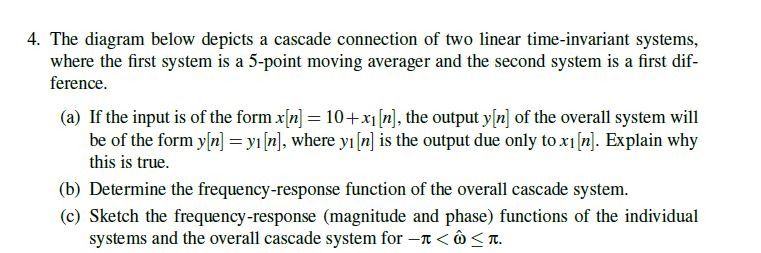 4. The diagram below depicts a cascade connection of two linear time-invariant systems,
where the first system is a 5-point moving averager and the second system is a first dif-
ference.
(a) If the input is of the form x[n] = 10+ x; [x], the output y[n] of the overall system will
be of the form y[n] = y1[n], where yi [n] is the output due only to xi [n]. Explain why
this is true.
(b) Determine the frequency-response function of the overall cascade system.
(c) Sketch the frequency-response (magnitude and phase) functions of the individual
systems and the overall cascade system for — < & < 7.
This is AI generated Response.
Asked by: M Raju
Created at: 2025-09-17 13:24:25
Asked by: M Raju
Created at: 2025-09-17 13:24:25
Final Answer:
Rendered
Raw Text
Did you like this answer?
Let's solve each part step-by-step:
---
### **4(a) Why is the output only due to \( x_1[n] \)?**
#### **Given:**
- The input \( x[n] = 10 + x_1[n] \).
- The first system is a **5-point moving averager**.
- The second system is a **first difference**.
#### **Step 1: System Linearity and Time-Invariance**
- Both systems are **linear** and **time-invariant** (LTI).
- For LTI systems: If input is the sum of two signals, output is the sum of their individual outputs.
#### **Step 2: Output Due to Constant Input**
- First, let’s process the constant \( 10 \) through the two systems:
**First System (Moving Averager):**
- For any constant \( a \), the moving average is still \( a \).
- So, after the first system, the output due to \( 10 \) is still \( 10 \).
**Second System (First Difference):**
- The first difference is \( y[n] = x[n] - x[n-1] \).
- For a constant input: \( y[n] = 10 - 10 = 0 \).
#### **Step 3: Output Due to \( x_1[n] \)**
- Let \( y_1[n] \) be the output due to \( x_1[n] \) alone.
- Since the system is linear, overall output is the sum of the outputs due to \( 10 \) and \( x_1[n] \):
\[
y[n] = \text{output due to 10} + \text{output due to } x_1[n] = 0 + y_1[n] = y_1[n]
\]
**Conclusion:**
The constant part is eliminated by the first-difference system, so only \( x_1[n] \) affects the output.
---
### **4(b) Frequency-Response Function of the Overall System**
#### **Step 1: Frequency Response of Each System**
**1. 5-point Moving Averager:**
- Impulse response: \( h_1[n] = \frac{1}{5},\ n=0,1,2,3,4 \)
- Frequency response:
\[
H_1(e^{j\omega}) = \sum_{k=0}^{4} \frac{1}{5} e^{-j\omega k} = \frac{1}{5} \frac{1 - e^{-j5\omega}}{1 - e^{-j\omega}}
\]
(This is a geometric series.)
**2. First Difference:**
- Impulse response: \( h_2[n] = \delta[n] - \delta[n-1] \)
- Frequency response:
\[
H_2(e^{j\omega}) = 1 - e^{-j\omega}
\]
#### **Step 2: Cascade System Frequency Response**
- The overall frequency response is the **product**:
\[
H(e^{j\omega}) = H_1(e^{j\omega}) \cdot H_2(e^{j\omega})
\]
Substituting:
\[
H(e^{j\omega}) = \left( \frac{1}{5} \frac{1 - e^{-j5\omega}}{1 - e^{-j\omega}} \right) (1 - e^{-j\omega})
\]
\[
= \frac{1}{5}(1 - e^{-j5\omega})
\]
---
### **4(c) Sketch Frequency Response (Magnitude & Phase)**
#### **1. 5-point Moving Averager (\( H_1 \)):**
- **Magnitude:** Low-pass filter (sinc shape), peaks at \( \omega=0 \), zeros at multiples of \( 2\pi/5 \).
- **Phase:** Linear decrease.
#### **2. First Difference (\( H_2 \)):**
- \( |H_2(e^{j\omega})| = |1 - e^{-j\omega}| = 2|\sin(\omega/2)| \)
- **Magnitude:** High-pass (zero at \( \omega=0 \), max at \( \omega=\pi \))
- **Phase:** \( -\omega/2 \) except for phase flip at \( \omega = 0, \pi \).
#### **3. Cascade System (\( H \)):**
\[
H(e^{j\omega}) = \frac{1}{5}(1 - e^{-j5\omega})
\]
- **Magnitude:** \( \frac{1}{5} |1 - e^{-j5\omega}| = \frac{2}{5} |\sin(5\omega/2)| \)
- **Phase:** Linear phase, jumps at frequencies where \( \sin(5\omega/2) = 0 \).
---
### **Summary Table**
| System | Frequency Response (\( H(e^{j\omega}) \)) | Magnitude (at key points) | Phase |
|-----------------------|---------------------------------------------------|----------------------------------------|-------------------------|
| Moving Averager | \( \frac{1}{5} \frac{1 - e^{-j5\omega}}{1 - e^{-j\omega}} \) | \( 1 \) at \( \omega=0 \), zeros at \( \omega = \frac{2\pi}{5}k \) for \( k=1,..,4 \) | Linear |
| First Difference | \( 1 - e^{-j\omega} \) | 0 at \( \omega=0 \), 2 at \( \omega=\pi \) | \( -\omega/2 \) |
| Overall System | \( \frac{1}{5}(1 - e^{-j5\omega}) \) | 0 at \( \omega=0, \frac{2\pi}{5}k \), max at \( \omega=\pi/5 \) | Linear |
---
### **Sketches (qualitative):**
#### **Moving Averager (Magnitude)**
- Peaks at \( \omega=0 \), drops to zero at \( \omega = \frac{2\pi}{5}, \frac{4\pi}{5}, ..., 2\pi \)
#### **First Difference (Magnitude)**
- Zero at \( \omega=0 \), rises to max at \( \omega=\pi \)
#### **Overall System (Magnitude)**
- Sinc-like, but with main lobe shifted (zero at \( \omega=0 \), max at \( \omega=\pi/5 \), zeros at \( \omega = \frac{2\pi}{5}, \frac{4\pi}{5}, ..., 2\pi \))
---
## **Final Answers:**
**(a) Output due to constant input is zero, so output is only due to \( x_1[n] \).**
**(b) Frequency-response function of cascade:**
\[
\boxed{H(e^{j\omega}) = \frac{1}{5}(1 - e^{-j5\omega})}
\]
**(c) Sketches:**
- See explanation above for qualitative plots of magnitude and phase for each system and overall cascade.
Let me know if you want detailed plots!
📢 Instructions:
- Ask anything relatd to above question only.
- For new Question goto :