 VIPSolutions
Give step-by-step solution with explanation and final answer:4. The diagram below depicts a cascade connection of two linear time-invariant systems, where the first system is a 5-point moving averager and the second system is a first dif- ference. (a) If the input is of the form x[n] = 10+ x; [x], the output y[n] of the overall system will be of the form y[n] = yi [n], where yi [n] is the output due only to xi]. Explain why this is true. (b) Determine the frequency-response function of the overall cascade system. (c) Sketch the frequency-response (magnitude and phase) functions of the individual systems and the overall cascade system for — < & < 7.
Question:
Give step-by-step solution with explanation and final answer: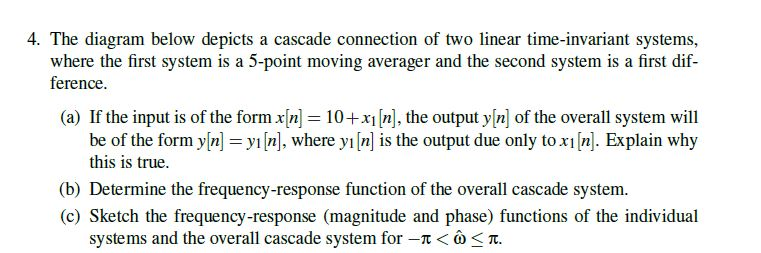 4. The diagram below depicts a cascade connection of two linear time-invariant systems,
where the first system is a 5-point moving averager and the second system is a first dif-
ference.
(a) If the input is of the form x[n] = 10+ x; [x], the output y[n] of the overall system will
be of the form y[n] = yi [n], where yi [n] is the output due only to xi]. Explain why
this is true.
(b) Determine the frequency-response function of the overall cascade system.
(c) Sketch the frequency-response (magnitude and phase) functions of the individual
systems and the overall cascade system for — < & < 7.
This is AI generated Response.
Asked by: kavya
Created at: 2025-09-17 13:02:39
Asked by: kavya
Created at: 2025-09-17 13:02:39
Final Answer:
Rendered
Raw Text
Did you like this answer?
Let's solve the problem step by step:
---
## **(a) Why does a constant in the input not affect the output?**
**Given:**
- Input: \( x[n] = 10 + x_1[n] \)
- First system: 5-point moving averager
- Second system: First difference
### **Step 1: Examine the systems**
**5-point moving average:**
This system averages the last 5 inputs:
\[
h_1[n] = \frac{1}{5}(\delta[n] + \delta[n-1] + \delta[n-2] + \delta[n-3] + \delta[n-4])
\]
The output is:
\[
y_1[n] = \frac{1}{5}\sum_{k=0}^{4} x[n-k]
\]
**First difference:**
This system computes the difference between the current and previous value:
\[
h_2[n] = \delta[n] - \delta[n-1]
\]
The output is:
\[
y[n] = y_1[n] - y_1[n-1]
\]
### **Step 2: Substitute the input**
Let \( x[n] = 10 + x_1[n] \).
Apply the moving average:
\[
y_1[n] = \frac{1}{5} \sum_{k=0}^{4} (10 + x_1[n-k]) = \frac{1}{5}(5 \times 10) + \frac{1}{5} \sum_{k=0}^{4} x_1[n-k] = 10 + \frac{1}{5} \sum_{k=0}^{4} x_1[n-k]
\]
### **Step 3: Apply the first difference**
Apply the second system:
\[
y[n] = y_1[n] - y_1[n-1] = \big(10 + \frac{1}{5} \sum_{k=0}^{4} x_1[n-k]\big) - \big(10 + \frac{1}{5} \sum_{k=0}^{4} x_1[n-1-k]\big)
\]
The constant \(10\) cancels:
\[
y[n] = \frac{1}{5} \sum_{k=0}^{4} x_1[n-k] - \frac{1}{5} \sum_{k=0}^{4} x_1[n-1-k]
\]
So the output depends only on \(x_1[n]\).
---
## **(b) Frequency-Response Function of Overall Cascade**
### **Step 1: Find frequency response of each system**
#### **5-point Moving Averager:**
Impulse response: \( h_1[n] = \frac{1}{5} \) for \( n = 0,1,2,3,4 \), 0 otherwise.
Frequency response:
\[
H_1(e^{j\omega}) = \frac{1}{5} \sum_{n=0}^{4} e^{-j\omega n}
= \frac{1}{5} \cdot \frac{1 - e^{-j5\omega}}{1 - e^{-j\omega}}
\]
Or, using the geometric sum formula, and simplifying:
\[
H_1(e^{j\omega}) = \frac{1}{5} e^{-j2\omega} \cdot \frac{\sin(2.5\omega)}{\sin(0.5\omega)}
\]
#### **First Difference:**
Impulse response: \( h_2[n] = \delta[n] - \delta[n-1] \)
Frequency response:
\[
H_2(e^{j\omega}) = 1 - e^{-j\omega}
\]
### **Step 2: Overall frequency response**
Cascaded system:
\[
H(e^{j\omega}) = H_1(e^{j\omega}) \cdot H_2(e^{j\omega})
\]
\[
\boxed{H(e^{j\omega}) = \frac{1}{5} \cdot \frac{1 - e^{-j5\omega}}{1 - e^{-j\omega}} \cdot (1 - e^{-j\omega}) = \frac{1}{5}(1 - e^{-j5\omega})}
\]
---
## **(c) Sketch Frequency Responses**
Let's describe the sketches:
### **1. 5-point Moving Averager (\(H_1(e^{j\omega})\)):**
- **Magnitude:** Peaks at DC (\(\omega=0\)), zeros at multiples of \(2\pi/5\) (except 0), typical low-pass response, main lobe centered at 0.
- **Phase:** Linear, due to the delay term \(e^{-j2\omega}\).
### **2. First Difference (\(H_2(e^{j\omega})\)):**
- **Magnitude:** \( |1 - e^{-j\omega}| = 2|\sin(\omega/2)| \)
Zero at \(\omega=0\) (DC), max at \(\omega=\pi\) (high-pass).
- **Phase:** Jumps from 0 to \(-\pi\), as this is a first difference (differentiator).
### **3. Overall Cascade (\(H(e^{j\omega})\)):**
- **Magnitude:** \( \frac{1}{5} |1 - e^{-j5\omega}| = \frac{2}{5} |\sin(2.5\omega)| \)
- Zeros at \(\omega = 0, \pm \frac{2\pi}{5}, \pm \frac{4\pi}{5}, \pm \pi\)
- Maximum at midpoints between zeros
- **Phase:** Linear phase, with jumps at the zeros.
---
### **Summary Table**
| System | Magnitude (\(\omega\)) | Phase (\(\omega\)) |
|-----------------------|-------------------------------------------|-------------------------------|
| 5-pt average | \( \left|\frac{1}{5} \frac{\sin(2.5\omega)}{\sin(0.5\omega)}\right| \) | Linear (due to \(e^{-j2\omega}\)) |
| First difference | \( 2|\sin(\omega/2)| \) | \( -\omega/2 \) or jump at \(\omega=0\) |
| Cascade (overall) | \( \frac{2}{5}|\sin(2.5\omega)| \) | Linear |
---
## **Final Answers**
### **(a)**
The output depends only on \( x_1[n] \) because both systems are linear and time-invariant, and the first difference system removes any constant (DC) component from its input.
### **(b)**
\[
\boxed{H(e^{j\omega}) = \frac{1}{5}(1 - e^{-j5\omega})}
\]
### **(c)**
- **5-pt average:** Low-pass, main lobe at DC, zeros at \(\omega = \frac{2\pi}{5}, \frac{4\pi}{5}, ...\)
- **First difference:** High-pass, zero at DC, max at \(\omega = \pi\)
- **Overall:** Bandpass-like, zeros at DC and multiples of \(\frac{2\pi}{5}\), main lobe at mid-frequencies.
You can sketch these using the formulas above for \( -\pi < \omega \leq \pi \). If you need actual plots, just ask!
📢 Instructions:
- Ask anything relatd to above question only.
- For new Question goto :