 VIPSolutions
Give step-by-step solution with explanation and final answer:‘Question 1(25 marks) (a) Solve the following as a single number raised to a power. I) Fx3 x3 [4 marks) (ii) Ex57x8? [4 marks] (b) Simplify the following two expressions without using a calculator: O 12/3-5VI+V3 14 marks] W @+VDx(@2-v2) [4 marks] (c) Identify the polynomials, its terms and its coefficients in the expression 2y3vdy 3. [3 marks] (@) Find the value of loge2+ logs3 [3 marks] Gi) log, 63-logy7 [3 marks)
Question:
Give step-by-step solution with explanation and final answer: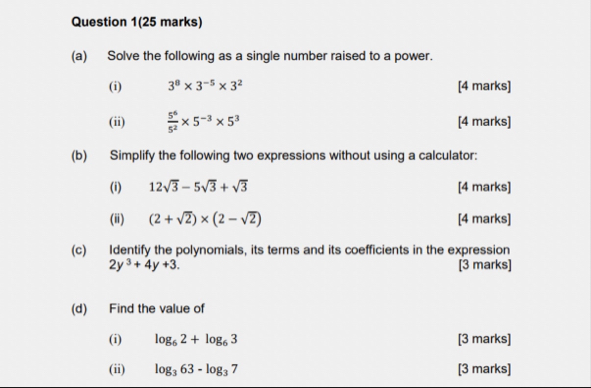 ‘Question 1(25 marks)
(a) Solve the following as a single number raised to a power.
I) Fx3 x3 [4 marks)
(ii) Ex57x8? [4 marks]
(b) Simplify the following two expressions without using a calculator:
O 12/3-5VI+V3 14 marks]
W @+VDx(@2-v2) [4 marks]
(c) Identify the polynomials, its terms and its coefficients in the expression
2y3vdy 3. [3 marks]
(@) Find the value of
loge2+ logs3 [3 marks]
Gi) log, 63-logy7 [3 marks)
This is AI generated Response.
Asked by: Venkatesh
Created at: 2025-09-17 12:46:40
Asked by: Venkatesh
Created at: 2025-09-17 12:46:40
Final Answer:
Rendered
Raw Text
Did you like this answer?
Let's solve each part **step by step**:
---
## (a) Solve as a single number raised to a power
### (i) \( 3^8 \times 3^{-5} \times 3^2 \)
**Step 1:** Use the law of indices: \( a^m \times a^n = a^{m+n} \):
\[
3^8 \times 3^{-5} \times 3^2 = 3^{8 + (-5) + 2}
\]
**Step 2:** Simplify the exponents:
\[
= 3^{8 - 5 + 2}
= 3^{3 + 2}
= 3^5
\]
**Final Answer:**
\[
\boxed{3^5}
\]
---
### (ii) \( \frac{5^5}{5^2} \times 5^{-3} \times 5^3 \)
**Step 1:** Use the laws of indices: \( \frac{a^m}{a^n} = a^{m-n} \) and \( a^m \times a^n = a^{m+n} \):
\[
\frac{5^5}{5^2} = 5^{5-2} = 5^3
\]
So the expression becomes:
\[
5^3 \times 5^{-3} \times 5^3
\]
**Step 2:** Combine the exponents:
\[
= 5^{3 + (-3) + 3}
= 5^{0 + 3}
= 5^3
\]
**Final Answer:**
\[
\boxed{5^3}
\]
---
## (b) Simplify the following expressions
### (i) \( 12\sqrt{3} - 5\sqrt{3} + \sqrt{3} \)
**Step 1:** Combine like terms (all are multiples of \( \sqrt{3} \)):
\[
(12 - 5 + 1)\sqrt{3} = (7 + 1)\sqrt{3} = 8\sqrt{3}
\]
**Final Answer:**
\[
\boxed{8\sqrt{3}}
\]
---
### (ii) \( (2 + \sqrt{2}) \times (2 - \sqrt{2}) \)
**Step 1:** Use the difference of squares formula: \( (a+b)(a-b) = a^2 - b^2 \):
\[
(2 + \sqrt{2})(2 - \sqrt{2}) = 2^2 - (\sqrt{2})^2 = 4 - 2 = 2
\]
**Final Answer:**
\[
\boxed{2}
\]
---
## (c) Identify the polynomials, its terms and its coefficients in \( 2y^3 + 4y + 3 \)
- **Polynomial:** \( 2y^3 + 4y + 3 \)
- **Terms:** \( 2y^3, 4y, 3 \)
- **Coefficients:**
- Coefficient of \( y^3 \): **2**
- Coefficient of \( y \): **4**
- Coefficient of constant term (3): **3**
**Final Answer:**
- **Polynomial:** \( 2y^3 + 4y + 3 \)
- **Terms:** \( 2y^3, 4y, 3 \)
- **Coefficients:** 2, 4, 3
---
## (d) Find the value of
### (i) \( \log_2 2 + \log_6 3 \)
- \( \log_2 2 = 1 \) because \( 2^1 = 2 \)
- \( \log_6 3 \) means the power to which 6 must be raised to get 3. Let’s express 3 in terms of 6:
- \( 6^x = 3 \implies x = \log_6 3 \)
- \( 3 = 6^{1/2} \) is not true, but \( 3 = 6^x \implies x = \log_6 3 \)
- Alternatively, use change of base:
\[
\log_6 3 = \frac{\log 3}{\log 6}
\]
but let's keep it as is for now.
- So, the answer is \( 1 + \log_6 3 \).
**If you want a decimal approximation:**
\[
\log_6 3 = \frac{\log_{10} 3}{\log_{10} 6} \approx \frac{0.4771}{0.7782} \approx 0.613
\]
So,
\[
1 + 0.613 = 1.613
\]
**Final Answer:**
\[
\boxed{1 + \log_6 3} \text{ or approximately } \boxed{1.613}
\]
---
### (ii) \( \log_3 63 - \log_3 7 \)
**Step 1:** Use log subtraction rule: \( \log_a b - \log_a c = \log_a \left( \frac{b}{c} \right) \):
\[
\log_3 63 - \log_3 7 = \log_3 \left( \frac{63}{7} \right) = \log_3 9
\]
**Step 2:** \( 9 = 3^2 \implies \log_3 9 = 2 \)
**Final Answer:**
\[
\boxed{2}
\]
---
# **Summary Table of Answers**
| Part | Answer |
|:----:|:---------------------------|
| (a)(i) | \( 3^5 \) |
| (a)(ii) | \( 5^3 \) |
| (b)(i) | \( 8\sqrt{3} \) |
| (b)(ii) | \( 2 \) |
| (c) | Polynomial: \( 2y^3 + 4y + 3 \), Terms: \( 2y^3, 4y, 3 \), Coefficients: 2, 4, 3 |
| (d)(i) | \( 1 + \log_6 3 \) or \( 1.613 \) |
| (d)(ii) | \( 2 \) |
📢 Instructions:
- Ask anything relatd to above question only.
- For new Question goto :