 VIPSolutions
Give step-by-step solution with explanation and final answer:blem 1. (Easy) f t 7 be a preference relation on a set X. Define I(z) to be the set of € X for which y ~ 2. . Show that the set (of sets!) {I(x)x € X} is a [FHEGEION of X, that is, : o For all 2 and y, either I(x) = I(y) or I(x) N I(y) = 0. 3 3 o Forcevery 3 € X, there is y € X such that z € (3). wg
Question:
Give step-by-step solution with explanation and final answer: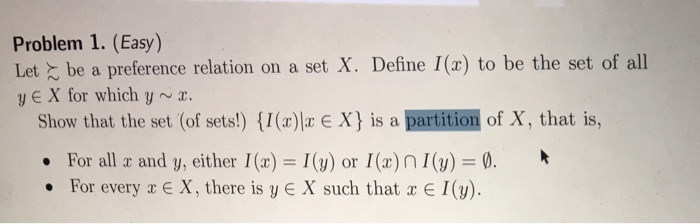 blem 1. (Easy) f
t 7 be a preference relation on a set X. Define I(z) to be the set of
€ X for which y ~ 2. .
Show that the set (of sets!) {I(x)x € X} is a [FHEGEION of X, that is, :
o For all 2 and y, either I(x) = I(y) or I(x) N I(y) = 0. 3 3
o Forcevery 3 € X, there is y € X such that z € (3). wg
This is AI generated Response.
Asked by: mayank
Created at: 2025-09-16 20:21:45
Asked by: mayank
Created at: 2025-09-16 20:21:45
Final Answer:
Rendered
Raw Text
Did you like this answer?
# Step-by-Step Solution
Let \(\sim\) be a **preference relation** on a set \(X\).
Define \(I(x) = \{y \in X : y \sim x\}\).
We are to show that the collection \(\{I(x) \mid x \in X\}\) is a **partition** of \(X\), i.e.,
1. For all \(x, y \in X\), either \(I(x) = I(y)\) or \(I(x) \cap I(y) = \emptyset\).
2. For every \(x \in X\), there is \(y \in X\) such that \(x \in I(y)\).
Let's proceed step by step.
---
## Step 1: **Properties of the Relation \(\sim\)**
A **preference relation** is typically assumed to be an **equivalence relation**:
- **Reflexive**: \(x \sim x\) for all \(x\)
- **Symmetric**: \(x \sim y \implies y \sim x\)
- **Transitive**: \(x \sim y, y \sim z \implies x \sim z\)
If the relation is not explicitly said to be an equivalence relation, the problem would not work as written. So we assume this.
---
## Step 2: **Show Each \(I(x)\) is non-empty**
By reflexivity, \(x \sim x\) for all \(x\). Thus \(x \in I(x)\), so every \(I(x)\) is **non-empty**.
---
## Step 3: **Show Every Element Is in Some \(I(y)\)**
For any \(x \in X\), take \(y = x\).
By reflexivity, \(x \in I(x)\).
So, for every \(x\), there is a \(y\) (namely, \(x\)) such that \(x \in I(y)\).
---
## Step 4: **Show the Sets are Pairwise Disjoint or Equal**
Suppose \(I(x) \cap I(y) \neq \emptyset\).
That is, there exists \(z \in I(x) \cap I(y)\).
So \(z \sim x\) and \(z \sim y\).
We want to show \(I(x) = I(y)\).
Let \(w \in I(x)\).
So \(w \sim x\).
But \(z \sim x\) and \(z \sim y\), and the relation is symmetric and transitive.
- \(w \sim x\), \(x \sim z\) ⇒ \(w \sim z\) (transitive).
- \(w \sim z\), \(z \sim y\) ⇒ \(w \sim y\) (transitive).
Thus, \(w \in I(y)\), so \(I(x) \subseteq I(y)\).
Similarly, any element in \(I(y)\) is also in \(I(x)\), so \(I(x) = I(y)\).
Thus, if \(I(x) \cap I(y) \neq \emptyset\), then \(I(x) = I(y)\).
Otherwise, \(I(x) \cap I(y) = \emptyset\).
---
## Step 5: **Conclusion — Partition**
- **Cover:** Every \(x \in X\) is in some \(I(y)\).
- **Disjoint or Equal:** \(I(x) = I(y)\) or \(I(x) \cap I(y) = \emptyset\).
Hence, \(\{I(x) \mid x \in X\}\) is a **partition** of \(X\).
---
## **Final Answer**
\[
\boxed{
\left\{ I(x) \mid x \in X \right\} \text{ is a partition of } X.
}
\]
**Proof:**
- Every \(x\) is in some \(I(y)\) (namely \(I(x)\)), so the sets cover \(X\).
- If \(I(x) \cap I(y) \neq \emptyset\), then \(I(x) = I(y)\); otherwise, \(I(x) \cap I(y) = \emptyset\).
Thus, the collection forms a partition of \(X\).
📢 Instructions:
- Ask anything relatd to above question only.
- For new Question goto :