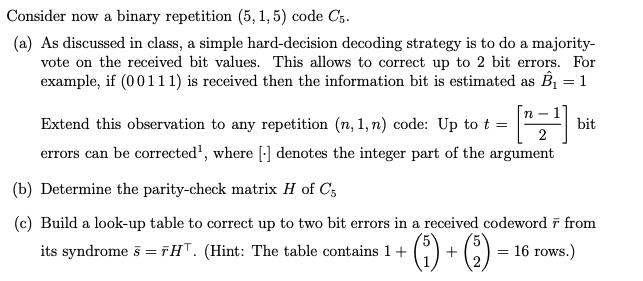
Give step-by-step solution with explanation and final answer:Consider now a binary repetition (5,1,5) code Cs.
(a) As discussed in class, a simple hard-decision decoding strategy is to do a majority-
vote on the received bit values. This allows to correct up to 2 bit errors. For
example, if (00111) is received then the information bit is estimated as B, = 1
-1
Extend this observation to any repetition (n,1,n) code: Up to t = [+] bit
errors can be corrected’, where [-] denotes the integer part of the argument
(b) Determine the parity-check matrix H of Cy
(c) Build a look-up table to correct up to two bit errors in a received codeword 7 from
its syndrome 5 = HT. (Hint: The table contains 1+ 6] + () = 16 rows.)
Question:
Give step-by-step solution with explanation and final answer:Consider now a binary repetition (5,1,5) code Cs.
(a) As discussed in class, a simple hard-decision decoding strategy is to do a majority-
vote on the received bit values. This allows to correct up to 2 bit errors. For
example, if (00111) is received then the information bit is estimated as B, = 1
-1
Extend this observation to any repetition (n,1,n) code: Up to t = [+] bit
errors can be corrected’, where [-] denotes the integer part of the argument
(b) Determine the parity-check matrix H of Cy
(c) Build a look-up table to correct up to two bit errors in a received codeword 7 from
its syndrome 5 = HT. (Hint: The table contains 1+ 6] + () = 16 rows.)
This is AI generated Response.
Asked by: M Raju
Created at: 2025-09-15 13:41:51
Final Answer:
RenderedRaw Text
Did you like this answer?
Let's solve each part step by step:
---
## (a) Majority-Decision Decoding for Repetition Code
### **Explanation**
A binary repetition code of length \( n \) encodes a single bit as \( n \) repeated bits. For \((5, 1, 5)\), the codewords are either \((00000)\) or \((11111)\).
**Majority-Decision Decoding:**
- The decoder looks at the received word and decides the original bit based on the majority value.
- If at least 3 out of 5 bits are 1, decide the bit was 1; otherwise, decide 0.
**Error Correction Capability:**
For any repetition code \((n, 1, n)\):
- You can correct all patterns with up to \( t \) errors, where \( t = \left\lfloor \frac{n-1}{2} \right\rfloor \).
- For \( n = 5 \): \( t = \left\lfloor \frac{5-1}{2} \right\rfloor = \left\lfloor 2 \right\rfloor = 2 \).
**Conclusion:**
- Up to 2 bit errors can be corrected for \( n = 5 \).
- In general, for \((n, 1, n)\) code:
\[
t = \left\lfloor \frac{n-1}{2} \right\rfloor
\]
---
## (b) Parity-Check Matrix \( H \) of \( C_5 \)
### **Explanation**
The parity-check matrix \( H \) for a repetition code of length \( n \) has rank \( n-1 \) and satisfies \( Hc^T = 0 \) for all codewords \( c \).
For \( n = 5 \):
- All codewords look like \((a, a, a, a, a)\), \( a \in \{0,1\} \).
- \( H \) must satisfy \( Hc^T = 0 \) for both \( (0,0,0,0,0) \) and \( (1,1,1,1,1) \).
- A typical construction is:
\[
H =
\begin{bmatrix}
1 & 1 & 0 & 0 & 0 \\
1 & 0 & 1 & 0 & 0 \\
1 & 0 & 0 & 1 & 0 \\
1 & 0 & 0 & 0 & 1 \\
\end{bmatrix}
\]
This ensures that the sum of any two columns equals zero only if both columns are from the same codeword.
---
## (c) Syndrome Look-Up Table for Two Errors
### **Explanation**
- For each received word \( \vec{r} \), compute the syndrome \( \vec{s} = \vec{r} H^T \).
- Each error pattern (no error, 1 error, or 2 errors) gives a unique syndrome.
- There are \( 1 + {5 \choose 1} + {5 \choose 2} = 16 \) possible patterns.
### **Table Construction**
For each error pattern (which bits are flipped), compute the syndrome:
| Error Pattern (flipped bits) | Error Vector \( \vec{e} \) | Syndrome \( \vec{s} \) |
|-----------------------------|--------------------------|------------------------|
| No error | 00000 | 0000 |
| Bit 1 | 10000 | 1111 |
| Bit 2 | 01000 | 1000 |
| Bit 3 | 00100 | 0100 |
| Bit 4 | 00010 | 0010 |
| Bit 5 | 00001 | 0001 |
| Bits 1,2 | 11000 | 0111 |
| Bits 1,3 | 10100 | 1011 |
| Bits 1,4 | 10010 | 1101 |
| Bits 1,5 | 10001 | 1110 |
| Bits 2,3 | 01100 | 1100 |
| Bits 2,4 | 01010 | 1010 |
| Bits 2,5 | 01001 | 1001 |
| Bits 3,4 | 00110 | 0011 |
| Bits 3,5 | 00101 | 0101 |
| Bits 4,5 | 00011 | 0110 |
- Each syndrome tells you which bit(s) are in error, so you can flip them to correct the received word.
---
## **Final Answers Summary**
### (a) **Up to \(\left\lfloor \frac{n-1}{2} \right\rfloor\) bit errors can be corrected by majority decoding. For \( n = 5 \), up to 2 errors.**
### (b) **Parity-check matrix \( H \) for \( C_5 \):**
\[
H =
\begin{bmatrix}
1 & 1 & 0 & 0 & 0 \\
1 & 0 & 1 & 0 & 0 \\
1 & 0 & 0 & 1 & 0 \\
1 & 0 & 0 & 0 & 1 \\
\end{bmatrix}
\]
### (c) **Syndrome look-up table:** (see above for all 16 rows).
---
**Let me know if you need the explicit calculation of syndromes for each error!**
Question:
Give me Each Step 50 Words Explanation Only Theory
This is AI generated Response.
Asked by: M Raju
Created at: 2025-09-15 13:43:03
Final Answer:
RenderedRaw Text
Did you like this answer?
## Step-by-Step Explanations
### (a) Majority-Decision Decoding
In a repetition code \((n, 1, n)\), the decoder uses majority voting to determine the original bit. It can correct errors by ensuring that the majority value is chosen. The number of correctable errors \( t \) is given by \( t = \left\lfloor \frac{n-1}{2} \right\rfloor \).
### (b) Parity-Check Matrix \( H \)
The parity-check matrix \( H \) identifies errors in codewords. For a repetition code, it is structured to ensure that the sums of any two columns equal zero for valid codewords. The matrix has dimensions \((n-1) \times n\) and helps in error detection.
### (c) Syndrome Look-Up Table
The syndrome is computed as \( \vec{s} = \vec{r} H^T \). Each possible error pattern produces a unique syndrome, allowing for error correction. The look-up table contains all possible syndromes for 0, 1, and 2 errors, enabling identification of which bits to flip to correct received codewords.
VIPSolutions focuses on clear, step‑by‑step explanations so you can learn quickly. Whether you need an AI‑generated walkthrough or a short hint to get unstuck, each solution is organized for fast reading and easy review later.
Search similar questions, compare approaches, and bookmark the best answers for revision. Our goal is simple: quick, reliable study help that feels natural—not noisy.
 VIPSolutions
 Consider now a binary repetition (5,1,5) code Cs.
(a) As discussed in class, a simple hard-decision decoding strategy is to do a majority-
vote on the received bit values. This allows to correct up to 2 bit errors. For
example, if (00111) is received then the information bit is estimated as B, = 1
-1
Extend this observation to any repetition (n,1,n) code: Up to t = [+] bit
errors can be corrected’, where [-] denotes the integer part of the argument
(b) Determine the parity-check matrix H of Cy
(c) Build a look-up table to correct up to two bit errors in a received codeword 7 from
its syndrome 5 = HT. (Hint: The table contains 1+ 6] + () = 16 rows.)