 VIPSolutions
Give step-by-step solution with explanation and final answer:Assignment 2 on Modules 2 X Rewru vise Question 7 (2 points) The parallel RLC circuit (natural response) is shown in the figure. If the values of the resistance and inductance are 100 Qand 20 mH, respectively. If C is adjusted to give a resonant frequency of 20 krad/s, find the value of one root (s1) of the characteristic equation that governs the transient behavior. Select the correct choice. ic| + iq | ix c=Ve Lh R (0) s1=-5359 rad/s (0) s1=-5000 rad/s (0) s1 = +5359 rad/s O None of the above (0) s1= +5935 rad/s
Question:
Give step-by-step solution with explanation and final answer: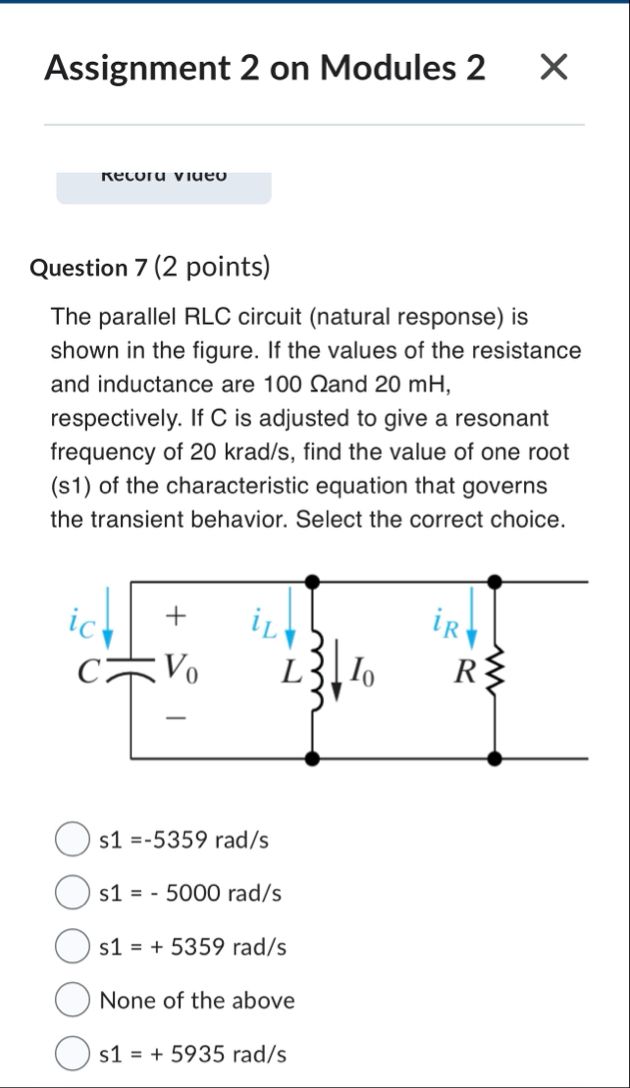 Assignment 2 on Modules 2 X
Rewru vise
Question 7 (2 points)
The parallel RLC circuit (natural response) is
shown in the figure. If the values of the resistance
and inductance are 100 Qand 20 mH,
respectively. If C is adjusted to give a resonant
frequency of 20 krad/s, find the value of one root
(s1) of the characteristic equation that governs
the transient behavior. Select the correct choice.
ic| + iq | ix
c=Ve Lh R
(0) s1=-5359 rad/s
(0) s1=-5000 rad/s
(0) s1 = +5359 rad/s
O None of the above
(0) s1= +5935 rad/s
This is AI generated Response.
Asked by: A j mahant
Created at: 2025-09-14 05:54:36
Asked by: A j mahant
Created at: 2025-09-14 05:54:36
Final Answer:
Rendered
Raw Text
Did you like this answer?
Let's solve the problem step by step:
## **Given Data**
- \( R = 100 \ \Omega \)
- \( L = 20 \ \text{mH} = 0.02 \ \text{H} \)
- Resonant frequency: \( \omega_0 = 20,000 \ \text{rad/s} \)
- Find one root \( s_1 \) of the characteristic equation.
---
## **Step 1: Find Capacitance \( C \)**
The resonant frequency for a parallel RLC circuit is:
\[
\omega_0 = \frac{1}{\sqrt{LC}}
\]
\[
C = \frac{1}{L \omega_0^2}
\]
Plug in the values:
\[
C = \frac{1}{0.02 \times (20,000)^2}
\]
\[
C = \frac{1}{0.02 \times 400,000,000}
\]
\[
C = \frac{1}{8,000,000}
\]
\[
C = 1.25 \times 10^{-7} \ \text{F} = 125 \ \text{nF}
\]
---
## **Step 2: Characteristic Equation for Parallel RLC**
The standard characteristic equation is:
\[
s^2 + \frac{1}{RC}s + \frac{1}{LC} = 0
\]
---
## **Step 3: Substitute Values**
- \( \frac{1}{RC} = \frac{1}{100 \times 1.25 \times 10^{-7}} = \frac{1}{1.25 \times 10^{-5}} = 80,000 \)
- \( \frac{1}{LC} = \frac{1}{0.02 \times 1.25 \times 10^{-7}} = \frac{1}{2.5 \times 10^{-9}} = 400,000,000 \)
So, the equation:
\[
s^2 + 80,000 s + 400,000,000 = 0
\]
---
## **Step 4: Find the Roots**
The roots are:
\[
s_{1,2} = \frac{-\frac{1}{RC} \pm \sqrt{\left(\frac{1}{RC}\right)^2 - 4 \frac{1}{LC}}}{2}
\]
\[
s_{1,2} = \frac{-80,000 \pm \sqrt{(80,000)^2 - 4 \times 400,000,000}}{2}
\]
\[
= \frac{-80,000 \pm \sqrt{6,400,000,000 - 1,600,000,000}}{2}
\]
\[
= \frac{-80,000 \pm \sqrt{4,800,000,000}}{2}
\]
\[
\sqrt{4,800,000,000} \approx 69,282.03
\]
So,
\[
s_1 = \frac{-80,000 + 69,282.03}{2} = \frac{-10,717.97}{2} \approx -5,359 \ \text{rad/s}
\]
\[
s_2 = \frac{-80,000 - 69,282.03}{2} = \frac{-149,282.03}{2} \approx -74,641 \ \text{rad/s}
\]
---
## **Step 5: Final Answer**
**The value of one root \( s_1 \) is:**
\[
\boxed{s_1 = -5359 \ \text{rad/s}}
\]
So, **the correct option is:**
> s1 = -5359 rad/s
---
### **Summary Table**
| Step | Calculation | Result |
|-----------|-----------------------------------------------|-------------------------|
| Capacitance \(C\) | \(C = 1/(L\omega_0^2)\) | \(1.25 \times 10^{-7}\) F |
| \(1/RC\) | \(1/(100 \times 1.25 \times 10^{-7})\) | 80,000 |
| \(1/LC\) | \(1/(0.02 \times 1.25 \times 10^{-7})\) | 400,000,000 |
| Roots | \(\frac{-80,000 \pm \sqrt{4,800,000,000}}{2}\) | \(-5359, -74641\) |
| **Answer**| | **-5359 rad/s** |
Question:
Why others option are incorrect
This is AI generated Response.
Asked by: A j mahant
Created at: 2025-09-14 05:55:48
Asked by: A j mahant
Created at: 2025-09-14 05:55:48
Final Answer:
Rendered
Raw Text
Did you like this answer?
## **Explanation of Incorrect Options**
### **Option Analysis**
1. **s1 = -5000 rad/s**
- This value does not match our calculated root of -5359 rad/s. It is arbitrary and does not arise from the characteristic equation.
2. **s1 = +5359 rad/s**
- The root value should be negative due to the damping factor in the characteristic equation. A positive root indicates an unstable system, which is not applicable here.
3. **None of the above**
- This option would imply that all provided options are incorrect. However, we have found a valid root value of -5359 rad/s, making this statement false.
4. **s1 = +5935 rad/s**
- Similar to the previous positive root option, this value does not correspond to any calculations made from the circuit parameters and is also indicative of an unstable system.
### **Conclusion**
The only valid calculation yields a single root of:
\[
s_1 = -5359 \ \text{rad/s}
\]
This corresponds with the system's behavior, as negative roots indicate a stable, damped response in a parallel RLC circuit. Hence, the correct option is:
> **s1 = -5359 rad/s**
📢 Instructions:
- Ask anything relatd to above question only.
- For new Question goto :