 VIPSolutions
Give step-by-step solution with explanation and final answer:Problem § Follow the procedure below to construct the CMOS logic gate for the function f = a+ b-c. a) Writ the equation forthe nMOS network ) Write the cquntion for the pMOS network © Use the squatons in (1) and (6) contre a schema (or 0) Veriy the nMOS and pMOS networks sr proper complemen (eres groups in sMOS are parallel in pMOS, etc).
Question:
Give step-by-step solution with explanation and final answer: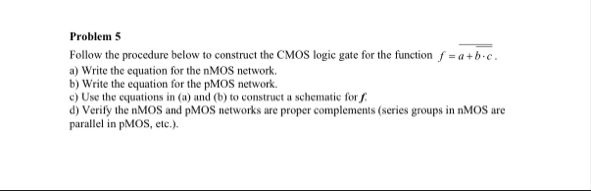 Problem §
Follow the procedure below to construct the CMOS logic gate for the function f = a+ b-c.
a) Writ the equation forthe nMOS network
) Write the cquntion for the pMOS network
© Use the squatons in (1) and (6) contre a schema (or
0) Veriy the nMOS and pMOS networks sr proper complemen (eres groups in sMOS are
parallel in pMOS, etc).
This is AI generated Response.
Asked by: A j mahant
Created at: 2025-09-13 06:33:43
Asked by: A j mahant
Created at: 2025-09-13 06:33:43
Final Answer:
Rendered
Raw Text
Did you like this answer?
Let's solve the problem step by step.
---
## **Given Function**
\[
f = \overline{a + b \cdot c}
\]
---
## **a) Write the equation for the nMOS network**
**nMOS network implements \( f' \) (i.e., \( a + b \cdot c \)):**
\[
f' = a + (b \cdot c)
\]
- **OR** (\(+\)): Parallel
- **AND** (\(\cdot\)): Series
So, in the nMOS pull-down network:
- One branch is just \( a \) (nMOS transistor controlled by \( a \)), connected **in parallel** with
- A **series** connection of \( b \) and \( c \) (nMOS transistors controlled by \( b \) and \( c \)).
---
## **b) Write the equation for the pMOS network**
**pMOS network implements \( f \):**
\[
f = \overline{a + b \cdot c}
\]
Apply DeMorgan's Law:
\[
f = \overline{a + b \cdot c} = \overline{a} \cdot \overline{b \cdot c} = \overline{a} \cdot (\overline{b} + \overline{c})
\]
- **AND** (\(\cdot\)): Series
- **OR** (\(+\)): Parallel
So, in the pMOS pull-up network:
- One branch is \( \overline{a} \) (pMOS controlled by \( a \)), connected **in series** with
- A **parallel** connection of \( \overline{b} \) and \( \overline{c} \) (pMOS transistors controlled by \( b \) and \( c \)), both inverted.
---
## **c) Construct a schematic for \( f \)**
### **nMOS Network (Pull-down to GND)**
- **Parallel**: nMOS controlled by \( a \)
- **Series**: nMOS controlled by \( b \) and \( c \) in series
So, source to drain connections:
- Output node is connected to GND if either \( a \) is ON (conducting), **or** both \( b \) and \( c \) are ON (conducting in series).
### **pMOS Network (Pull-up to Vdd)**
- **Series**: pMOS controlled by \( a \)
- **Parallel**: pMOS controlled by \( b \) and \( c \) (in parallel), both in series with the first
So, source to drain connections:
- Vdd is connected to output if \( a \) is OFF **and** either \( b \) is OFF **or** \( c \) is OFF.
#### **Schematic Diagram Structure**
```
Vdd
|
|
pMOS (a) (series)
|
+-----+------+
| |
pMOS(b) pMOS(c) (parallel)
| |
+-----+------+
|
Output
|
+-----+------+
| |
nMOS(a) nMOS(b)
|
nMOS(c)
| |
GND GND
```
- The nMOS(b) and nMOS(c) are in series, and that series is in parallel to nMOS(a).
---
## **d) Verify the nMOS and pMOS networks are complements**
- **nMOS**: Parallel \( a \) with series \( b \) - \( c \)
- **pMOS**: Series \( a \) with parallel \( b \), \( c \)
This matches the complementarity rule: **series in nMOS = parallel in pMOS** and vice versa.
---
## **Final Answer (Summary)**
### a) **nMOS equation:**
\[
f' = a + (b \cdot c)
\]
### b) **pMOS equation:**
\[
f = \overline{a} \cdot (\overline{b} + \overline{c})
\]
### c) **CMOS schematic:**
- **Pull-down (nMOS):** \( a \) in parallel with \( b \) series \( c \)
- **Pull-up (pMOS):** \( a \) in series with parallel of \( b \) and \( c \)
### d) **Complementarity:**
- nMOS and pMOS networks are proper complements.
---
**Let me know if you want a drawn schematic!**
📢 Instructions:
- Ask anything relatd to above question only.
- For new Question goto :