 VIPSolutions
Give step-by-step solution with explanation and final answer:a -~ eral solution SEAMS NAMI A Ta © eR gh Wh i ie Vv J U cv c z m he ol | Find the general solution o the ven os 0 - pH ne laliaN a (mae) . Ga x - spk 0 ee a xno] Eo ee la CE mes
Question:
Give step-by-step solution with explanation and final answer: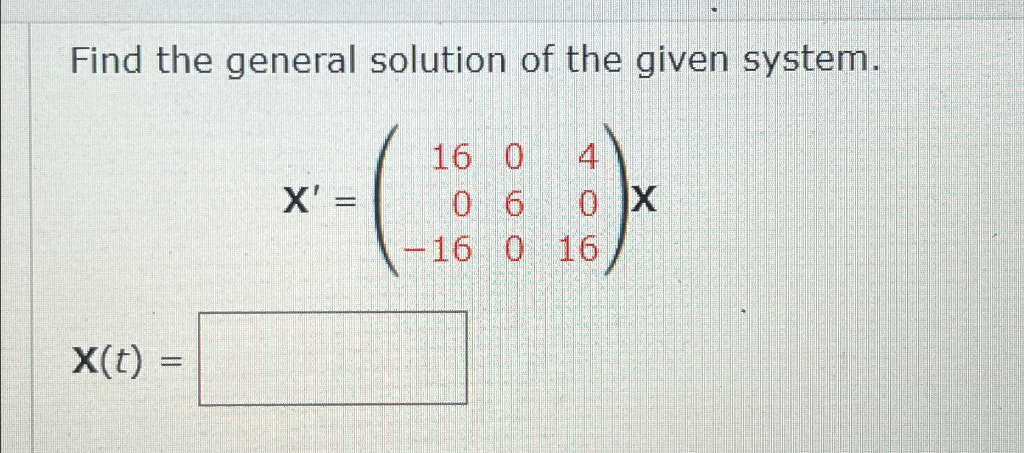 a -~ eral solution SEAMS NAMI A Ta
© eR gh Wh i ie Vv J U cv c z m he ol
| Find the general solution o the ven os 0 -
pH
ne laliaN a
(mae) . Ga
x - spk
0 ee a
xno]
Eo ee la
CE mes
This is AI generated Response.
Asked by: Himanshu Kushwaha
Created at: 2025-09-11 19:33:31
Asked by: Himanshu Kushwaha
Created at: 2025-09-11 19:33:31
Final Answer:
Rendered
Raw Text
Did you like this answer?
Let's solve the system step by step:
\[
\mathbf{X}' =
\begin{pmatrix}
16 & 0 & 4 \\
0 & 6 & 0 \\
-16 & 0 & 16
\end{pmatrix}
\mathbf{X}
\]
Let \(\mathbf{X} = \begin{pmatrix} x_1 \\ x_2 \\ x_3 \end{pmatrix}\).
---
## **Step 1: Find Eigenvalues**
Set up the characteristic equation:
\[
\det \left( A - \lambda I \right) = 0
\]
\[
A - \lambda I =
\begin{pmatrix}
16 - \lambda & 0 & 4 \\
0 & 6 - \lambda & 0 \\
-16 & 0 & 16 - \lambda
\end{pmatrix}
\]
Calculate the determinant:
\[
\begin{vmatrix}
16-\lambda & 0 & 4 \\
0 & 6-\lambda & 0 \\
-16 & 0 & 16-\lambda
\end{vmatrix}
= (6-\lambda)
\begin{vmatrix}
16-\lambda & 4 \\
-16 & 16-\lambda
\end{vmatrix}
\]
\[
= (6-\lambda)[(16-\lambda)^2 - (-16)(4)]
\]
\[
= (6-\lambda)[(16-\lambda)^2 + 64]
\]
\[
= (6-\lambda)[(256 - 32\lambda + \lambda^2) + 64]
\]
\[
= (6-\lambda)[\lambda^2 - 32\lambda + 320]
\]
Set to zero:
\[
(6-\lambda)[\lambda^2 - 32\lambda + 320] = 0
\]
So, eigenvalues:
1. \(\lambda_1 = 6\)
2. \(\lambda_{2,3}^2 - 32\lambda_{2,3} + 320 = 0\)
Solve the quadratic:
\[
\lambda^2 - 32\lambda + 320 = 0
\]
\[
\lambda = \frac{32 \pm \sqrt{(-32)^2 - 4 \cdot 1 \cdot 320}}{2}
\]
\[
= \frac{32 \pm \sqrt{1024 - 1280}}{2}
\]
\[
= \frac{32 \pm \sqrt{-256}}{2}
\]
\[
= \frac{32 \pm 16i}{2}
\]
\[
= 16 \pm 8i
\]
So, eigenvalues are \(\boxed{6,\ 16+8i,\ 16-8i}\).
---
## **Step 2: Find Eigenvectors**
### For \(\lambda = 6\):
\[
A - 6I =
\begin{pmatrix}
10 & 0 & 4 \\
0 & 0 & 0 \\
-16 & 0 & 10
\end{pmatrix}
\]
Let eigenvector \(\mathbf{v}_1 = \begin{pmatrix} a \\ b \\ c \end{pmatrix}\):
First row: \(10a + 4c = 0\)
Second row: \(0\)
Third row: \(-16a + 10c = 0\)
From third row: \(10c = 16a \implies c = \frac{8}{5}a\)
From first row: \(10a + 4c = 0 \implies 10a + 4\left(\frac{8}{5}a\right) = 0 \implies 10a + \frac{32}{5}a = 0 \implies 50a + 32a = 0 \implies 82a = 0 \implies a = 0\)
So \(a = 0\), then \(c = 0\) and \(b\) is free.
So, eigenvector is \(\mathbf{v}_1 = \begin{pmatrix} 0 \\ 1 \\ 0 \end{pmatrix}\).
---
### For \(\lambda = 16 + 8i\):
\[
A - (16+8i)I =
\begin{pmatrix}
-8i & 0 & 4 \\
0 & -10 - 8i & 0 \\
-16 & 0 & -8i
\end{pmatrix}
\]
Second row: \(-10-8i = 0\) so \(b = 0\).
First and third rows:
\[
\begin{cases}
-8i a + 4c = 0 \\
-16a - 8i c = 0
\end{cases}
\]
From first: \(4c = 8i a \implies c = 2i a\)
From third: \(-16a - 8i c = 0 \implies -16a - 8i (2i a) = -16a - 16i^2 a = -16a - 16(-1)a = -16a + 16a = 0\)
So, pick \(a=1\):
\[
\mathbf{v}_2 = \begin{pmatrix} 1 \\ 0 \\ 2i \end{pmatrix}
\]
---
### For \(\lambda = 16 - 8i\):
Similarly, eigenvector is conjugate:
\[
\mathbf{v}_3 = \begin{pmatrix} 1 \\ 0 \\ -2i \end{pmatrix}
\]
---
## **Step 3: General Solution**
The general solution is:
\[
\mathbf{X}(t) = c_1 e^{6t} \begin{pmatrix} 0 \\ 1 \\ 0 \end{pmatrix}
+ c_2 e^{(16+8i)t} \begin{pmatrix} 1 \\ 0 \\ 2i \end{pmatrix}
+ c_3 e^{(16-8i)t} \begin{pmatrix} 1 \\ 0 \\ -2i \end{pmatrix}
\]
Or, combine complex conjugate terms using Euler's formula:
Let \(c_2, c_3\) be chosen so the sum is real:
Let \(c_2 = \alpha + i \beta\), \(c_3 = \alpha - i \beta\).
Or, write as:
\[
\mathbf{X}(t) = c_1 e^{6t} \begin{pmatrix} 0 \\ 1 \\ 0 \end{pmatrix}
+ e^{16t} \left[ A \cos(8t) + B \sin(8t) \right]
\]
where \(A, B\) are real vectors formed as real and imaginary parts of \(e^{8it} \begin{pmatrix} 1 \\ 0 \\ 2i \end{pmatrix}\):
\[
e^{8it} \begin{pmatrix} 1 \\ 0 \\ 2i \end{pmatrix}
= \begin{pmatrix} \cos 8t + i \sin 8t \\ 0 \\ 2i(\cos 8t + i \sin 8t) \end{pmatrix}
= \begin{pmatrix} \cos 8t + i \sin 8t \\ 0 \\ 2i\cos 8t - 2\sin 8t \end{pmatrix}
\]
So, real part:
\[
\text{Re} =
\begin{pmatrix}
\cos 8t \\
0 \\
-2\sin 8t
\end{pmatrix}
\]
Imaginary part:
\[
\text{Im} =
\begin{pmatrix}
\sin 8t \\
0 \\
2\cos 8t
\end{pmatrix}
\]
So the real general solution is:
\[
\boxed{
\mathbf{X}(t) =
c_1 e^{6t} \begin{pmatrix} 0 \\ 1 \\ 0 \end{pmatrix}
+ c_2 e^{16t} \begin{pmatrix} \cos 8t \\ 0 \\ -2\sin 8t \end{pmatrix}
+ c_3 e^{16t} \begin{pmatrix} \sin 8t \\ 0 \\ 2\cos 8t \end{pmatrix}
}
\]
Where \(c_1, c_2, c_3\) are arbitrary constants.
📢 Instructions:
- Ask anything relatd to above question only.
- For new Question goto :