 VIPSolutions
Give step-by-step solution with explanation and final answer:Pe ry es rtnot sens pn
Question:
Give step-by-step solution with explanation and final answer: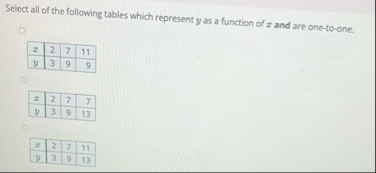 Pe ry es rtnot sens pn
This is AI generated Response.
Asked by: MD ISRARUL HAQUE
Created at: 2025-09-11 08:47:01
Asked by: MD ISRARUL HAQUE
Created at: 2025-09-11 08:47:01
Final Answer:
Rendered
Raw Text
Did you like this answer?
Let's analyze each table step-by-step to determine if **\( y \) is a function of \( z \) and if it is one-to-one**.
---
## **Definitions**
- **Function:** For each input \( z \), there is only one output \( y \).
- **One-to-one:** Each \( y \) value corresponds to only one \( z \) value (no two \( z \) values give the same \( y \)).
---
## **Table 1**
| z | 2 | 7 | 11 |
|---|---|---|----|
| y | 3 | 9 | 9 |
- Check if \( y \) is a function of \( z \):
Each \( z \) has only one \( y \) value.
**Yes, it's a function.**
- Check if one-to-one:
The value \( y = 9 \) appears twice (for \( z = 7 \) and \( z = 11 \)).
**No, it is not one-to-one.**
---
## **Table 2**
| z | 2 | 7 | 7 |
|---|---|---|---|
| y | 3 | 9 | 13|
- Check if \( y \) is a function of \( z \):
\( z = 7 \) maps to both \( 9 \) and \( 13 \).
**No, it's not a function.**
---
## **Table 3**
| z | 2 | 7 | 11 |
|---|---|---|----|
| y | 3 | 9 | 13 |
- Check if \( y \) is a function of \( z \):
Each \( z \) has only one \( y \) value.
**Yes, it's a function.**
- Check if one-to-one:
All \( y \) values are different.
**Yes, it is one-to-one.**
---
## **Final Answer**
### **Only Table 3 represents \( y \) as a function of \( z \) and is one-to-one.**
---
### **Summary Table**
| Table | Is Function? | One-to-One? | Select? |
|-------|--------------|-------------|---------|
| 1 | Yes | No | No |
| 2 | No | No | No |
| 3 | Yes | Yes | **Yes** |
Question:
This is not z, it is x dude.
This is AI generated Response.
Asked by: MD ISRARUL HAQUE
Created at: 2025-09-11 08:49:27
Asked by: MD ISRARUL HAQUE
Created at: 2025-09-11 08:49:27
Final Answer:
Rendered
Raw Text
Did you like this answer?
# Step-by-Step Solution to Determine Functionality
Let's analyze the tables to determine if \( y \) is a function of \( x \) and if it is one-to-one.
## Definitions
- **Function:** Each input \( x \) maps to exactly one output \( y \).
- **One-to-One:** Each output \( y \) corresponds to only one input \( x \) (no two \( x \) values yield the same \( y \)).
---
## Table Analysis
### **Table 1**
| x | 2 | 7 | 11 |
|----|---|---|----|
| y | 3 | 9 | 9 |
- **Function Check:**
Every \( x \) has a single \( y \) value.
**Conclusion:** Yes, it is a function.
- **One-to-One Check:**
The value \( y = 9 \) corresponds to both \( x = 7 \) and \( x = 11 \).
**Conclusion:** No, it is not one-to-one.
---
### **Table 2**
| x | 2 | 7 | 7 |
|----|---|---|----|
| y | 3 | 9 | 13 |
- **Function Check:**
The input \( x = 7 \) maps to two different \( y \) values (9 and 13).
**Conclusion:** No, it is not a function.
---
### **Table 3**
| x | 2 | 7 | 11 |
|----|---|---|----|
| y | 3 | 9 | 13 |
- **Function Check:**
Each \( x \) has a unique \( y \) value.
**Conclusion:** Yes, it is a function.
- **One-to-One Check:**
All \( y \) values (3, 9, 13) are distinct.
**Conclusion:** Yes, it is one-to-one.
---
## Final Answer
**Only Table 3 represents \( y \) as a function of \( x \) and is one-to-one.**
---
### Summary Table
| Table | Is Function? | One-to-One? | Select? |
|-------|--------------|-------------|---------|
| 1 | Yes | No | No |
| 2 | No | N/A | No |
| 3 | Yes | Yes | **Yes** |
📢 Instructions:
- Ask anything relatd to above question only.
- For new Question goto :