 VIPSolutions
Give step-by-step solution with explanation and final answer:2. (12 points) Determine if the following ODEs correspond to a system that is stable, unstable, marginally stable or neutrally stable. a. ¥(t) + 9%(t) + 14x(t) = 10u(t) d. %(t) + 2x(t) = f(t) b. #(t) +48(t) + 16x(t) =0 e. ¥(t)+5x(t) =0 c. 4x(t) —4x(t) = f(t) f. see below dix (t) x(t) et Bm + 81x(t) =0
Question:
Give step-by-step solution with explanation and final answer: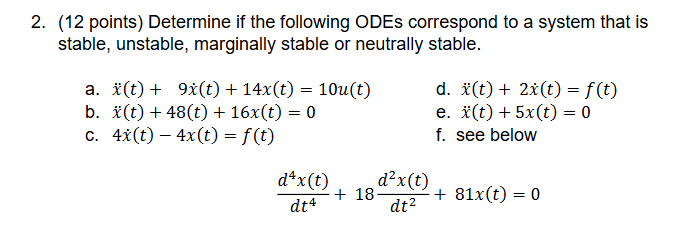 2. (12 points) Determine if the following ODEs correspond to a system that is
stable, unstable, marginally stable or neutrally stable.
a. ¥(t) + 9%(t) + 14x(t) = 10u(t) d. %(t) + 2x(t) = f(t)
b. #(t) +48(t) + 16x(t) =0 e. ¥(t)+5x(t) =0
c. 4x(t) —4x(t) = f(t) f. see below
dix (t) x(t)
et Bm + 81x(t) =0
This is AI generated Response.
Asked by: Himanshu Kushwaha
Created at: 2025-09-11 05:49:49
Asked by: Himanshu Kushwaha
Created at: 2025-09-11 05:49:49
Final Answer:
Rendered
Raw Text
Did you like this answer?
# Stability Analysis of the Given ODEs
To determine the stability of each system, **find the characteristic equation**, solve for its roots, and analyze their real parts:
- **Stable:** All roots have negative real parts.
- **Unstable:** Any root has a positive real part.
- **Marginally stable:** Roots have zero real parts, but none repeated (except simple poles at zero).
- **Neutrally stable:** All roots have zero real parts, but may have repeated zeros or pure imaginary parts.
---
## (a) \( \ddot{x}(t) + 9\dot{x}(t) + 14x(t) = 10u(t) \)
### Characteristic Equation:
\[
s^2 + 9s + 14 = 0
\]
### Roots:
\[
s = \frac{-9 \pm \sqrt{81 - 56}}{2} = \frac{-9 \pm 5}{2}
\]
\[
s_1 = \frac{-9 + 5}{2} = -2, \quad s_2 = \frac{-9 - 5}{2} = -7
\]
### Conclusion:
- Both roots have **negative real parts**.
- **System is Stable.**
---
## (b) \( \ddot{x}(t) + 48\dot{x}(t) + 16x(t) = 0 \)
### Characteristic Equation:
\[
s^2 + 48s + 16 = 0
\]
\[
s = \frac{-48 \pm \sqrt{48^2 - 4 \cdot 16}}{2}
\]
\[
s = \frac{-48 \pm \sqrt{2304 - 64}}{2} = \frac{-48 \pm \sqrt{2240}}{2}
\]
\[
\sqrt{2240} \approx 47.4
\]
\[
s_1 \approx \frac{-48 + 47.4}{2} = -0.3, \quad s_2 \approx \frac{-48 - 47.4}{2} = -47.7
\]
### Conclusion:
- Both roots have **negative real parts**.
- **System is Stable.**
---
## (c) \( 4\dot{x}(t) - 4x(t) = f(t) \)
### Homogeneous Equation:
\[
4\dot{x}(t) - 4x(t) = 0 \implies \dot{x}(t) - x(t) = 0
\]
### Characteristic Equation:
\[
s - 1 = 0 \implies s = 1
\]
### Conclusion:
- **Positive real part** root.
- **System is Unstable.**
---
## (d) \( \dot{x}(t) + 2x(t) = f(t) \)
### Homogeneous Equation:
\[
\dot{x}(t) + 2x(t) = 0
\]
### Characteristic Equation:
\[
s + 2 = 0 \implies s = -2
\]
### Conclusion:
- **Negative real part**.
- **System is Stable.**
---
## (e) \( \dot{x}(t) + 5x(t) = 0 \)
### Characteristic Equation:
\[
s + 5 = 0 \implies s = -5
\]
### Conclusion:
- **Negative real part**.
- **System is Stable.**
---
## (f) \( \dfrac{d^4x(t)}{dt^4} + 18\dfrac{d^2x(t)}{dt^2} + 81x(t) = 0 \)
### Characteristic Equation:
\[
s^4 + 18s^2 + 81 = 0
\]
Let \( y = s^2 \):
\[
y^2 + 18y + 81 = 0
\]
\[
y = \frac{-18 \pm \sqrt{324 - 324}}{2} = \frac{-18}{2} = -9
\]
So \( s^2 = -9 \implies s = \pm 3i \)
### Roots:
- \( s = 3i, -3i, 3i, -3i \) (each root is double)
### Conclusion:
- All roots are **purely imaginary and repeated**.
- **System is Unstable** (since repeated imaginary roots cause unbounded oscillations).
---
# **Summary Table**
| Part | Roots | Stability |
|------|-----------------------------------------------------|----------------------|
| (a) | -2, -7 | Stable |
| (b) | -0.3, -47.7 | Stable |
| (c) | 1 | Unstable |
| (d) | -2 | Stable |
| (e) | -5 | Stable |
| (f) | \(3i, -3i, 3i, -3i\) (repeated) | Unstable |
📢 Instructions:
- Ask anything relatd to above question only.
- For new Question goto :