 VIPSolutions
Give step-by-step solution with explanation and final answer: Please do inlude two equal sign in the same line. For your help to read the graph correctly: vertical asymp at x=-1,2 and horiontal asymp y=0 (x-axis). y-intercept is (0,2) and x-intercept is (1,0).| i N Liss i — Be me : Eo F : BE FE Ee = L =r — rE = EE - ili Eo hii LL i 7 ei dl
Question:
Give step-by-step solution with explanation and final answer:
Please do inlude two equal sign in the same line.
For your help to read the graph correctly: vertical asymp at x=-1,2 and horiontal asymp y=0 (x-axis). y-intercept is (0,2) and x-intercept is (1,0).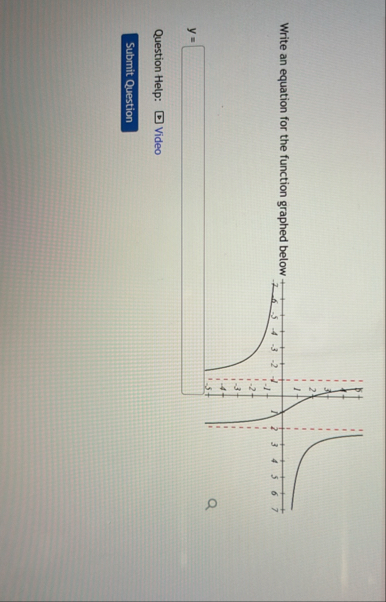 | i N Liss i —
Be
me :
Eo
F :
BE
FE
Ee =
L =r —
rE =
EE -
ili Eo
hii LL i 7
ei dl
This is AI generated Response.
Asked by: MD ISRARUL HAQUE
Created at: 2025-09-11 05:45:03
Asked by: MD ISRARUL HAQUE
Created at: 2025-09-11 05:45:03
Final Answer:
Rendered
Raw Text
Did you like this answer?
# Step-by-Step Solution
Let's use the key features from your description and the graph:
- **Vertical asymptotes:** \(x = -1\), \(x = 2\)
- **Horizontal asymptote:** \(y = 0\)
- **y-intercept:** \((0, 2)\)
- **x-intercept:** \((1, 0)\)
## 1. **Form of the Rational Function**
Since there are vertical asymptotes at \(x = -1\) and \(x = 2\), the denominator must be zero at those points:
\[
(x + 1)(x - 2)
\]
Let the function be:
\[
y = \frac{A(x - h)}{(x + 1)(x - 2)}
\]
where \(A\) and \(h\) are constants to be found.
## 2. **x-intercept at \(x=1\)**
Set \(y = 0\) and \(x=1\):
\[
0 = \frac{A(1 - h)}{(1 + 1)(1 - 2)}
\]
Numerator must be zero:
\[
1 - h = 0 \implies h = 1
\]
So now:
\[
y = \frac{A(x - 1)}{(x + 1)(x - 2)}
\]
## 3. **y-intercept at \(x=0\): \((0, 2)\)**
Plug \(x=0\), \(y=2\):
\[
2 = \frac{A(0 - 1)}{(0 + 1)(0 - 2)}
\]
\[
2 = \frac{-A}{1 \times -2} = \frac{-A}{-2} = \frac{A}{2}
\]
\[
A = 4
\]
## 4. **Final Equation**
Combine all found values:
\[
\boxed{y = \frac{4(x-1)}{(x+1)(x-2)}}
\]
## 5. **Check: Horizontal Asymptote \(y=0\)**
As \(x \to \infty\), numerator and denominator are both degree 1 and 2, so \(y \to 0\) as required.
---
## **Final Answer**
\[
\boxed{y = \frac{4(x-1)}{(x+1)(x-2)}}
\]
**Demonstrating two equal signs in one line:**
\[
y = \frac{4(x-1)}{(x+1)(x-2)} = \frac{4x-4}{x^2-x-2}
\]
📢 Instructions:
- Ask anything relatd to above question only.
- For new Question goto :