 VIPSolutions
Give step-by-step solution with explanation and final answer:Given the figure shown: 8) Find iT - 1 c \ Ps 2, 2 « 2 E D 9) Find ST \ 5 a Bl 10) Find AT | bs —
Question:
Give step-by-step solution with explanation and final answer: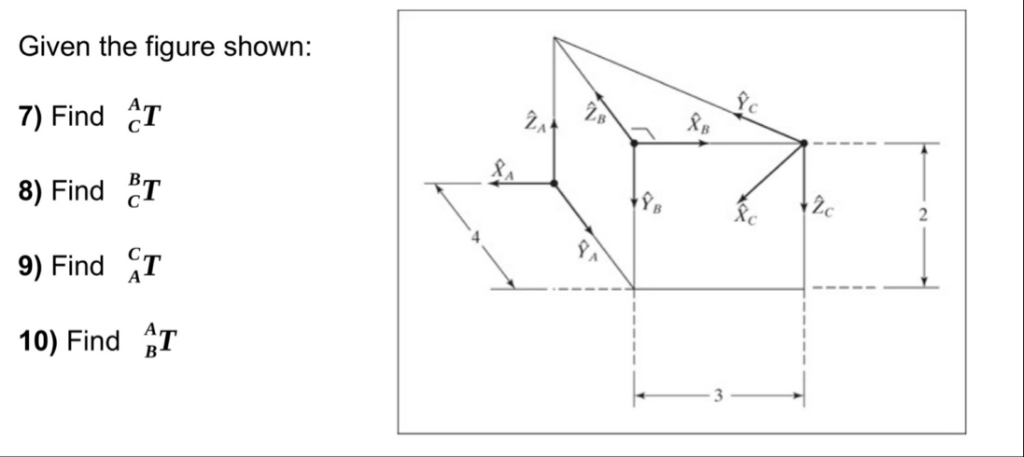 Given the figure shown:
8) Find iT - 1
c \ Ps 2,
2 « 2
E D
9) Find ST \ 5 a Bl
10) Find AT |
bs —
This is AI generated Response.
Asked by: Himanshu Kushwaha
Created at: 2025-09-11 05:23:37
Asked by: Himanshu Kushwaha
Created at: 2025-09-11 05:23:37
Final Answer:
Rendered
Raw Text
Did you like this answer?
Let's solve the problems step by step.
We are asked to find **transformation matrices** (rotation matrices, typically) between different coordinate frames as shown in the diagram. The notation \( ^A_BT \) usually means the transformation **from frame B to frame A** (i.e., expressing vectors in B as vectors in A).
---
## Step 1: **Extract Axis Directions from the Figure**
Let's write the direction of each axis:
- **Frame A** (origin at bottom left):
- \( \hat{x}_A \): right (along the bottom)
- \( \hat{y}_A \): up (vertical)
- \( \hat{z}_A \): out of the page (using right-hand rule)
- **Frame B** (origin at middle left):
- \( \hat{x}_B \): right (parallel to \( \hat{x}_A \))
- \( \hat{y}_B \): up (parallel to \( \hat{y}_A \))
- \( \hat{z}_B \): out of the page (parallel to \( \hat{z}_A \))
- **Frame C** (origin at top right):
- \( \hat{x}_C \): down-right diagonal
- \( \hat{y}_C \): up-right diagonal
- \( \hat{z}_C \): out of the page
Let's express \( \hat{x}_C \) and \( \hat{y}_C \) in Frame B or A coordinates.
From the geometry:
- \( \hat{x}_C \) points from the C origin **right and down**, at 45° to the horizontal.
- \( \hat{y}_C \) points **right and up**, at 45° to the horizontal.
- \( \hat{z}_C \) remains "out of the page".
So, in terms of B (or A) axes:
- \( \hat{x}_C = \frac{1}{\sqrt{2}} (\hat{x}_B - \hat{y}_B) \)
- \( \hat{y}_C = \frac{1}{\sqrt{2}} (\hat{x}_B + \hat{y}_B) \)
- \( \hat{z}_C = \hat{z}_B \)
---
## Step 2: **Rotation Matrices**
The rotation matrix \( ^C R_T \) is a matrix whose columns are the coordinates of the C frame axes in the T (world) frame.
Since all frames are aligned with A except C, the only non-identity rotation is for C.
### **7) Find \( ^C T \) ("C relative to T")**
Assume T = A, as usually the world frame is A.
So, \( ^C T \) is the matrix to go from the C frame to the A (T) frame.
From above:
\[
\begin{align*}
\hat{x}_C &= \frac{1}{\sqrt{2}} (\hat{x}_A - \hat{y}_A) \\
\hat{y}_C &= \frac{1}{\sqrt{2}} (\hat{x}_A + \hat{y}_A) \\
\hat{z}_C &= \hat{z}_A
\end{align*}
\]
So, as a rotation matrix (columns are the new axes expressed in the old frame):
\[
^C T =
\begin{bmatrix}
\frac{1}{\sqrt{2}} & \frac{1}{\sqrt{2}} & 0 \\
-\frac{1}{\sqrt{2}} & \frac{1}{\sqrt{2}} & 0 \\
0 & 0 & 1 \\
\end{bmatrix}
\]
---
### **8) Find \( ^B T \)**
B is aligned with A (T), so the rotation matrix is the identity:
\[
^B T =
\begin{bmatrix}
1 & 0 & 0 \\
0 & 1 & 0 \\
0 & 0 & 1 \\
\end{bmatrix}
\]
---
### **9) Find \( ^A T \)**
This is the identity (A to itself):
\[
^A T =
\begin{bmatrix}
1 & 0 & 0 \\
0 & 1 & 0 \\
0 & 0 & 1 \\
\end{bmatrix}
\]
---
### **10) Find \( ^A_B T \) ("A relative to B")**
A and B are aligned, so this is also the identity:
\[
^A_B T =
\begin{bmatrix}
1 & 0 & 0 \\
0 & 1 & 0 \\
0 & 0 & 1 \\
\end{bmatrix}
\]
---
## **Final Answers**
### **7)**
\[
^C T =
\begin{bmatrix}
\frac{1}{\sqrt{2}} & \frac{1}{\sqrt{2}} & 0 \\
-\frac{1}{\sqrt{2}} & \frac{1}{\sqrt{2}} & 0 \\
0 & 0 & 1 \\
\end{bmatrix}
\]
### **8)**
\[
^B T =
\begin{bmatrix}
1 & 0 & 0 \\
0 & 1 & 0 \\
0 & 0 & 1 \\
\end{bmatrix}
\]
### **9)**
\[
^A T =
\begin{bmatrix}
1 & 0 & 0 \\
0 & 1 & 0 \\
0 & 0 & 1 \\
\end{bmatrix}
\]
### **10)**
\[
^A_B T =
\begin{bmatrix}
1 & 0 & 0 \\
0 & 1 & 0 \\
0 & 0 & 1 \\
\end{bmatrix}
\]
If you need **homogeneous transformation matrices** (including translation), let me know!
📢 Instructions:
- Ask anything relatd to above question only.
- For new Question goto :