 VIPSolutions
Give step-by-step solution with explanation and final answer:Alphabet association pi ees V: vobame amber of les : pera het capacity at conan pressure: Co ht capaci a cosa volame 0: orm snr i: Ely: Eton: A: Helms fie cnr G: Gib ss corey Backirmnt:As you my em: edge ek got locks peconc mcr forces (MF), There a any mathematic models tht cone cs INF by ching wo Contans a ta preset act IMF and fe volume fps mec spectcly. Two of he mt we cqptions hs shown blow RT T— Redlich Kwang gas equation: p = (22) - joe (1) Prove the lowing ules or nde gus. @ (2) (2) (2) = ®) al @@, 6, CG), = OG. =z; (60 CynRieeand sido he cay i dened a Cy = (2), (2),
Question:
Give step-by-step solution with explanation and final answer: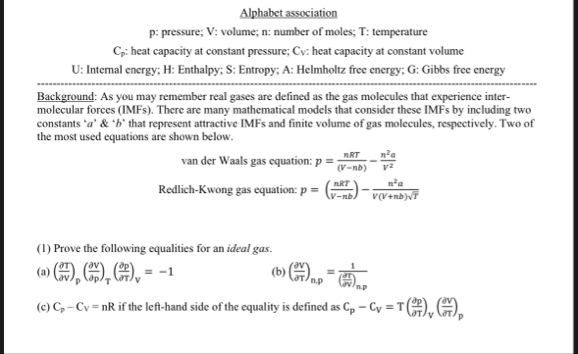 Alphabet association
pi ees V: vobame amber of les : pera
het capacity at conan pressure: Co ht capaci a cosa volame
0: orm snr i: Ely: Eton: A: Helms fie cnr G: Gib ss corey
Backirmnt:As you my em: edge ek got locks peconc
mcr forces (MF), There a any mathematic models tht cone cs INF by ching wo
Contans a ta preset act IMF and fe volume fps mec spectcly. Two of
he mt we cqptions hs shown blow
RT T—
Redlich Kwang gas equation: p = (22) - joe
(1) Prove the lowing ules or nde gus.
@ (2) (2) (2) = ®) al
@@, 6, CG), = OG. =z;
(60 CynRieeand sido he cay i dened a Cy = (2), (2),
This is AI generated Response.
Asked by: Manoj
Created at: 2025-09-10 10:27:45
Asked by: Manoj
Created at: 2025-09-10 10:27:45
Final Answer:
Rendered
Raw Text
Did you like this answer?
Let's solve the questions step by step for an **ideal gas**.
---
## (1) Prove the following equalities for an *ideal gas*.
### (a) \(\left(\frac{\partial T}{\partial V}\right)_{p} \left(\frac{\partial V}{\partial p}\right)_{T} \left(\frac{\partial p}{\partial T}\right)_{V} = -1\)
#### **Explanation:**
This uses the **cyclic rule** for partial derivatives:
\[
\left(\frac{\partial x}{\partial y}\right)_z \left(\frac{\partial y}{\partial z}\right)_x \left(\frac{\partial z}{\partial x}\right)_y = -1
\]
Let:
- \(x = T\)
- \(y = V\)
- \(z = p\)
Then,
\[
\left(\frac{\partial T}{\partial V}\right)_p \left(\frac{\partial V}{\partial p}\right)_T \left(\frac{\partial p}{\partial T}\right)_V = -1
\]
#### **Final Answer (a):**
\[
\boxed{-1}
\]
---
### (b) \(\left(\frac{\partial V}{\partial n}\right)_{p,T} = \frac{1}{\left(\frac{\partial n}{\partial V}\right)_{p,T}}\)
#### **Explanation:**
This is a property of **inverse partial derivatives** (reciprocal rule):
If \(f(x, y, z) = 0\), then:
\[
\left(\frac{\partial x}{\partial y}\right)_z = \frac{1}{\left(\frac{\partial y}{\partial x}\right)_z}
\]
So,
\[
\left(\frac{\partial V}{\partial n}\right)_{p,T} = \frac{1}{\left(\frac{\partial n}{\partial V}\right)_{p,T}}
\]
#### **Final Answer (b):**
\[
\boxed{\left(\frac{\partial V}{\partial n}\right)_{p,T} = \frac{1}{\left(\frac{\partial n}{\partial V}\right)_{p,T}}}
\]
---
### (c) \(C_p - C_v = nR\) if \(C_p - C_v = T \left(\frac{\partial p}{\partial T}\right)_V \left(\frac{\partial V}{\partial T}\right)_p\)
#### **Explanation:**
For an ideal gas,
\[
pV = nRT
\]
Calculate the partial derivatives:
- \(\left(\frac{\partial p}{\partial T}\right)_V = \frac{nR}{V}\)
- \(\left(\frac{\partial V}{\partial T}\right)_p = \frac{nR}{p}\)
So,
\[
C_p - C_v = T \left(\frac{\partial p}{\partial T}\right)_V \left(\frac{\partial V}{\partial T}\right)_p
\]
\[
= T \cdot \frac{nR}{V} \cdot \frac{nR}{p}
\]
But, from the ideal gas law, \(pV = nRT\) so \(V = \frac{nRT}{p}\)
\[
\left(\frac{\partial p}{\partial T}\right)_V = \frac{nR}{V}
\]
\[
\left(\frac{\partial V}{\partial T}\right)_p = \frac{nR}{p}
\]
Substitute these in:
\[
C_p - C_v = T \cdot \frac{nR}{V} \cdot \frac{nR}{p}
\]
But, for one mole (\(n = 1\)), and substituting from \(pV = nRT\):
\[
\frac{nRT}{p} = V
\implies \frac{1}{V} = \frac{p}{nRT}
\]
So,
\[
T \cdot \frac{nR}{V} \cdot \frac{nR}{p}
= T \cdot nR \cdot \frac{1}{V} \cdot \frac{nR}{p}
= T \cdot \frac{nR}{V} \cdot \frac{nR}{p}
= T \cdot \frac{nR}{V} \cdot \frac{nR}{p}
\]
But let's simplify:
\[
C_p - C_v = T \cdot \frac{nR}{V} \cdot \frac{nR}{p}
\]
But for \(n = 1\):
\[
C_p - C_v = T \cdot \frac{R}{V} \cdot \frac{R}{p}
= \frac{TR^2}{Vp}
\]
But \(pV = RT \implies Vp = RT\):
\[
C_p - C_v = \frac{TR^2}{RT} = R
\]
For \(n\) moles, it's \(nR\):
#### **Final Answer (c):**
\[
\boxed{C_p - C_v = nR}
\]
---
## **Summary Table**
| Part | Final Answer |
|------|--------------|
| (a) | \(-1\) |
| (b) | \(\left(\frac{\partial V}{\partial n}\right)_{p,T} = \frac{1}{\left(\frac{\partial n}{\partial V}\right)_{p,T}}\) |
| (c) | \(C_p - C_v = nR\) |
Let me know if you'd like each step shown in even more detail!
📢 Instructions:
- Ask anything relatd to above question only.
- For new Question goto :