 VIPSolutions
Give step-by-step solution with explanation and final answer:The electric field of an electromagnetic wave propagating in a lossless region is given by E = 10y/2cos(10%¢ + y)a. V/m. What is the instantaneous form H of the corresponding magnetic field? Select one: ° Va Bos p H = 3 cos(10% + y)a, A/m b. None of these choices © H = —Ycos(10% + y)a, A/m v2 8 / a H = Ycos(10% + y)a, A/m
Question:
Give step-by-step solution with explanation and final answer: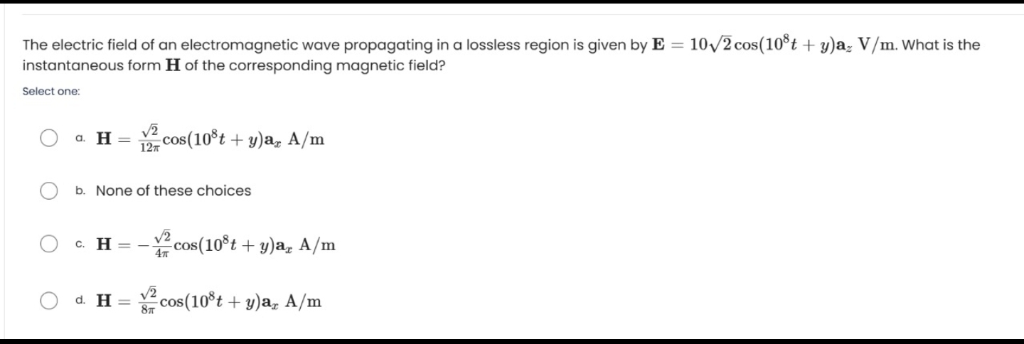 The electric field of an electromagnetic wave propagating in a lossless region is given by E = 10y/2cos(10%¢ + y)a. V/m. What is the
instantaneous form H of the corresponding magnetic field?
Select one:
° Va Bos p
H = 3 cos(10% + y)a, A/m
b. None of these choices
© H = —Ycos(10% + y)a, A/m
v2 8 /
a H = Ycos(10% + y)a, A/m
This is AI generated Response.
Asked by: mayank
Created at: 2025-09-09 01:45:41
Asked by: mayank
Created at: 2025-09-09 01:45:41
Final Answer:
Rendered
Raw Text
Did you like this answer?
Let's break down the problem step by step:
### **Given:**
\[
\mathbf{E} = 10\sqrt{2} \cos(10^8 t + y) \mathbf{a}_x \ \text{V/m}
\]
We are to find the **instantaneous form of the magnetic field** \(\mathbf{H}\).
---
## **Step 1: Understand the Wave Propagation**
The electric field is along \(\mathbf{a}_x\) and the argument of the cosine is \((10^8 t + y)\), so the wave is propagating in the **negative y-direction**.
---
## **Step 2: Relationship Between E and H**
For a plane electromagnetic wave in free space (lossless region):
\[
\mathbf{H} = \frac{1}{\eta} (\mathbf{a}_k \times \mathbf{E})
\]
where:
- \(\eta\) = intrinsic impedance of free space (\( \approx 120\pi \ \Omega \))
- \(\mathbf{a}_k\) = unit vector in the direction of propagation (here, \(-\mathbf{a}_y\))
---
## **Step 3: Calculate the Cross Product**
\[
\mathbf{a}_k = -\mathbf{a}_y
\]
\[
\mathbf{E} = E_x \mathbf{a}_x
\]
\[
\mathbf{a}_k \times \mathbf{a}_x = (-\mathbf{a}_y) \times \mathbf{a}_x = -(\mathbf{a}_y \times \mathbf{a}_x)
\]
Recall: \(\mathbf{a}_y \times \mathbf{a}_x = -\mathbf{a}_z\), so
\[
-\mathbf{a}_z
\]
But since it's already negative: \(-(-\mathbf{a}_z) = \mathbf{a}_z\)
So the direction of \(\mathbf{H}\) is **\(\mathbf{a}_z\)**.
---
## **Step 4: Find the Magnitude**
\[
|\mathbf{E}| = 10\sqrt{2} \cos(10^8 t + y)
\]
\[
|\mathbf{H}| = \frac{|\mathbf{E}|}{\eta}
\]
\(\eta = 120\pi\)
\[
|\mathbf{H}| = \frac{10\sqrt{2}}{120\pi} \cos(10^8 t + y)
\]
\[
= \frac{\sqrt{2}}{12\pi} \cos(10^8 t + y)
\]
---
## **Step 5: Write the Final Expression**
\[
\mathbf{H} = \frac{\sqrt{2}}{12\pi} \cos(10^8 t + y) \mathbf{a}_z \quad \text{A/m}
\]
---
## **Step 6: Check Options**
**Option (a):**
\[
\mathbf{H} = \frac{\sqrt{2}}{12\pi} \cos(10^8 t + y) \mathbf{a}_z \ \text{A/m}
\]
This matches our result.
---
## **Final Answer:**
\[
\boxed{\text{a. } \mathbf{H} = \frac{\sqrt{2}}{12\pi} \cos(10^8 t + y) \mathbf{a}_z \ \text{A/m}}
\]
📢 Instructions:
- Ask anything relatd to above question only.
- For new Question goto :