 VIPSolutions
Give step-by-step solution with explanation and final answer: choose the correct options give reason for both correct options and why other optionns are incorrect
Question:
Give step-by-step solution with explanation and final answer:
choose the correct options give reason for both correct options and why other optionns are incorrect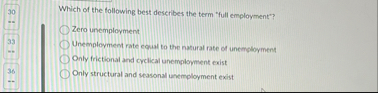
This is AI generated Response.
Asked by: mayank
Created at: 2025-09-08 05:31:38
Asked by: mayank
Created at: 2025-09-08 05:31:38
Final Answer:
Rendered
Raw Text
Did you like this answer?
Let's analyze each option step-by-step:
**Question:**
Which of the following best describes the term "full employment"?
**Options:**
1. Zero unemployment
2. Unemployment rate equal to the natural rate of unemployment
3. Only frictional and cyclical unemployment exist
4. Only structural and seasonal unemployment exist
---
### **Step-by-Step Explanation**
#### **Option 1: Zero unemployment**
- **Reasoning:**
Full employment does **not** mean zero unemployment. There will always be some unemployment due to people changing jobs (frictional) and due to structural changes in the economy (structural). Zero unemployment is unrealistic in a dynamic economy.
- **Conclusion:**
**Incorrect.**
---
#### **Option 2: Unemployment rate equal to the natural rate of unemployment**
- **Reasoning:**
The **natural rate of unemployment** includes only frictional and structural unemployment (not cyclical). At full employment, cyclical unemployment is zero, but frictional and structural persist.
- **Conclusion:**
**Correct!**
This option best describes "full employment" in economic terms.
---
#### **Option 3: Only frictional and cyclical unemployment exist**
- **Reasoning:**
At full employment, **cyclical unemployment is zero** (it is present during recessions). Only frictional and structural unemployment exist, not cyclical.
- **Conclusion:**
**Incorrect.**
---
#### **Option 4: Only structural and seasonal unemployment exist**
- **Reasoning:**
While structural unemployment is part of the natural rate, **seasonal unemployment** is not always included in the definition of the natural rate, and frictional unemployment is missing from this option.
- **Conclusion:**
**Incorrect.**
---
### **Final Answer:**
**Correct Option:**
**2. Unemployment rate equal to the natural rate of unemployment**
**Reason for correct option:**
- Full employment occurs when the unemployment rate is equal to the natural rate, meaning only frictional and structural unemployment exist (no cyclical unemployment).
**Why other options are incorrect:**
- Option 1: Zero unemployment is unrealistic and not the definition.
- Option 3: Cyclical unemployment does not exist at full employment.
- Option 4: Seasonal unemployment is not part of the natural rate, and frictional unemployment is missing.
📢 Instructions:
- Ask anything relatd to above question only.
- For new Question goto :