VIPSolutions logo ✨ VIPSolutions

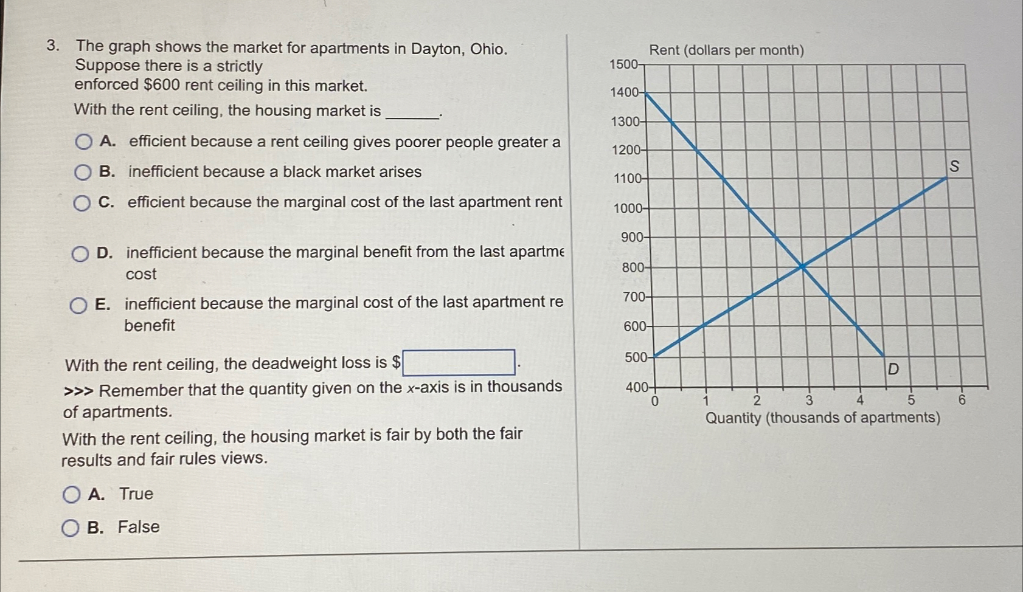
Give step-by-step solution with explanation and final answer:3. Spiess 03 Sachs for apartments in Dayton, Ohio. Fo CTT TLE enforce rent ceiling in this market. With the rent ceiling, the housing market is 3 | i IN| —— 0 OA efficient because a rent ceiling gives poorer people greater | 4300 | N\| || | || S| SS} OB. inefficient because a black market arses EMEENEEE CET © C. efficient because the marginal cost of the last apartment rent | 1000 EEENEEE LDC ; | eo EE INS SS © D. inefficient because the marginal benefit from the last apartme HEEEENTa cost 500 vg OE. inefficient because the marginal cost of the last apartment re 700 NH er MEE AREENEEREE With the rent ceiling, the deadweight losis S| |. | 500 EdEBEEEERNG >>> Remember that the quantity given on the x-axis is in thousands 400 BEEEEREE DL of apartments. 0 if 2 3 4 5 6 With the rent ceiling, the housing market is fair by both the fair Quanity (houeands ot cre] results and fair rules views. O A. True OB. False

Question:

Give step-by-step solution with explanation and final answer:Uploaded Image3. Spiess 03 Sachs for apartments in Dayton, Ohio. Fo CTT TLE enforce rent ceiling in this market. With the rent ceiling, the housing market is 3 | i IN| —— 0 OA efficient because a rent ceiling gives poorer people greater | 4300 | N\| || | || S| SS} OB. inefficient because a black market arses EMEENEEE CET © C. efficient because the marginal cost of the last apartment rent | 1000 EEENEEE LDC ; | eo EE INS SS © D. inefficient because the marginal benefit from the last apartme HEEEENTa cost 500 vg OE. inefficient because the marginal cost of the last apartment re 700 NH er MEE AREENEEREE With the rent ceiling, the deadweight losis S| |. | 500 EdEBEEEERNG >>> Remember that the quantity given on the x-axis is in thousands 400 BEEEEREE DL of apartments. 0 if 2 3 4 5 6 With the rent ceiling, the housing market is fair by both the fair Quanity (houeands ot cre] results and fair rules views. O A. True OB. False
This is AI generated Response.
Asked by: mayank
Created at: 2025-09-07 16:57:41

Final Answer:

Rendered Raw Text
Did you like this answer?
Let's break down the question step by step: ### 1. **Efficiency of the Housing Market with Rent Ceiling** A rent ceiling (price ceiling) set below the equilibrium price causes a shortage and leads to inefficiency because: - The quantity supplied is less than the equilibrium quantity. - Not all renters who value the apartment most highly get one. - Deadweight loss occurs. Let's analyze the options: - **A. Efficient because a rent ceiling gives poorer people greater access.** - Not necessarily true; it creates shortages and misallocation. - **B. Inefficient because a black market arises.** - This is often true, but the main reason for inefficiency is not just the black market. - **C. Efficient because the marginal cost of the last apartment rented equals the marginal benefit.** - Not true, because the rent ceiling prevents the market from reaching equilibrium. - **D. Inefficient because the marginal benefit from the last apartment rented exceeds its marginal cost.** - This is correct. With the rent ceiling, quantity supplied is less than equilibrium, so the marginal benefit (demand curve) at the last apartment rented (at the ceiling) is higher than the marginal cost (supply curve). - **E. Inefficient because the marginal cost of the last apartment rented exceeds its marginal benefit.** - This is not true for a price ceiling (more true for a price floor). **Correct Answer:** **D. Inefficient because the marginal benefit from the last apartment rented exceeds its marginal cost.** --- ### 2. **Deadweight Loss Calculation** Deadweight loss (DWL) is the area of the triangle between the demand and supply curves, from the quantity supplied at the rent ceiling to the equilibrium quantity. - **Equilibrium:** - Equilibrium is where D and S intersect: at $900 and 3,000 apartments. - **With rent ceiling ($600):** - At $600, supply = 2,000 apartments, demand = 4,000 apartments. - So, quantity supplied = 2,000 apartments. **DWL Area:** - Base: Difference in quantity = 3,000 - 2,000 = 1,000 apartments (or 1 on the x-axis, since units are in thousands). - Height: Difference in price (vertical distance between D and S at Q = 2,000) - At Q = 2 (2,000 apartments): - Demand price: from demand curve, at Q=2, P=1,200. - Supply price: from supply curve, at Q=2, P=600. - Height = 1,200 - 600 = $600. - **Area of triangle:** \[\text{DWL} = \frac{1}{2} \times \text{base} \times \text{height}\] \[= \frac{1}{2} \times 1,000 \times 600\] \[= 500 \times 600 = 300,000\] **Final DWL:** **$300,000** --- ### 3. **Fairness** With the rent ceiling: - The market is not fair by the fair results view (not everyone who needs an apartment gets one). - The market is not fair by the fair rules view (not voluntary exchange; some willing renters/suppliers are excluded). **Correct answer:** **B. False** --- ## **Summary of Answers:** 1. **With the rent ceiling, the housing market is:** **D. inefficient because the marginal benefit from the last apartment rented exceeds its marginal cost.** 2. **Deadweight loss is:** **$300,000** 3. **With the rent ceiling, the housing market is fair by both views:** **B. False**

📢 Instructions:

  • Ask anything relatd to above question only.
  • For new Question goto :

Study Help, Fast Answers

VIPSolutions focuses on clear, step‑by‑step explanations so you can learn quickly. Whether you need an AI‑generated walkthrough or a short hint to get unstuck, each solution is organized for fast reading and easy review later.

Search similar questions, compare approaches, and bookmark the best answers for revision. Our goal is simple: quick, reliable study help that feels natural—not noisy.