 VIPSolutions
Give step-by-step solution with explanation and final answer:[ Required Information Two transmission belts pass over sheaves welded to an axle supported by bearings at 8and D. The sheave at A has a radius of 2.5 In., and the sheave at C has a radius of 2 in. Know that the system rotates at a constant rate. Assume that the bearing at D does not exert any axial thrust and neglect the weights of the sheaves and axle. Consider the value of P = 35.50 Ib A y in, 6in. 241b B . c| “ein. 181 z D x T P Determine the reactions at Band D. (Include a minus sign If necessary) The reaction at 81s (Jib) +([__]Ibk. The reaction at Dis (|b) +([___]ibk.
Question:
Give step-by-step solution with explanation and final answer: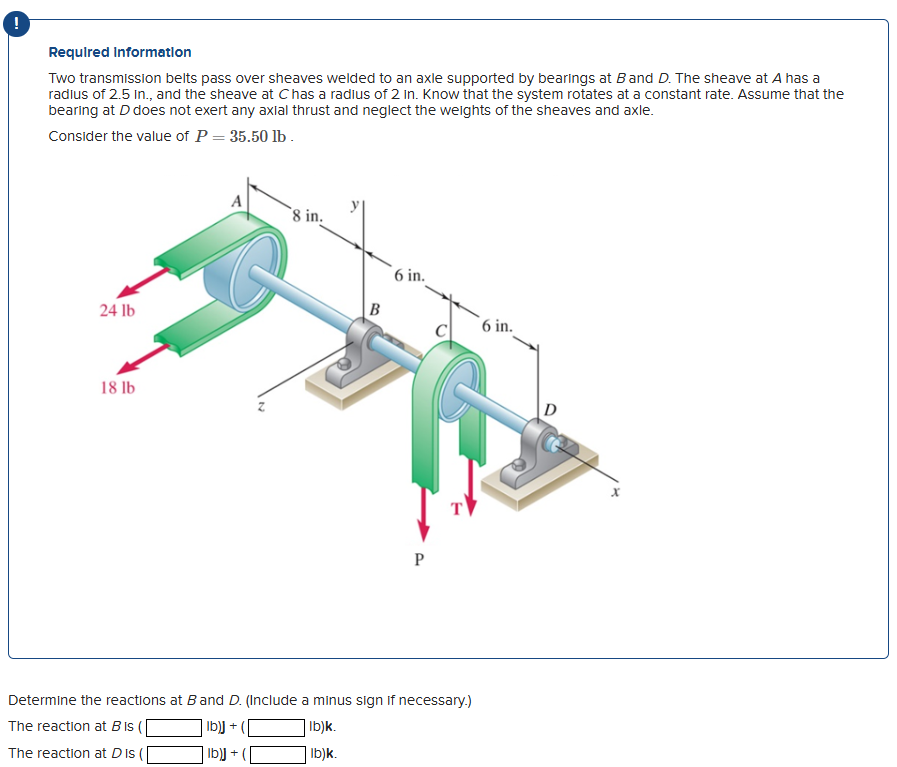 [
Required Information
Two transmission belts pass over sheaves welded to an axle supported by bearings at 8and D. The sheave at A has a
radius of 2.5 In., and the sheave at C has a radius of 2 in. Know that the system rotates at a constant rate. Assume that the
bearing at D does not exert any axial thrust and neglect the weights of the sheaves and axle.
Consider the value of P = 35.50 Ib
A y
in,
6in.
241b B .
c| “ein.
181
z D
x
T
P
Determine the reactions at Band D. (Include a minus sign If necessary)
The reaction at 81s (Jib) +([__]Ibk.
The reaction at Dis (|b) +([___]ibk.
This is AI generated Response.
Asked by: manish kumar
Created at: 2025-09-07 13:27:42
Asked by: manish kumar
Created at: 2025-09-07 13:27:42
Final Answer:
Rendered
Raw Text
Did you like this answer?
Let's break down the solution step by step:
### Step 1: **Identify All Forces Acting on the Shaft**
#### At A (Sheave)
- 24 lb (in the negative z-direction)
- 18 lb (in the positive y-direction)
#### At C (Sheave)
- \(P = 35.5 \) lb (in the negative y-direction)
- \(T\) (in the negative z-direction)
\(T = \frac{2.5 \text{ in.}}{2 \text{ in.}} \times 24 \text{ lb} = 30 \text{ lb}\) (Since tension is proportional to the radius, and the belt at A is 24 lb, the tension at C is calculated as above.)
#### Bearings:
- At B and D: Reactions in y and z directions: \(B_y, B_z, D_y, D_z\).
### Step 2: **Write Equilibrium Equations**
#### (1) \(\sum F_y = 0\)
\[
B_y + D_y + 18\,(-y \text{ at A}) - 35.5\,(-y \text{ at C}) = 0
\]
\[
B_y + D_y + 18 - 35.5 = 0
\]
\[
B_y + D_y = 17.5
\]
#### (2) \(\sum F_z = 0\)
\[
B_z + D_z - 24\,(-z \text{ at A}) - 30\,(-z \text{ at C}) = 0
\]
\[
B_z + D_z - 24 - 30 = 0
\]
\[
B_z + D_z = 54
\]
---
### Step 3: **Moment Equilibrium About D (\(\sum M_D = 0\))**
Take moments about point D (using right-hand rule, positive y is up, z is out of page):
#### For Each Force:
- **At A (12 in from D):**
- 24 lb in -z: \(12\,\text{in} \times 24\,\text{lb} = 288\,\text{in}\cdot\text{lb}\) (about y)
- 18 lb in +y: \(12\,\text{in} \times 18\,\text{lb} = 216\,\text{in}\cdot\text{lb}\) (about z)
- **At C (6 in from D):**
- 35.5 lb in -y: \(6\,\text{in} \times 35.5\,\text{lb} = 213\,\text{in}\cdot\text{lb}\) (about z)
- 30 lb in -z: \(6\,\text{in} \times 30\,\text{lb} = 180\,\text{in}\cdot\text{lb}\) (about y)
- **At B (6 in from D):**
- \(B_y, B_z\) at 6 in from D
#### Write Moment Equations (using the cross product):
\[
\sum M_D = 0 = r \times F
\]
For each force, \(r\) is the position vector from D to the point of application.
\[
\begin{align*}
\text{At A:} & \quad r_A = -12\,\hat{i} \\
& \quad F_{A,y} = 18\,\hat{j} \implies M_{A,18} = (-12\,\hat{i}) \times (18\,\hat{j}) = -216\,\hat{k} \\
& \quad F_{A,z} = -24\,\hat{k} \implies M_{A,24} = (-12\,\hat{i}) \times (-24\,\hat{k}) = -288\,\hat{j} \\
\text{At C:} & \quad r_C = -6\,\hat{i} \\
& \quad F_{C,y} = -35.5\,\hat{j} \implies M_{C,35.5} = (-6\,\hat{i}) \times (-35.5\,\hat{j}) = -213\,\hat{k} \\
& \quad F_{C,z} = -30\,\hat{k} \implies M_{C,30} = (-6\,\hat{i}) \times (-30\,\hat{k}) = -180\,\hat{j} \\
\text{At B:} & \quad r_B = -6\,\hat{i} \\
& \quad B_y\,\hat{j} \implies M_{B_y} = (-6\,\hat{i}) \times (B_y\,\hat{j}) = -6B_y\,\hat{k} \\
& \quad B_z\,\hat{k} \implies M_{B_z} = (-6\,\hat{i}) \times (B_z\,\hat{k}) = 6B_z\,\hat{j} \\
\end{align*}
\]
Sum up moments about D:
- **j components:**
\[
-288 - 180 + 6B_z = 0 \implies 6B_z = 468 \implies B_z = 78
\]
- **k components:**
\[
-216 - 213 - 6B_y = 0 \implies -6B_y = 429 \implies B_y = -71.5
\]
---
### Step 4: **Solve for D_y and D_z Using the Force Equations**
Recall:
\[
B_y + D_y = 17.5 \implies D_y = 17.5 - B_y = 17.5 - (-71.5) = 89
\]
\[
B_z + D_z = 54 \implies D_z = 54 - B_z = 54 - 78 = -24
\]
---
### **Final Answers**
\[
\boxed{
\begin{align*}
\text{The reaction at } B &: (-71.5\,\hat{j} + 78\,\hat{k}) \text{ lb} \\
\text{The reaction at } D &: (89\,\hat{j} + (-24)\,\hat{k}) \text{ lb}
\end{align*}
}
\]
**Plug these into the answer boxes:**
- The reaction at \( B \) is ( -71.5 ) lb j + ( 78 ) lb k.
- The reaction at \( D \) is ( 89 ) lb j + ( -24 ) lb k.
---
If you need further clarification or a free body diagram, let me know!
📢 Instructions:
- Ask anything relatd to above question only.
- For new Question goto :