 VIPSolutions
Give step-by-step solution with explanation and final answer:(15 points) This problem corresponds to Problem 2.27 in the text. [o9) a) The value or [ 5(t)[3e* + 6sin(2710%¢)]dt is -1 [o9) b) The value or [ 8(t + 3)e Htu(t)dt is —00 [o¢) c) The value o | 5(t — 2)e 2 [u(t) — u(t + 9)dt is 0
Question:
Give step-by-step solution with explanation and final answer: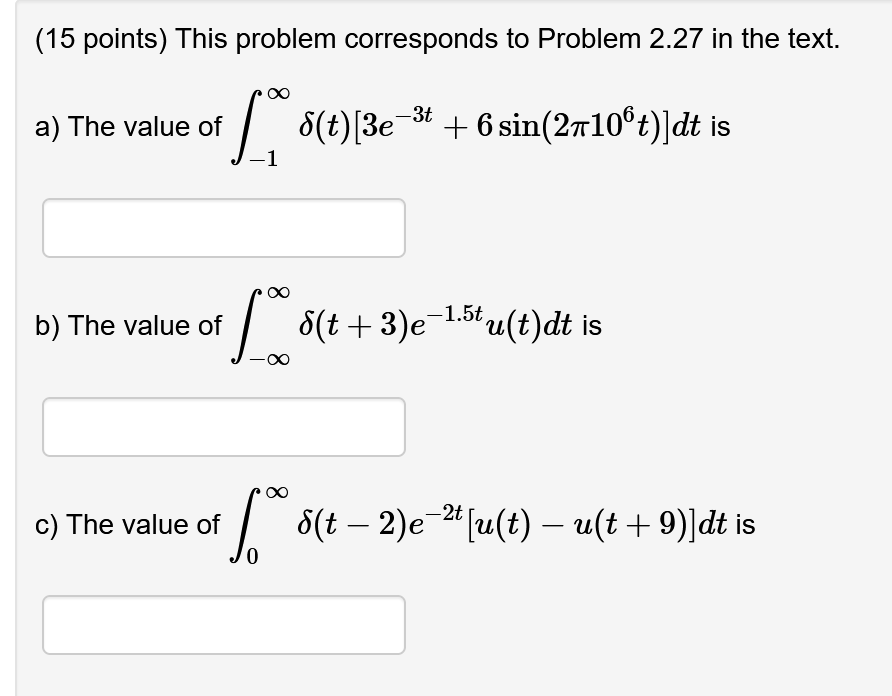 (15 points) This problem corresponds to Problem 2.27 in the text.
[o9)
a) The value or [ 5(t)[3e* + 6sin(2710%¢)]dt is
-1
[o9)
b) The value or [ 8(t + 3)e Htu(t)dt is
—00
[o¢)
c) The value o | 5(t — 2)e 2 [u(t) — u(t + 9)dt is
0
This is AI generated Response.
Asked by: M Raju
Created at: 2025-09-06 08:12:45
Asked by: M Raju
Created at: 2025-09-06 08:12:45
Final Answer:
Rendered
Raw Text
Did you like this answer?
Let's solve each part step by step using the properties of the **Dirac delta function** (\(\delta(t)\)):
### **Delta Function Property**
\[
\int_{-\infty}^{\infty} \delta(t-a) f(t)\,dt = f(a)
\]
If the limits include \(t=a\), the delta "picks out" \(f(a)\).
---
### **(a) \(\int_{-1}^{\infty} \delta(t) [3e^{-3t} + 6\sin(2\pi 10^6 t)]dt\)**
**Step 1:** Identify the location of the delta: \(\delta(t)\) is nonzero only at \(t=0\).
**Step 2:** Is \(t=0\) within integration limits? Yes, since \(-1 < 0 < \infty\).
**Step 3:** Apply the property:
\[
\int_{-1}^{\infty} \delta(t) f(t) dt = f(0)
\]
where \(f(t) = 3e^{-3t} + 6\sin(2\pi 10^6 t)\).
**Step 4:** Compute \(f(0)\):
\[
f(0) = 3e^{-3 \cdot 0} + 6\sin(2\pi 10^6 \cdot 0) = 3 \cdot 1 + 6 \cdot 0 = 3
\]
**Final Answer (a):**
\[
\boxed{3}
\]
---
### **(b) \(\int_{-\infty}^{\infty} \delta(t + 3) e^{-1.5t} u(t) dt\)**
**Step 1:** Delta is nonzero at \(t=-3\).
**Step 2:** Plug \(t=-3\) into \(e^{-1.5t} u(t)\):
- \(u(-3) = 0\) (since the unit step \(u(t)\) is 0 for \(t<0\)).
\[
e^{-1.5 \cdot (-3)} u(-3) = e^{4.5} \cdot 0 = 0
\]
**Final Answer (b):**
\[
\boxed{0}
\]
---
### **(c) \(\int_{0}^{\infty} \delta(t-2) e^{-2t} [u(t) - u(t+9)]dt\)**
**Step 1:** Delta is nonzero at \(t=2\).
**Step 2:** Is \(t=2\) within integration limits? Yes (\(0 < 2 < \infty\)).
**Step 3:** Plug \(t=2\) into the rest:
- \(u(2) = 1\)
- \(u(2+9) = u(11) = 1\)
So, \([u(2) - u(11)] = 1 - 1 = 0\)
\[
e^{-2 \cdot 2} \times 0 = e^{-4} \times 0 = 0
\]
**Final Answer (c):**
\[
\boxed{0}
\]
---
### **Summary of Answers**
a) \(\boxed{3}\)
b) \(\boxed{0}\)
c) \(\boxed{0}\)
If you need further explanation about any step, let me know!
Question:
Give ME Each Problem in 50 Words Explaines only Theory
This is AI generated Response.
Asked by: M Raju
Created at: 2025-09-06 08:13:43
Asked by: M Raju
Created at: 2025-09-06 08:13:43
Final Answer:
Rendered
Raw Text
Did you like this answer?
Certainly! Here are the concise theoretical explanations for each problem in about 50 words:
**(a)**
The integral involves a delta function \(\delta(t)\), which "picks out" the value of the integrand at \(t=0\). Since the integration limits include zero, the integral equals the value of the remaining function evaluated at zero.
**(b)**
The delta function \(\delta(t+3)\) activates at \(t=-3\). But the integral limits are from \(-\infty\) to \(\infty\), so the delta "samples" the integrand at \(-3\). Since the step function \(u(t)\) is zero at \(-3\), the integral evaluates to zero.
**(c)**
The delta function \(\delta(t-2)\) is centered at \(t=2\), within the limits. The integrand includes step functions which evaluate to 1 or 0 at \(t=2\). Since \(u(2)=1\) and \(u(11)=1\), their difference is zero, resulting in the integral being zero.
📢 Instructions:
- Ask anything relatd to above question only.
- For new Question goto :