Give step-by-step solution with explanation and final answer:
Please do not include two equal sign in the same line. Please be humanizer as much as possible.
Question and solution are attached with the image and i need details solution.1-37. When the force P is applied to the plate, the velocity 24mm p
profile for a Newtonian fluid that is confined under the plate
is approximated by « = (12y") mm/s, where y is in mm.
Determine the Miiflimum shear stress within the fluid. Take
= 05(107) N-s/m?.
SOLUTION
Since the velocity distribution is not linear, the velocity gradient varies with y.
u=129"*
du
du _ 3am
a=
The velocity gradient is smallest when y = 16 mm. Thus,
on =p = [05(107) N+ s/m?][3(16 mm) 57"
wn = wg = [05(107) N-s/m?] [306 mm) 571]
Tin = 0.1875 mPa Ans.
du .
Note: When y = 0, 5 =, so, that 7 — =. Hence the equation can not be used at
this point. ~~ 4
Question:
Give step-by-step solution with explanation and final answer:
Please do not include two equal sign in the same line. Please be humanizer as much as possible.
Question and solution are attached with the image and i need details solution.1-37. When the force P is applied to the plate, the velocity 24mm p
profile for a Newtonian fluid that is confined under the plate
is approximated by « = (12y") mm/s, where y is in mm.
Determine the Miiflimum shear stress within the fluid. Take
= 05(107) N-s/m?.
SOLUTION
Since the velocity distribution is not linear, the velocity gradient varies with y.
u=129"*
du
du _ 3am
a=
The velocity gradient is smallest when y = 16 mm. Thus,
on =p = [05(107) N+ s/m?][3(16 mm) 57"
wn = wg = [05(107) N-s/m?] [306 mm) 571]
Tin = 0.1875 mPa Ans.
du .
Note: When y = 0, 5 =, so, that 7 — =. Hence the equation can not be used at
this point. ~~ 4
This is AI generated Response.
Asked by: Md Israrul Haque
Created at: 2025-09-06 06:49:16
Final Answer:
RenderedRaw Text
Did you like this answer?
Let’s break down the problem step by step, explaining each part so it’s clear and thorough.
---
### **Step 1: Understanding the Problem**
We are given:
- The velocity profile for a Newtonian fluid under a plate is:
\( u = (12y^{1/4}) \) mm/s, where \( y \) is in mm.
- The fluid's viscosity, \( \mu = 0.5 \times 10^{-3} \) N·s/m².
- We are asked to **determine the minimum shear stress** within the fluid.
---
### **Step 2: Shear Stress Formula**
For a Newtonian fluid, **shear stress** is:
\[
\tau = \mu \frac{du}{dy}
\]
---
### **Step 3: Find the Velocity Gradient**
Given \( u = 12y^{1/4} \) mm/s,
Let’s find \(\frac{du}{dy}\):
First, recall the power rule:
\[
\frac{d}{dy}(y^n) = n y^{n-1}
\]
Apply this to our velocity profile:
\[
\frac{du}{dy} = 12 \cdot \frac{d}{dy}\left(y^{1/4}\right)
\]
\[
\frac{du}{dy} = 12 \cdot \left( \frac{1}{4} y^{-3/4} \right)
\]
\[
\frac{du}{dy} = 3 y^{-3/4}
\]
---
### **Step 4: Where is Shear Stress Minimum?**
The shear stress is minimum where the velocity gradient is minimum.
Since \(\frac{du}{dy} = 3y^{-3/4}\),
This expression **decreases** as \(y\) increases.
Given the plate's height is 16 mm,
the minimum gradient is at \(y = 16\) mm.
---
### **Step 5: Plug Values into Shear Stress Formula**
Let’s substitute:
- \(\mu = 0.5 \times 10^{-3}\) N·s/m²
- \(\frac{du}{dy} = 3(16)^{-3/4}\) (make sure units are consistent)
\[
\tau_{min} = \mu \frac{du}{dy}
\]
\[
\tau_{min} = \left[0.5 \times 10^{-3} \text{ N·s/m}^2\right] \times \left[3 \times (16 \text{ mm})^{-3/4}\right]
\]
Evaluate \((16)^{-3/4}\):
- \(16^{1/4} = 2\), so \(16^{-3/4} = (16^{1/4})^{-3} = 2^{-3} = 1/8\)
Now calculate:
\[
\tau_{min} = 0.5 \times 10^{-3} \times 3 \times \frac{1}{8}
\]
\[
\tau_{min} = 0.5 \times 10^{-3} \times 0.375
\]
\[
\tau_{min} = 0.1875 \times 10^{-3} \text{ N/m}^2
\]
\[
\tau_{min} = 0.1875 \text{ mPa}
\]
---
### **Step 6: Final Answer**
The **minimum shear stress** within the fluid is:
\[
\boxed{0.1875 \ \text{mPa}}
\]
---
#### **Extra Note**
At \(y = 0\), the velocity gradient becomes infinite, so the formula isn’t valid at the wall.
---
Let me know if you have any questions or need more explanation!
VIPSolutions focuses on clear, step‑by‑step explanations so you can learn quickly. Whether you need an AI‑generated walkthrough or a short hint to get unstuck, each solution is organized for fast reading and easy review later.
Search similar questions, compare approaches, and bookmark the best answers for revision. Our goal is simple: quick, reliable study help that feels natural—not noisy.
 VIPSolutions
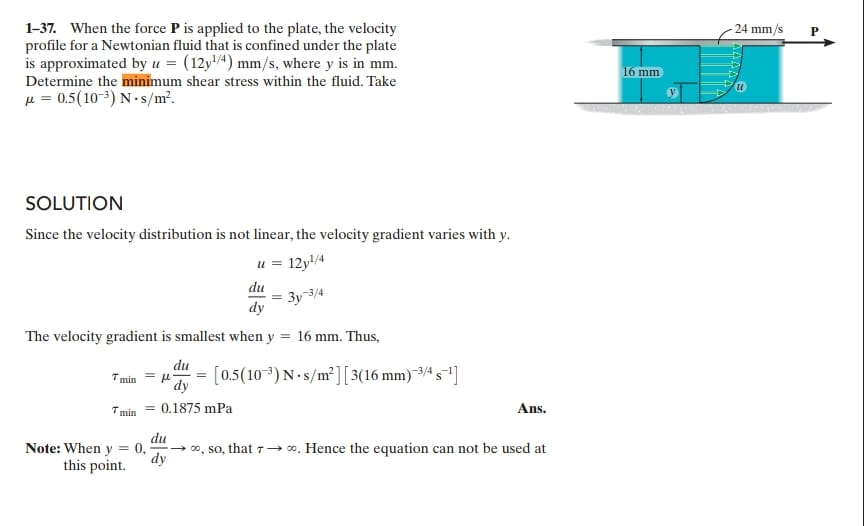 1-37. When the force P is applied to the plate, the velocity 24mm p
profile for a Newtonian fluid that is confined under the plate
is approximated by « = (12y") mm/s, where y is in mm.
Determine the Miiflimum shear stress within the fluid. Take
= 05(107) N-s/m?.
SOLUTION
Since the velocity distribution is not linear, the velocity gradient varies with y.
u=129"*
du
du _ 3am
a=
The velocity gradient is smallest when y = 16 mm. Thus,
on =p = [05(107) N+ s/m?][3(16 mm) 57"
wn = wg = [05(107) N-s/m?] [306 mm) 571]
Tin = 0.1875 mPa Ans.
du .
Note: When y = 0, 5 =, so, that 7 — =. Hence the equation can not be used at
this point. ~~ 4