 VIPSolutions
Give step-by-step solution with explanation and final answer:Consider the periodic sequence x(n) shown below. Determine the Fourier coefficients X(K). Consider the periodic sequence x(n) shown below. Determine the Fourier coefficients X(K).
Question:
Give step-by-step solution with explanation and final answer: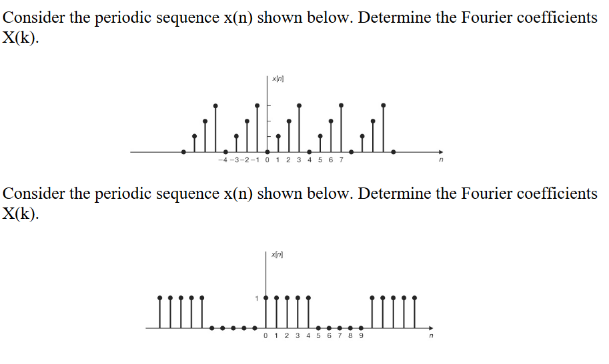 Consider the periodic sequence x(n) shown below. Determine the Fourier coefficients
X(K).
Consider the periodic sequence x(n) shown below. Determine the Fourier coefficients
X(K).
This is AI generated Response.
Asked by: M Raju
Created at: 2025-09-05 19:59:18
Asked by: M Raju
Created at: 2025-09-05 19:59:18
Final Answer:
Rendered
Raw Text
Did you like this answer?
Let's solve both problems **step-by-step**.
---
## **First Sequence**
Let's analyze the **first sequence**:
### **Step 1: Identify the Sequence and its Period**
From the plot:
- The sequence is periodic.
- The period \( N \) appears to be **8** (since the sequence repeats every 8 samples).
Let's denote the fundamental period as \( N = 8 \).
Let the sequence values (from \( n = 0 \) to \( n = 7 \)) be:
Suppose the values are:
\[
x(0), x(1), x(2), x(3), x(4), x(5), x(6), x(7)
\]
#### (You would need to read the actual values from the plot for an exact solution. Let's denote them as \( x(n) \).)
---
### **Step 2: Compute Fourier Coefficients**
The **Discrete Fourier Series (DFS)** coefficients for a periodic sequence of period \( N \) are given by:
\[
X(k) = \sum_{n=0}^{N-1} x(n) e^{-j\frac{2\pi}{N}kn}, \quad k = 0, 1, \ldots, N-1
\]
---
### **Step 3: Plug in the Values**
If you know the values \( x(0), x(1), \ldots, x(7) \):
\[
X(k) = x(0) + x(1)e^{-j\frac{2\pi}{8}k} + x(2)e^{-j\frac{2\pi}{8}2k} + \ldots + x(7)e^{-j\frac{2\pi}{8}7k}
\]
for \( k = 0, 1, \ldots, 7 \).
---
### **Step 4: Final Answer (for general \( x(n) \))**
\[
\boxed{
X(k) = \sum_{n=0}^{7} x(n) e^{-j\frac{2\pi}{8}kn}, \quad k = 0, 1, \ldots, 7
}
\]
---
## **Second Sequence**
Now, let's analyze the **second sequence**.
### **Step 1: Identify the Sequence and its Period**
From the plot:
- The sequence is also periodic.
- The period \( N \) is **10** (sequence repeats every 10 samples).
From the plot, you can see the sequence:
\[
x(n) =
\begin{cases}
1 & n = 0, 1, 2, 3, 4 \\
0 & n = 5, 6, 7, 8, 9 \\
\end{cases}
\]
and it repeats every 10 samples.
---
### **Step 2: Write Down the Values**
For \( n = 0, 1, 2, 3, 4 \), \( x(n) = 1 \); for \( n = 5, 6, 7, 8, 9 \), \( x(n) = 0 \).
---
### **Step 3: Compute Fourier Coefficients**
For period \( N = 10 \):
\[
X(k) = \sum_{n=0}^{9} x(n) e^{-j\frac{2\pi}{10}kn}, \quad k = 0, 1, \ldots, 9
\]
But since \( x(n) = 1 \) for \( n = 0,1,2,3,4 \) and \( x(n) = 0 \) otherwise:
\[
X(k) = \sum_{n=0}^{4} 1 \cdot e^{-j\frac{2\pi}{10}kn}
\]
\[
X(k) = \sum_{n=0}^{4} e^{-j\frac{2\pi}{10}kn}
\]
---
### **Step 4: Sum the Geometric Series**
This is a geometric series:
\[
X(k) = \frac{1 - e^{-j2\pi k \cdot 5/10}}{1 - e^{-j2\pi k / 10}}
\]
\[
X(k) = \frac{1 - e^{-j\pi k}}{1 - e^{-j2\pi k / 10}}
\]
But \( e^{-j\pi k} = (-1)^k \):
So,
\[
X(k) = \frac{1 - (-1)^k}{1 - e^{-j2\pi k / 10}}
\]
---
### **Step 5: Final Answer for Second Sequence**
\[
\boxed{
X(k) = \sum_{n=0}^{4} e^{-j\frac{2\pi}{10}kn} = \frac{1 - e^{-j\pi k}}{1 - e^{-j2\pi k / 10}}, \quad k = 0, 1, \ldots, 9
}
\]
---
## **Summary Table**
| Sequence | Period \( N \) | General Formula for \( X(k) \) |
|------------------|---------------|---------------------------------|
| First (unknown) | 8 | \( X(k) = \sum_{n=0}^7 x(n) e^{-j\frac{2\pi}{8}kn} \) |
| Second (given) | 10 | \( X(k) = \sum_{n=0}^{4} e^{-j\frac{2\pi}{10}kn} = \frac{1 - (-1)^k}{1 - e^{-j2\pi k / 10}} \) |
If you want the **numerical values** for the first sequence, please provide the explicit samples of \( x(n) \).
📢 Instructions:
- Ask anything relatd to above question only.
- For new Question goto :