 VIPSolutions
Give step-by-step solution with explanation and final answer:Vop =1.1V, W/L =1pum/40 nm = 25, A=0. Vey = +025V, 1, Core = 0.20 mA/V?, Bn = tnCox W/L =5 mA/V?, Voo R1 Mo | Ix R2 Vx Figure 1: Gate Divider with Fixed Drain a) Determine the transistor region of operation, i.e., off, triode, or saturation as a function of voltage Vx V, for Vx ranging from 0 to VDD; b) Derive L.(V,) (Hint: derive it piecewise, i.e., separately for each region of operation); ¢) Sketch I,.(V,) clearly marking the transition point between the operation regions.
Question:
Give step-by-step solution with explanation and final answer: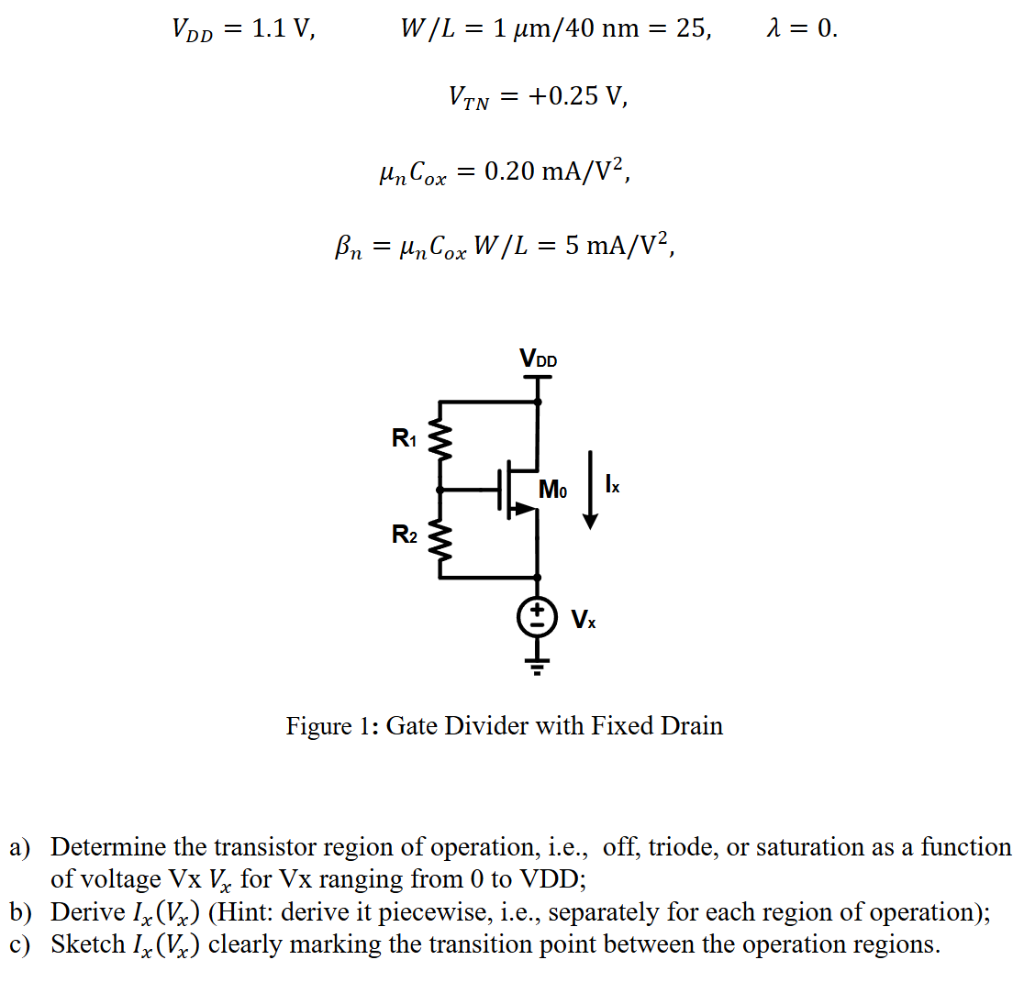 Vop =1.1V, W/L =1pum/40 nm = 25, A=0.
Vey = +025V,
1, Core = 0.20 mA/V?,
Bn = tnCox W/L =5 mA/V?,
Voo
R1
Mo | Ix
R2
Vx
Figure 1: Gate Divider with Fixed Drain
a) Determine the transistor region of operation, i.e., off, triode, or saturation as a function
of voltage Vx V, for Vx ranging from 0 to VDD;
b) Derive L.(V,) (Hint: derive it piecewise, i.e., separately for each region of operation);
¢) Sketch I,.(V,) clearly marking the transition point between the operation regions.
This is AI generated Response.
Asked by: M Raju
Created at: 2025-09-05 06:54:50
Asked by: M Raju
Created at: 2025-09-05 06:54:50
Final Answer:
Rendered
Raw Text
Did you like this answer?
Let's solve the problem **step-by-step** as requested:
---
### **Given Parameters**
- \( V_{DD} = 1.1\,V \)
- \( V_{TN} = 0.25\,V \)
- \( \mu_n C_{ox} = 0.20\,mA/V^2 \)
- \( W/L = 25 \)
- \( \beta_n = \mu_n C_{ox} (W/L) = 5\,mA/V^2 \)
- \( \lambda = 0 \) (ignore channel length modulation)
---
### **a) Determine the transistor region of operation as a function of \( V_x \) (0 to \( V_{DD} \)):**
#### **Node Voltages:**
- **Source of \( M_0 \):** \( V_x \)
- **Drain of \( M_0 \):** \( V_{DD} \)
- **Gate of \( M_0 \):** Set by the resistor divider:
\[
V_G = V_{DD} \frac{R_2}{R_1 + R_2}
\]
Let's denote \( V_G = V_{G} \).
#### **Region Conditions for nMOS**:
- **OFF (Cutoff):** \( V_{GS} < V_{TN} \)
- **Triode (Linear):** \( V_{GS} > V_{TN} \) and \( V_{DS} < V_{GS} - V_{TN} \)
- **Saturation:** \( V_{GS} > V_{TN} \) and \( V_{DS} \geq V_{GS} - V_{TN} \)
#### **Key Voltages:**
- \( V_{GS} = V_G - V_x \)
- \( V_{DS} = V_{DD} - V_x \)
Now analyze as \( V_x \) increases from 0 to \( V_{DD} \):
---
#### **1. OFF Region (\( V_{GS} < V_{TN} \)):**
\[
V_G - V_x < V_{TN} \implies V_x > V_G - V_{TN}
\]
---
#### **2. Triode/Saturation Boundary:**
- **Triode:** \( V_{DS} < V_{GS} - V_{TN} \)
\[
V_{DD} - V_x < (V_G - V_x) - V_{TN} \implies V_{DD} < V_G - V_{TN}
\]
But since \( V_{DD} \) is a constant (1.1V), typically \( V_G - V_{TN} < V_{DD} \), so **normally, the triode region does not occur unless gate voltage is very high** (which is not the case with resistive divider).
- **Saturation:** \( V_{DS} \geq V_{GS} - V_{TN} \)
\[
V_{DD} - V_x \geq (V_G - V_x) - V_{TN}
\implies V_{DD} \geq V_G - V_{TN}
\]
This is typically always true here.
---
**Summary of Regions as \( V_x \) varies:**
- **For** \( V_x < V_G - V_{TN} \): **Saturation**
- **For** \( V_x \geq V_G - V_{TN} \): **OFF**
---
### **b) Derive \( I_x(V_x) \) (piecewise for each region):**
#### **Saturation Region (\( V_x < V_G - V_{TN} \)):**
\[
I_x = \frac{\beta_n}{2} (V_{GS} - V_{TN})^2
= \frac{5}{2} (V_G - V_x - 0.25)^2 \,\,\, [mA]
\]
#### **OFF Region (\( V_x \geq V_G - V_{TN} \)):**
\[
I_x = 0
\]
---
### **c) Sketch \( I_x(V_x) \) and Mark Transition Point:**
- **Transition occurs at:** \( V_x = V_G - V_{TN} \)
- **For \( V_x < V_G - V_{TN} \):** Parabolic decrease in \( I_x \)
- **At \( V_x = V_G - V_{TN} \):** \( I_x = 0 \)
- **For \( V_x > V_G - V_{TN} \):** \( I_x = 0 \)
**The graph would look like:**
- A downward-opening parabola (starting at \( V_x = 0 \)), reaching zero at \( V_x = V_G - V_{TN} \), and staying at zero for higher \( V_x \).
---
## **Summary Table**
| Region | Condition | \( I_x(V_x) \) equation |
|----------------|---------------------------|---------------------------------|
| Saturation | \( V_x < V_G - V_{TN} \) | \( \frac{5}{2} (V_G - V_x - 0.25)^2 \) |
| OFF | \( V_x \geq V_G - V_{TN} \) | \( 0 \) |
---
## **Final Answers (in terms of \( V_G \)):**
### **a) Region of operation as a function of \( V_x \):**
- For \( V_x < V_G - V_{TN} \): Saturation
- For \( V_x \geq V_G - V_{TN} \): OFF
### **b) Piecewise Current Equation:**
\[
I_x(V_x) =
\begin{cases}
\frac{5}{2} (V_G - V_x - 0.25)^2, & V_x < V_G - 0.25 \\
0, & V_x \geq V_G - 0.25
\end{cases}
\]
### **c) Sketch:**
- See the description above: Parabola from \( V_x = 0 \) to \( V_x = V_G - 0.25 \), then flat at zero.
**If you have values for \( R_1 \) and \( R_2 \), substitute to get \( V_G \) for a numerical answer.**
Let me know if you want to plug in resistor values for a full numerical solution!
Question:
Give ME a,b,c 50 Words Explaine only Theory
This is AI generated Response.
Asked by: M Raju
Created at: 2025-09-05 06:56:28
Asked by: M Raju
Created at: 2025-09-05 06:56:28
Final Answer:
Rendered
Raw Text
Did you like this answer?
a) The transistor operates in saturation when \( V_x < V_G - V_{TN} \) because \( V_{GS} > V_{TN} \) and \( V_{DS} \geq V_{GS} - V_{TN} \). It turns off (cutoff) when \( V_x \geq V_G - V_{TN} \), as \( V_{GS} < V_{TN} \).
b) In saturation, \( I_x = \frac{\beta_n}{2}(V_{GS} - V_{TN})^2 \); off, \( I_x=0 \).
c) The \( I_x \) vs. \( V_x \) graph is a parabola decreasing to zero at \( V_x= V_G - V_{TN} \), then flat at zero, marking the transition from saturation to cutoff.
Question:
Given Parameters Give ME Explanation in 50 Words
This is AI generated Response.
Asked by: M Raju
Created at: 2025-09-05 07:03:56
Asked by: M Raju
Created at: 2025-09-05 07:03:56
Final Answer:
Rendered
Raw Text
Did you like this answer?
a) The transistor is in saturation when \( V_{GS} > V_{TN} \) and \( V_{DS} \geq V_{GS} - V_{TN} \), i.e., for \( V_x < V_G - V_{TN} \). It turns off (cutoff) when \( V_x \geq V_G - V_{TN} \), as \( V_{GS} < V_{TN} \).
b) In saturation, \( I_x = \frac{\beta_n}{2} (V_{GS} - V_{TN})^2 \); off state, \( I_x=0 \).
c) The \( I_x(V_x) \) curve is a parabola decreasing to zero at \( V_x = V_G - V_{TN} \), then remains zero, indicating the transition from saturation to cutoff.
📢 Instructions:
- Ask anything relatd to above question only.
- For new Question goto :