 VIPSolutions
Give step-by-step solution with explanation and final answer: Provide a step-by-step, in-depth, and comprehensive solution in a structured format, ensuring completeness and clarity . The solution should address all requirements specified in the question without omitting any details. Include an Explanation block after each step, containing relevant supporting statements that clarify the methodology and reasoning used. Guidelines for Answering the Question: 1. Professional and Impersonal Tone: · Maintain a professional and impersonal tone throughout the response. · Avoid using personal pronouns such as 'I', 'we', 'you', etc. 2. Accuracy and Adherence to Concepts: · Ensure utmost accuracy and strict adherence to the necessary concepts and correct textbook-based formulas required to solve the question. · Utilize relevant theories, principles, and formulas essential for solving the problem. 3. Explanation Blocks: · Include an Explanation block at the end of each step to provide context and clarify the methodology used. · Provide necessary supporting statements that enhance understanding of the step. 4. Direct and Complete Answer: · Focus solely on delivering a well-explained, direct, and complete answer to the question without additional guidance or extraneous content. 5. Specified Format: · Strictly follow the specified format. · Ensure that each section, especially each step of the solution, is accompanied by a detailed and relevant supporting statement in the Explanation block. 6. Detailed Comprehensive Solution: · Provide an exact, detailed, and comprehensive step-by-step answer. · Include explanations for each step with the required supporting statements. · Do not skip any steps or omit any part of the solution. 7. Correctness and Completeness: · Always provide a correct, complete, detailed, and well-explained solution. · Ensure that all aspects of the problem are addressed thoroughly. 8. No Errors: · Ensure there are no typographical, formulaic, calculation, programming, or grammatical errors in the solution. · Perform calculations and simplifications step-by-step vertically (downward), not horizontally (to the right side). 9. Graphs/Diagrams/Tables/Charts: · Generate correct graphs, diagrams, tables, or charts whenever required in the solution. · Ensure that all visual aids are accurate and appropriately labelled. 10. Units and Notations: · Ensure there are no errors in units or notations in the solution. · Use standard units and notations consistently throughout the solution. 11. Vital Parts: · Avoid missing any vital part of the solution. · Ensure every part of the solution is included and well-explained. I want solution in this model.Question 9 The figure below shows the arm of an excavator, which is controlled by three hydraulic cylinders. If the soil peavey | in the scoop weighs 415 kg, with the centre of gravity at G. Calculate the magnitude of the force (in kN) anaes applied by the cylinder AB to the arm BC. [Flag question 720 —~——1680 - AB 2! a 54 = _— 360 a D, 2 - i E \ \. Cg E we. 180 Dimensions in mm 600 Answer: Question 10 Calculate the pin reactions at E in kN. Not yet answered [Flag question Answer: Question 11 Calculate the pin reactions at F in kN. Not yet answered [Flag question Answer: Question 12 Calculate the magnitude of the force (kN) in the intermediate cylinder if the cylinder is Oriented at 15° to the (dad J horizontal and the horizontal distance between C and its point of attachment on member CB is 600 mm. answere [Flag question Answer: ? e— EE ————
Question:
Give step-by-step solution with explanation and final answer:
Provide a step-by-step, in-depth, and comprehensive solution in a structured format, ensuring completeness and clarity . The solution should address all requirements specified in the question without omitting any details.
Include an Explanation block after each step, containing relevant supporting statements that clarify the methodology and reasoning used.
Guidelines for Answering the Question:
1. Professional and Impersonal Tone:
· Maintain a professional and impersonal tone throughout the response.
· Avoid using personal pronouns such as 'I', 'we', 'you', etc.
2. Accuracy and Adherence to Concepts:
· Ensure utmost accuracy and strict adherence to the necessary concepts and correct textbook-based formulas required to solve the question.
· Utilize relevant theories, principles, and formulas essential for solving the problem.
3. Explanation Blocks:
· Include an Explanation block at the end of each step to provide context and clarify the methodology used.
· Provide necessary supporting statements that enhance understanding of the step.
4. Direct and Complete Answer:
· Focus solely on delivering a well-explained, direct, and complete answer to the question without additional guidance or extraneous content.
5. Specified Format:
· Strictly follow the specified format.
· Ensure that each section, especially each step of the solution, is accompanied by a detailed and relevant supporting statement in the Explanation block.
6. Detailed Comprehensive Solution:
· Provide an exact, detailed, and comprehensive step-by-step answer.
· Include explanations for each step with the required supporting statements.
· Do not skip any steps or omit any part of the solution.
7. Correctness and Completeness:
· Always provide a correct, complete, detailed, and well-explained solution.
· Ensure that all aspects of the problem are addressed thoroughly.
8. No Errors:
· Ensure there are no typographical, formulaic, calculation, programming, or grammatical errors in the solution.
· Perform calculations and simplifications step-by-step vertically (downward), not horizontally (to the right side).
9. Graphs/Diagrams/Tables/Charts:
· Generate correct graphs, diagrams, tables, or charts whenever required in the solution.
· Ensure that all visual aids are accurate and appropriately labelled.
10. Units and Notations:
· Ensure there are no errors in units or notations in the solution.
· Use standard units and notations consistently throughout the solution.
11. Vital Parts:
· Avoid missing any vital part of the solution.
· Ensure every part of the solution is included and well-explained.
I want solution in this model.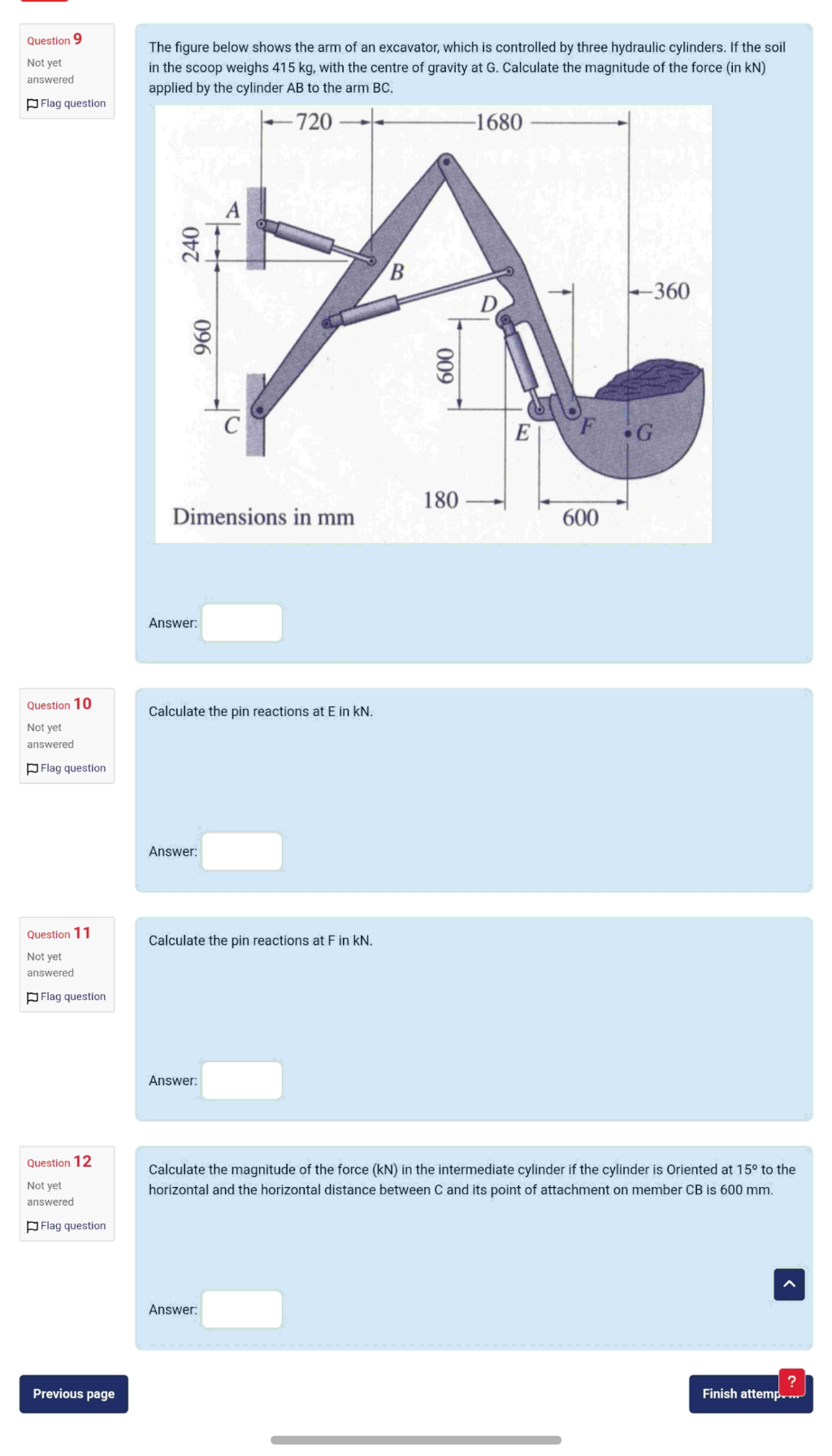 Question 9 The figure below shows the arm of an excavator, which is controlled by three hydraulic cylinders. If the soil
peavey | in the scoop weighs 415 kg, with the centre of gravity at G. Calculate the magnitude of the force (in kN)
anaes applied by the cylinder AB to the arm BC.
[Flag question
720 —~——1680
-
AB
2!
a 54
=
_— 360
a D,
2 -
i E \
\.
Cg E
we. 180
Dimensions in mm 600
Answer:
Question 10 Calculate the pin reactions at E in kN.
Not yet
answered
[Flag question
Answer:
Question 11 Calculate the pin reactions at F in kN.
Not yet
answered
[Flag question
Answer:
Question 12 Calculate the magnitude of the force (kN) in the intermediate cylinder if the cylinder is Oriented at 15° to the
(dad J horizontal and the horizontal distance between C and its point of attachment on member CB is 600 mm.
answere
[Flag question
Answer:
?
e—
EE ————
Asked by: Veera manikanta
Created at: 2025-09-04 18:27:48
Final Answer:
📢 Instructions:
- Ask anything relatd to above question only.
- For new Question goto :