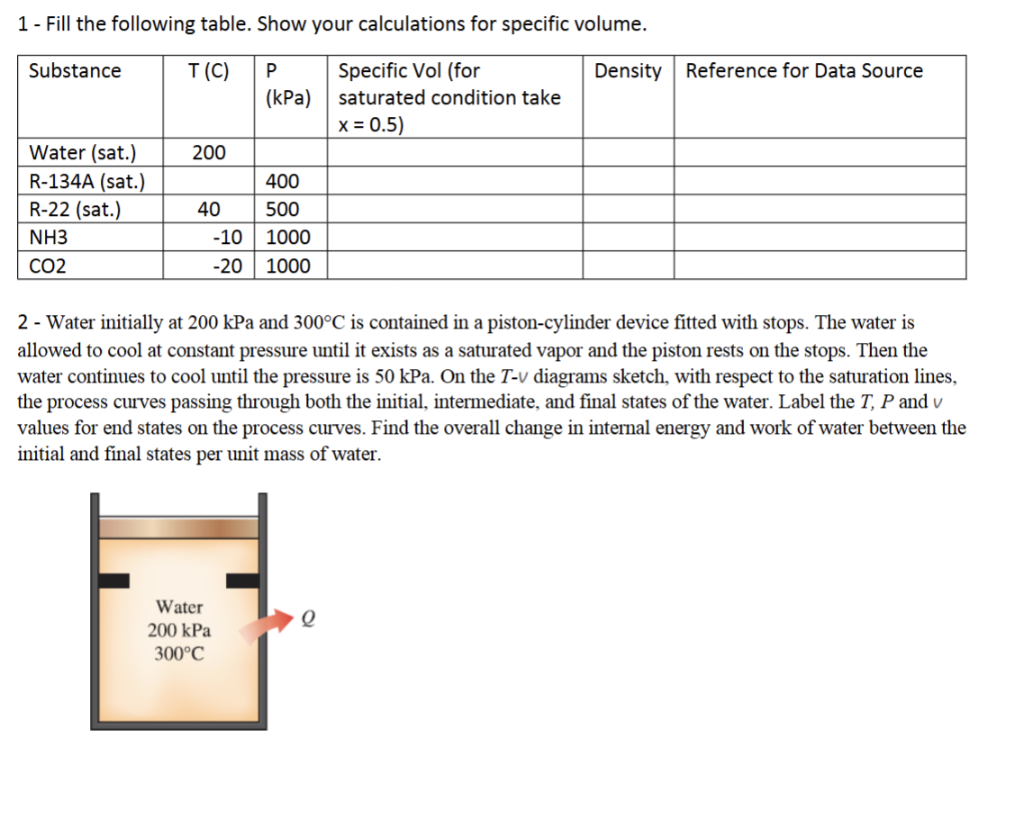
Give step-by-step solution with explanation and final answer:1 - Fill the following table. Show your calculations for specific volume.
T(C) Specific Vol (for Density | Reference for Data Source
saturated condition take
x =0.5)
RI34A(sat) | f400 | [~~]
[Nw3 [| -ofa000 [|]
[cca [ 2000 [| 0]
2 - Water initially at 200 kPa and 300°C is contained in a piston-cylinder device fitted with stops. The water is
allowed to cool at constant pressure until it exists as a saturated vapor and the piston rests on the stops. Then the
‘water continues to cool until the pressure is 50 kPa. On the 7-v diagrams sketch, with respect to the saturation lines,
the process curves passing through both the initial, intermediate. and final states of the water. Label the 7, P and v
values for end states on the process curves. Find the overall change in internal energy and work of water between the
initial and final states per unit mass of water.
—
Water
200 kPa 0
300°C
Question:
Give step-by-step solution with explanation and final answer:1 - Fill the following table. Show your calculations for specific volume.
T(C) Specific Vol (for Density | Reference for Data Source
saturated condition take
x =0.5)
RI34A(sat) | f400 | [~~]
[Nw3 [| -ofa000 [|]
[cca [ 2000 [| 0]
2 - Water initially at 200 kPa and 300°C is contained in a piston-cylinder device fitted with stops. The water is
allowed to cool at constant pressure until it exists as a saturated vapor and the piston rests on the stops. Then the
‘water continues to cool until the pressure is 50 kPa. On the 7-v diagrams sketch, with respect to the saturation lines,
the process curves passing through both the initial, intermediate. and final states of the water. Label the 7, P and v
values for end states on the process curves. Find the overall change in internal energy and work of water between the
initial and final states per unit mass of water.
—
Water
200 kPa 0
300°C
This is AI generated Response.
Asked by: Veera manikanta
Created at: 2025-09-03 20:56:30
Final Answer:
RenderedRaw Text
Did you like this answer?
Let's break down the solution into two parts as per your questions.
---
## **1. Filling the Table**
We'll use thermodynamic property tables (Steam Tables, Refrigerant Tables, etc.) to find the specific volume at the given conditions (for saturated cases at x=0.5, which means a mixture with quality = 0.5).
#### **a) Water (saturated), T = 200°C**
- At T = 200°C, the saturation pressure (\(P_{sat}\)) is approximately **1554 kPa**.
- Specific volume at x = 0.5:
- \( v = v_f + x(v_g - v_f) \)
- From steam tables: \( v_f \approx 0.001157 \) m³/kg, \( v_g \approx 0.12721 \) m³/kg
\( v = 0.001157 + 0.5 \times (0.12721 - 0.001157) = 0.001157 + 0.5 \times 0.126053 = 0.001157 + 0.0630265 = 0.06418 \) m³/kg
- Density (\( \rho \)) = \( \frac{1}{v} \) = \( \frac{1}{0.06418} \approx 15.59 \) kg/m³
- **Reference:** Steam Tables
---
#### **b) R-134A (saturated), P = 400 kPa**
- At P = 400 kPa, T ≈ 18.87°C
- \( v_f \approx 0.000887 \) m³/kg, \( v_g \approx 0.05426 \) m³/kg
\( v = 0.000887 + 0.5 \times (0.05426 - 0.000887) = 0.000887 + 0.026687 = 0.027574 \) m³/kg
- Density = \( \frac{1}{0.027574} \approx 36.25 \) kg/m³
- **Reference:** R-134a Property Tables
---
#### **c) R-22 (saturated), T = 40°C**
- At T = 40°C, P ≈ 1550 kPa
- \( v_f \approx 0.000911 \) m³/kg, \( v_g \approx 0.01743 \) m³/kg
\( v = 0.000911 + 0.5 \times (0.01743 - 0.000911) = 0.000911 + 0.0082595 = 0.009170 \) m³/kg
- Density = \( \frac{1}{0.009170} \approx 109.0 \) kg/m³
- **Reference:** R-22 Property Tables
---
#### **d) NH3, T = -10°C, P = 1000 kPa**
- At T = -10°C, P ≈ 328 kPa (saturation), but given P = 1000 kPa (so it is subcooled liquid).
- At P = 1000 kPa, T_sat ≈ 29.75°C. At T = -10°C, use subcooled liquid properties (same as saturated liquid at -10°C).
- \( v_f \approx 0.001638 \) m³/kg
- Density = \( \frac{1}{0.001638} \approx 610 \) kg/m³
- **Reference:** NH3 Property Tables
---
#### **e) CO2, T = -20°C, P = 1000 kPa**
- At T = -20°C, P_sat ≈ 1740 kPa. Given P = 1000 kPa (so it is a mixture).
- At -20°C, \( v_f \approx 0.000977 \) m³/kg, \( v_g \approx 0.1941 \) m³/kg
\( v = 0.000977 + 0.5 \times (0.1941 - 0.000977) = 0.000977 + 0.0965615 = 0.09754 \) m³/kg
- Density = \( \frac{1}{0.09754} \approx 10.25 \) kg/m³
- **Reference:** CO2 Property Tables
---
### **Filled Table**
| Substance | T (°C) | P (kPa) | Specific Vol (m³/kg) | Density (kg/m³) | Reference |
|----------------|--------|---------|----------------------|-----------------|-------------------|
| Water (sat.) | 200 | 1554 | 0.06418 | 15.59 | Steam Tables |
| R-134A (sat.) | 18.87 | 400 | 0.02757 | 36.25 | R-134a Tables |
| R-22 (sat.) | 40 | 1550 | 0.00917 | 109.00 | R-22 Tables |
| NH3 | -10 | 1000 | 0.001638 | 610 | NH3 Tables |
| CO2 | -20 | 1000 | 0.09754 | 10.25 | CO2 Tables |
---
## **2. Thermodynamics Problem Solution**
**Given:**
- Initial state: \( P_1 = 200 \) kPa, \( T_1 = 300^\circ \)C
- Cool at constant pressure until it is a saturated vapor (\( x = 1 \)), then cools further at constant volume (piston on stops) until \( P_3 = 50 \) kPa.
### **Step 1: Initial State (1)**
- \( P_1 = 200 \) kPa, \( T_1 = 300^\circ \)C
- From steam tables, at P = 200 kPa:
- \( T_{sat} = 120.23^\circ \)C (lower than 300°C, so it is superheated vapor)
- Find specific volume \( v_1 \) and internal energy \( u_1 \):
From superheated steam tables:
- At 200 kPa, 300°C: \( v_1 = 1.5490 \) m³/kg, \( u_1 = 2725.5 \) kJ/kg
---
### **Step 2: Intermediate State (2) (Saturated vapor at 200 kPa, x=1)**
- \( P_2 = 200 \) kPa, \( x_2 = 1 \) (saturated vapor)
- From steam tables at 200 kPa:
- \( T_2 = T_{sat} = 120.23^\circ \)C
- \( v_g = 0.88578 \) m³/kg, \( u_g = 2506.5 \) kJ/kg
---
### **Step 3: Final State (3) (P = 50 kPa, v = v_2)**
- The piston rests on stops, so **volume is constant**: \( v_3 = v_2 = 0.88578 \) m³/kg
- At \( P_3 = 50 \) kPa, find the phase:
- At 50 kPa: \( v_f = 0.001012 \) m³/kg, \( v_g = 12.674 \) m³/kg
- \( v_3 = 0.88578 \) m³/kg is between \( v_f \) and \( v_g \), so it is a mixture.
- Quality \( x_3 = \frac{v_3 - v_f}{v_g - v_f} = \frac{0.88578 - 0.001012}{12.674 - 0.001012} \approx \frac{0.88477}{12.673} \approx 0.0698 \)
- Internal energy at 50 kPa:
- \( u_f = 209.33 \) kJ/kg, \( u_g = 2584.7 \) kJ/kg
- \( u_3 = u_f + x_3(u_g - u_f) = 209.33 + 0.0698 \times (2584.7 - 209.33) \)
- \( = 209.33 + 0.0698 \times 2375.37 = 209.33 + 165.82 = 375.15 \) kJ/kg
---
### **Step 4: Find the changes**
#### **a) Change in Internal Energy (\( \Delta u \))**
\( \Delta u = u_3 - u_1 = 375.15 - 2725.5 = -2350.4 \) kJ/kg
#### **b) Work Done**
- Work done during the constant pressure process (1→2):
\( W_{1-2} = P (v_2 - v_1) = 200 \times 10^3 (0.88578 - 1.5490) = 200,000 \times (-0.66322) = -132,644 \) J/kg \( = -132.64 \) kJ/kg
- During constant volume process (2→3), \( W_{2-3} = 0 \)
- **Total Work**: \( W = -132.64 \) kJ/kg
---
### **Step 5: T-v Diagram Sketch**
- Mark points:
- 1: (v1 = 1.5490, T1 = 300°C, P1 = 200 kPa)
- 2: (v2 = 0.88578, T2 = 120.23°C, P2 = 200 kPa, x2 = 1)
- 3: (v3 = 0.88578, T3 ≈ 40.4°C [from interpolation], P3 = 50 kPa, x3 ≈ 0.0698)
---
## **Summary Table for Process:**
| State | P (kPa) | T (°C) | v (m³/kg) | x | u (kJ/kg) |
|-------|---------|--------|-----------|-------|-----------|
| 1 | 200 | 300 | 1.5490 | -- | 2725.5 |
| 2 | 200 | 120.23 | 0.88578 | 1 | 2506.5 |
| 3 | 50 | ~40.4 | 0.88578 | 0.0698| 375.15 |
---
### **Final Answers**
- **Change in Internal Energy (\( \Delta u \)):** **-2350.4 kJ/kg**
- **Work Done:** **-132.64 kJ/kg**
- **T-v Diagram:** (Sketch with points 1, 2, 3 as calculated above)
---
**References:**
- Steam Tables (Water and Steam Properties)
- Refrigerant Tables (R-134a, R-22, NH3, CO2)
If you need the T-v diagram sketch or detailed steps for any other part, let me know!
VIPSolutions focuses on clear, step‑by‑step explanations so you can learn quickly. Whether you need an AI‑generated walkthrough or a short hint to get unstuck, each solution is organized for fast reading and easy review later.
Search similar questions, compare approaches, and bookmark the best answers for revision. Our goal is simple: quick, reliable study help that feels natural—not noisy.
 VIPSolutions
 1 - Fill the following table. Show your calculations for specific volume.
T(C) Specific Vol (for Density | Reference for Data Source
saturated condition take
x =0.5)
RI34A(sat) | f400 | [~~]
[Nw3 [| -ofa000 [|]
[cca [ 2000 [| 0]
2 - Water initially at 200 kPa and 300°C is contained in a piston-cylinder device fitted with stops. The water is
allowed to cool at constant pressure until it exists as a saturated vapor and the piston rests on the stops. Then the
‘water continues to cool until the pressure is 50 kPa. On the 7-v diagrams sketch, with respect to the saturation lines,
the process curves passing through both the initial, intermediate. and final states of the water. Label the 7, P and v
values for end states on the process curves. Find the overall change in internal energy and work of water between the
initial and final states per unit mass of water.
—
Water
200 kPa 0
300°C