 VIPSolutions
Give step-by-step solution with explanation and final answer: Think like the best software engineer and give e the code for :Question 3 A palindrome can be defined as 1) a string that reads the same forward and backward or 2) By the following rules 1. eis a palindrome. 2.1f ais any symbol, then the string a is a palindrome. 3.1f ais any symbol and z is a palindrome, then aza is a palindrome. 4. Nothing is a palindrome unless it follows from (1) through (3) Prove by induction that these two definitions are equivalent.
Question:
Give step-by-step solution with explanation and final answer:
Think like the best software engineer and give e the code for :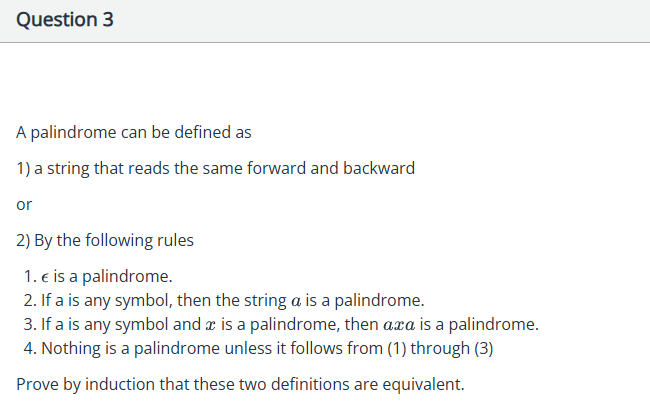 Question 3
A palindrome can be defined as
1) a string that reads the same forward and backward
or
2) By the following rules
1. eis a palindrome.
2.1f ais any symbol, then the string a is a palindrome.
3.1f ais any symbol and z is a palindrome, then aza is a palindrome.
4. Nothing is a palindrome unless it follows from (1) through (3)
Prove by induction that these two definitions are equivalent.
This is AI generated Response.
Asked by: mayank
Created at: 2025-09-03 19:55:00
Asked by: mayank
Created at: 2025-09-03 19:55:00
Final Answer:
Rendered
Raw Text
Did you like this answer?
Let's break down the proof step by step and then provide code to check palindromes using the recursive definition.
---
### **Step 1: Restate The Problem**
We have two definitions of a palindrome:
1. **Definition 1 (D1):** A string that reads the same forward and backward.
2. **Definition 2 (D2):** The recursive rules (epsilon, single character, and wrapping).
We need to **prove by induction that these definitions are equivalent**:
- Every string that satisfies D1 also satisfies D2.
- Every string that satisfies D2 also satisfies D1.
---
## **Step 2: Prove D2 ⇒ D1 (All Recursively-Defined Palindromes are Reversible Palindromes)**
**Proof by induction on the length of the string:**
**Base case:**
- Length 0: `ε` is a palindrome. Clearly, reading `ε` forward or backward is the same.
- Length 1: Any symbol `a` is a palindrome. A single character reads the same forward and backward.
**Inductive step:**
Assume any string of length ≤ n that satisfies rules 1-3 is a palindrome (i.e., reads the same forward and backward).
Consider a string of length n+2 constructed by rule 3: `axa`, where `x` is a palindrome of length n, and `a` is any symbol.
- The reverse of `axa` is `a x^R a`, where `x^R` is the reverse of `x`.
- By the inductive hypothesis, `x` is a palindrome, so `x^R = x`.
- Therefore, the reverse is `a x a`, which is the original string.
**Conclusion:** Any string generated by rules 1–3 reads the same forward and backward.
**D2 ⇒ D1 is proven.**
---
## **Step 3: Prove D1 ⇒ D2 (All Reversible Palindromes Can Be Built Recursively)**
**Proof by induction on the length of the string:**
**Base case:**
- Length 0: Only `ε`, which matches rule 1.
- Length 1: Only one symbol, which matches rule 2.
**Inductive step:**
Suppose for length ≤ n, any palindrome can be constructed by rules 1–3.
Consider a palindrome `s` of length n+2.
- Since `s` reads the same forward and backward, the first and last symbols must be the same. Let `s = a x a`, where `a` is a symbol and `x` is the substring in the middle.
- The substring `x` must also be a palindrome (since if you remove the first and last character, the remainder must still read the same forward and backward).
- By inductive hypothesis, `x` can be constructed using the rules.
- By rule 3, `a x a` is a palindrome.
**Conclusion:** Any palindrome by D1 can be built using rules 1–3.
**D1 ⇒ D2 is proven.**
---
## **Step 4: Final Conclusion**
**The two definitions are equivalent.**
---
## **Step 5: Code Implementation**
### **Python Code: Recursive Palindrome Check (Rule-based)**
```python
def is_palindrome_recursive(s):
# Rule 1: epsilon (empty string) is a palindrome
if len(s) == 0:
return True
# Rule 2: any single character is a palindrome
if len(s) == 1:
return True
# Rule 3: wrap with same character
if s[0] == s[-1]:
return is_palindrome_recursive(s[1:-1])
# Rule 4: otherwise, not a palindrome
return False
# Test cases
print(is_palindrome_recursive("")) # True
print(is_palindrome_recursive("a")) # True
print(is_palindrome_recursive("aba")) # True
print(is_palindrome_recursive("abba")) # True
print(is_palindrome_recursive("abc")) # False
```
### **Python Code: Standard Palindrome Check (By Reversal)**
```python
def is_palindrome_standard(s):
return s == s[::-1]
# Test cases
print(is_palindrome_standard("")) # True
print(is_palindrome_standard("a")) # True
print(is_palindrome_standard("aba")) # True
print(is_palindrome_standard("abba")) # True
print(is_palindrome_standard("abc")) # False
```
---
## **Summary**
- **Proof:** Both definitions are equivalent, as shown by induction.
- **Code:** Both recursive and standard checks confirm the equivalence.
If you need code in another language or a more formal mathematical write-up, let me know!
📢 Instructions:
- Ask anything relatd to above question only.
- For new Question goto :