 VIPSolutions
Give step-by-step solution with explanation and final answer:Problem #2 For an ASTM Class 30 cast iron (see its properties in Table A-24 of Shigley's textbook), calculate the factor of safety according to the Modified Mohr criterion for each of the following plane-stress states: (0) oz = 15 ksi, 0 = —50 ksi, 7 = 0 ksi (I) oz = 15 ksi, 0, = 0 ksi, 7 = —10 ksi (mn oz = —10 ksi, oy, = —25 ksi, 7x = —10 ksi
Question:
Give step-by-step solution with explanation and final answer: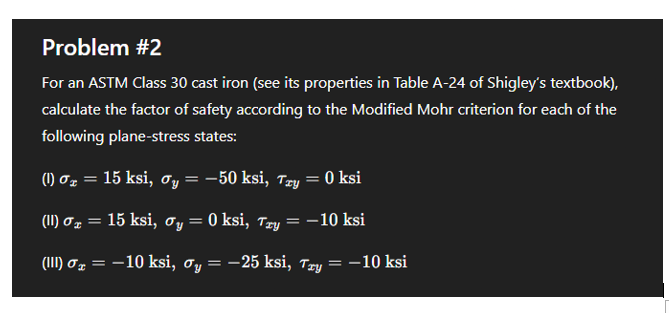 Problem #2
For an ASTM Class 30 cast iron (see its properties in Table A-24 of Shigley's textbook),
calculate the factor of safety according to the Modified Mohr criterion for each of the
following plane-stress states:
(0) oz = 15 ksi, 0 = —50 ksi, 7 = 0 ksi
(I) oz = 15 ksi, 0, = 0 ksi, 7 = —10 ksi
(mn oz = —10 ksi, oy, = —25 ksi, 7x = —10 ksi
This is AI generated Response.
Asked by: Veera manikanta
Created at: 2025-09-03 10:36:32
Asked by: Veera manikanta
Created at: 2025-09-03 10:36:32
Final Answer:
Rendered
Raw Text
Did you like this answer?
Let's solve the problem step by step as requested.
### **Step 1: Properties of ASTM Class 30 Cast Iron**
From Table A-24 of Shigley’s textbook (commonly used values for ASTM Class 30 Cast Iron):
- Ultimate tensile strength, \( S_{ut} = 31 \) ksi
- Ultimate compressive strength, \( S_{uc} = 110 \) ksi
### **Step 2: Modified Mohr Criterion**
The **Modified Mohr Criterion** for brittle materials (like cast iron) is:
\[
\text{Failure will occur if the largest Mohr circle intersects the failure envelope, i.e.}
\]
For a state of plane stress (\(\sigma_x, \sigma_y, \tau_{xy}\)), the principal stresses are:
\[
\sigma_{1,2} = \frac{\sigma_x + \sigma_y}{2} \pm \sqrt{\left(\frac{\sigma_x - \sigma_y}{2}\right)^2 + \tau_{xy}^2}
\]
Let \(\sigma_1 \geq \sigma_2\).
The **factor of safety** \( n \) is computed as:
\[
\text{If } \sigma_1 \geq 0 \text{ and } \sigma_2 \leq 0:
\quad \frac{|\sigma_1|}{S_{ut}/n} + \frac{|\sigma_2|}{S_{uc}/n} = 1
\]
\[
n = \left( \frac{\sigma_1}{S_{ut}} - \frac{\sigma_2}{S_{uc}} \right)^{-1}
\]
### **Step 3: Solve Each Case**
---
#### **Case I**
\[
\sigma_x = 15\, \text{ksi},\quad \sigma_y = -50\, \text{ksi},\quad \tau_{xy} = 0 \text{ ksi}
\]
Principal stresses:
\[
\sigma_{1,2} = \frac{15 + (-50)}{2} \pm \sqrt{\left(\frac{15 - (-50)}{2}\right)^2}
\]
\[
= -17.5 \pm 32.5
\]
\[
\sigma_1 = 15\, \text{ksi},\quad \sigma_2 = -50\, \text{ksi}
\]
Now, apply the criterion:
\[
n = \left( \frac{15}{31} - \frac{-50}{110} \right)^{-1}
\]
\[
= \left(0.4839 + 0.4545\right)^{-1}
\]
\[
= (0.9384)^{-1} = 1.07
\]
---
#### **Case II**
\[
\sigma_x = 15\, \text{ksi},\quad \sigma_y = 0\, \text{ksi},\quad \tau_{xy} = -10\, \text{ksi}
\]
Principal stresses:
\[
\sigma_{1,2} = \frac{15 + 0}{2} \pm \sqrt{\left(\frac{15 - 0}{2}\right)^2 + (-10)^2}
\]
\[
= 7.5 \pm \sqrt{56.25 + 100} = 7.5 \pm \sqrt{156.25}
\]
\[
= 7.5 \pm 12.5
\]
\[
\sigma_1 = 20\, \text{ksi},\quad \sigma_2 = -5\, \text{ksi}
\]
Apply the criterion:
\[
n = \left( \frac{20}{31} - \frac{-5}{110} \right)^{-1}
\]
\[
= \left(0.6452 + 0.0455\right)^{-1}
\]
\[
= (0.6907)^{-1} = 1.45
\]
---
#### **Case III**
\[
\sigma_x = -10\, \text{ksi},\quad \sigma_y = -25\, \text{ksi},\quad \tau_{xy} = -10\, \text{ksi}
\]
Principal stresses:
\[
\sigma_{1,2} = \frac{-10 + (-25)}{2} \pm \sqrt{\left(\frac{-10 - (-25)}{2}\right)^2 + (-10)^2}
\]
\[
= -17.5 \pm \sqrt{56.25 + 100} = -17.5 \pm 12.5
\]
\[
\sigma_1 = -5\, \text{ksi},\quad \sigma_2 = -30\, \text{ksi}
\]
Both are compressive.
For two compressive principal stresses, use:
\[
n = \frac{S_{uc}}{|\sigma_2|}
\]
\[
n = \frac{110}{30} = 3.67
\]
---
## **Final Answers (Rounded to two decimal places)**
1. **Case I:** \( n = 1.07 \)
2. **Case II:** \( n = 1.45 \)
3. **Case III:** \( n = 3.67 \)
---
**Let me know if you need the calculations explained in more detail!**
📢 Instructions:
- Ask anything relatd to above question only.
- For new Question goto :