 VIPSolutions
Give step-by-step solution with explanation and final answer:Section 4.1 The Transmission-Line Equations 4.1.1 For the per-unit-length representations of a lossless transmission line shown in Fig. P4.1.1, derive the transmission-line equations in the limit as Az — 0. Note that the total per-unit-length inductance and capacitance in each circuit are / and c, respectively. This shows that the structure of the per-unit-length equivalent circuit is not important in the limit as Az — 0. 18z 18z ! chAz icAz : I 2chAz «AZ ——————— (@) b 3IAz $82 ® i clAz (c) FIGURE P4.1.1.
Question:
Give step-by-step solution with explanation and final answer: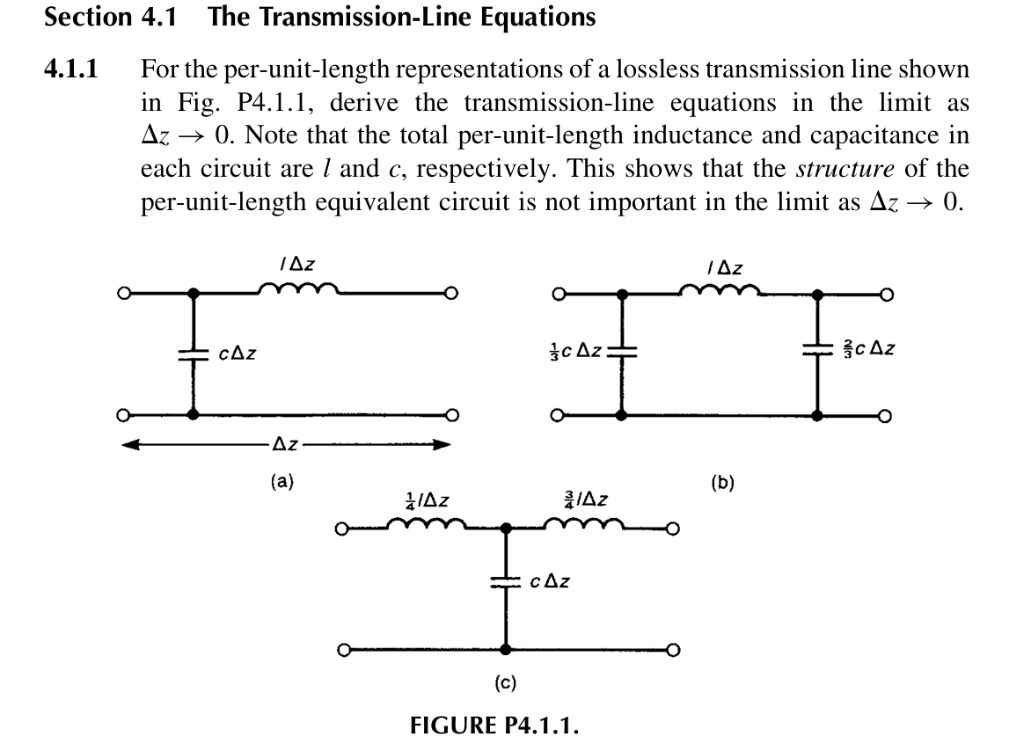 Section 4.1 The Transmission-Line Equations
4.1.1 For the per-unit-length representations of a lossless transmission line shown
in Fig. P4.1.1, derive the transmission-line equations in the limit as
Az — 0. Note that the total per-unit-length inductance and capacitance in
each circuit are / and c, respectively. This shows that the structure of the
per-unit-length equivalent circuit is not important in the limit as Az — 0.
18z 18z
! chAz icAz : I 2chAz
«AZ ———————
(@) b
3IAz $82 ®
i clAz
(c)
FIGURE P4.1.1.
This is AI generated Response.
Asked by: M Murali
Created at: 2025-09-01 06:41:50
Asked by: M Murali
Created at: 2025-09-01 06:41:50
Final Answer:
Rendered
Raw Text
Did you like this answer?
Let's derive the **transmission-line equations** (Telegrapher’s equations) for a **lossless line** from the equivalent circuit in the limit as \(\Delta z \rightarrow 0\).
---
### **Step 1: Model the Segment**
Consider the segment of length \(\Delta z\) in **Figure (a)**:
- Series inductance: \(L = l \Delta z\)
- Shunt capacitance: \(C = c \Delta z\)
Let:
- \(v(z, t)\): Voltage at position \(z\)
- \(i(z, t)\): Current at position \(z\)
- \(v(z+\Delta z, t)\): Voltage at \(z+\Delta z\)
- \(i(z+\Delta z, t)\): Current at \(z+\Delta z\)
---
### **Step 2: Apply KVL (Kirchhoff’s Voltage Law)**
For the series inductor:
\[
v(z, t) = v(z+\Delta z, t) + L \frac{\partial i}{\partial t}
\]
So,
\[
v(z, t) - v(z+\Delta z, t) = l \Delta z \frac{\partial i(z, t)}{\partial t}
\]
Divide both sides by \(\Delta z\):
\[
\frac{v(z, t) - v(z+\Delta z, t)}{\Delta z} = l \frac{\partial i(z, t)}{\partial t}
\]
Take the limit \(\Delta z \to 0\):
\[
-\frac{\partial v}{\partial z} = l \frac{\partial i}{\partial t}
\]
Or,
\[
\boxed{\frac{\partial v}{\partial z} = -l \frac{\partial i}{\partial t}}
\]
---
### **Step 3: Apply KCL (Kirchhoff’s Current Law)**
For the shunt capacitor:
\[
i(z, t) = i(z+\Delta z, t) + C \frac{\partial v(z+\Delta z, t)}{\partial t}
\]
So,
\[
i(z, t) - i(z+\Delta z, t) = c \Delta z \frac{\partial v(z+\Delta z, t)}{\partial t}
\]
Divide both sides by \(\Delta z\):
\[
\frac{i(z, t) - i(z+\Delta z, t)}{\Delta z} = c \frac{\partial v(z+\Delta z, t)}{\partial t}
\]
Take the limit \(\Delta z \to 0\):
\[
-\frac{\partial i}{\partial z} = c \frac{\partial v}{\partial t}
\]
Or,
\[
\boxed{\frac{\partial i}{\partial z} = -c \frac{\partial v}{\partial t}}
\]
---
### **Step 4: Final Transmission-Line Equations**
\[
\boxed{
\begin{align*}
\frac{\partial v}{\partial z} &= -l \frac{\partial i}{\partial t} \\
\frac{\partial i}{\partial z} &= -c \frac{\partial v}{\partial t}
\end{align*}
}
\]
These are the **lossless transmission-line (Telegrapher's) equations**.
The specific arrangement of the lumped elements does **not** affect the result as \(\Delta z \to 0\), as all three circuits (a), (b), and (c) will yield the same equations in this limit.
---
## **Summary**
- **Step 1:** Write KVL and KCL for the infinitesimal segment.
- **Step 2:** Divide by \(\Delta z\), take the limit as \(\Delta z \to 0\).
- **Step 3:** Obtain the transmission-line equations:
\[
\boxed{
\frac{\partial v}{\partial z} = -l \frac{\partial i}{\partial t} \\
\frac{\partial i}{\partial z} = -c \frac{\partial v}{\partial t}
}
\]
📢 Instructions:
- Ask anything relatd to above question only.
- For new Question goto :