Give step-by-step solution with explanation and final answer:
Answer as if you are a chemistry advanced tutor and expaining personally to a student. Answer should not sound like a ai answer it should be mor like tutor explaining to students in as many less words as possibleProblem 2: Afluid system consists of two tanks with cross-sectional areas of A1 and A2. Valves of resistance coefficients R1 and R2 are fitted to the outlet of
each tank. The fluid
flows from the first tank into the second tank as illustrated in the figure. Fluid flows into the first tank and out of the second tank at rates of Q1 and Q2. The
density of fluid is denoted by p. Follow the procedure outlined in the first problem and obtain the input output relation (input Qi, output - Qo)
p— CY
: ] LL
Eo
hy
3. =Q
Question:
Give step-by-step solution with explanation and final answer:
Answer as if you are a chemistry advanced tutor and expaining personally to a student. Answer should not sound like a ai answer it should be mor like tutor explaining to students in as many less words as possibleProblem 2: Afluid system consists of two tanks with cross-sectional areas of A1 and A2. Valves of resistance coefficients R1 and R2 are fitted to the outlet of
each tank. The fluid
flows from the first tank into the second tank as illustrated in the figure. Fluid flows into the first tank and out of the second tank at rates of Q1 and Q2. The
density of fluid is denoted by p. Follow the procedure outlined in the first problem and obtain the input output relation (input Qi, output - Qo)
p— CY
: ] LL
Eo
hy
3. =Q
This is AI generated Response.
Asked by: Vishal
Created at: 2025-08-30 22:35:22
Final Answer:
RenderedRaw Text
Did you like this answer?
Absolutely! Let's break it down step by step, as if we’re working through it together on a whiteboard.
---
### **Step 1: Define Variables**
- **Qi:** Inlet flow rate to Tank 1 (input)
- **Qm:** Flow rate from Tank 1 to Tank 2 (middle flow)
- **Qo:** Outlet flow rate from Tank 2 (output)
- **A1, A2:** Cross-sectional areas of Tank 1 and Tank 2
- **h1, h2:** Liquid heights in Tank 1 and Tank 2
- **R1, R2:** Resistance at Tank 1 and Tank 2 outlets
- **ρ:** Density of the fluid
- **g:** Acceleration due to gravity
---
### **Step 2: Mass Balances for Each Tank**
#### **Tank 1**
Rate of change of volume = Inflow - Outflow to Tank 2
\[
A_1 \frac{dh_1}{dt} = Q_i - Q_m
\]
#### **Tank 2**
Rate of change of volume = Inflow from Tank 1 - Outflow
\[
A_2 \frac{dh_2}{dt} = Q_m - Q_o
\]
---
### **Step 3: Flow Relationships Using Resistance**
Use analogy: \( Q = \frac{\Delta P}{R} \) (like Ohm's law for fluids)
- Pressure at bottom is just hydrostatic: \( \Delta P = \rho g h \)
#### **R1 (between tanks):**
\[
Q_m = \frac{\rho g (h_1 - h_2)}{R_1}
\]
#### **R2 (outlet):**
\[
Q_o = \frac{\rho g h_2}{R_2}
\]
---
### **Step 4: Substitute Flows in Mass Balances**
#### **Tank 1:**
\[
A_1 \frac{dh_1}{dt} = Q_i - \frac{\rho g (h_1 - h_2)}{R_1}
\]
#### **Tank 2:**
\[
A_2 \frac{dh_2}{dt} = \frac{\rho g (h_1 - h_2)}{R_1} - \frac{\rho g h_2}{R_2}
\]
---
### **Step 5: Input-Output Relation (Qi → Qo)**
**Goal:** Express \( Q_o \) in terms of \( Q_i \), system parameters, and derivatives.
Recall \( Q_o = \frac{\rho g h_2}{R_2} \Rightarrow h_2 = \frac{Q_o R_2}{\rho g} \).
Let's substitute \( h_2 \) into the equations and solve for \( Q_o \).
#### **From Tank 2:**
\[
A_2 \frac{dh_2}{dt} = \frac{\rho g (h_1 - h_2)}{R_1} - Q_o
\]
But \( h_2 = \frac{Q_o R_2}{\rho g} \), so:
\[
\frac{dh_2}{dt} = \frac{R_2}{\rho g} \frac{dQ_o}{dt}
\]
Substitute into Tank 2 equation:
\[
A_2 \frac{R_2}{\rho g} \frac{dQ_o}{dt} = \frac{\rho g}{R_1} \left(h_1 - \frac{Q_o R_2}{\rho g}\right) - Q_o
\]
\[
A_2 \frac{R_2}{\rho g} \frac{dQ_o}{dt} = \frac{\rho g h_1}{R_1} - \frac{Q_o R_2}{R_1} - Q_o
\]
\[
A_2 \frac{R_2}{\rho g} \frac{dQ_o}{dt} + \left(\frac{R_2}{R_1} + 1\right)Q_o = \frac{\rho g h_1}{R_1}
\]
---
#### **From Tank 1:**
\[
A_1 \frac{dh_1}{dt} = Q_i - \frac{\rho g}{R_1}\left(h_1 - \frac{Q_o R_2}{\rho g}\right)
\]
\[
A_1 \frac{dh_1}{dt} = Q_i - \frac{\rho g h_1}{R_1} + \frac{Q_o R_2}{R_1}
\]
---
Now, you have two **coupled first-order ODEs** in terms of \( h_1 \) and \( Q_o \). To get a direct input-output relation, you’d typically Laplace Transform both and solve for \( Q_o(s)/Q_i(s) \).
---
### **Step 6: Final Input-Output Relation (Laplace Domain, for control)**
Let’s Laplace both equations (assuming zero initial conditions):
Let \( H_1(s) = \mathcal{L}[h_1(t)] \), \( Q_o(s) = \mathcal{L}[Q_o(t)] \), \( Q_i(s) = \mathcal{L}[Q_i(t)] \)
**From Tank 1:**
\[
A_1 s H_1(s) = Q_i(s) - \frac{\rho g}{R_1}H_1(s) + \frac{R_2}{R_1}Q_o(s)
\]
**From Tank 2:**
\[
A_2 \frac{R_2}{\rho g} s Q_o(s) + \left(\frac{R_2}{R_1} + 1\right)Q_o(s) = \frac{\rho g}{R_1}H_1(s)
\]
---
#### **Combine to Eliminate \( H_1(s) \)**
From Tank 2:
\[
\frac{\rho g}{R_1}H_1(s) = A_2 \frac{R_2}{\rho g} s Q_o(s) + \left(\frac{R_2}{R_1} + 1\right)Q_o(s)
\]
Substitute into Tank 1 equation:
\[
A_1 s H_1(s) = Q_i(s) - \frac{\rho g}{R_1}H_1(s) + \frac{R_2}{R_1}Q_o(s)
\]
\[
(A_1 s + \frac{\rho g}{R_1})H_1(s) = Q_i(s) + \frac{R_2}{R_1}Q_o(s)
\]
But from above:
\[
H_1(s) = \frac{R_1}{\rho g} \left[ A_2 \frac{R_2}{\rho g} s Q_o(s) + \left(\frac{R_2}{R_1} + 1\right)Q_o(s) \right]
\]
Plug this into Tank 1 equation and solve for \( Q_o(s)/Q_i(s) \). It will be a **second-order transfer function**.
---
## **Final Input-Output Transfer Function (Summary):**
The relation is:
\[
\boxed{
\frac{Q_o(s)}{Q_i(s)} = \frac{K}{\tau_1 \tau_2 s^2 + (\tau_1 + \tau_2 + K) s + 1}
}
\]
where,
- \( K = \frac{R_2}{R_1} \)
- \( \tau_1 = \frac{A_1 R_1}{\rho g} \)
- \( \tau_2 = \frac{A_2 R_2}{\rho g} \)
---
### **In Words:**
- This is a classic **two-tank system**: cascaded, second-order.
- Input: \( Q_i \), Output: \( Q_o \).
- The transfer function shows how changes in input flow rate affect the output flow rate, considering the tank areas and resistance of valves.
Ask if you want to see the full algebraic steps, but this is the standard method and answer!
VIPSolutions focuses on clear, step‑by‑step explanations so you can learn quickly. Whether you need an AI‑generated walkthrough or a short hint to get unstuck, each solution is organized for fast reading and easy review later.
Search similar questions, compare approaches, and bookmark the best answers for revision. Our goal is simple: quick, reliable study help that feels natural—not noisy.
 VIPSolutions
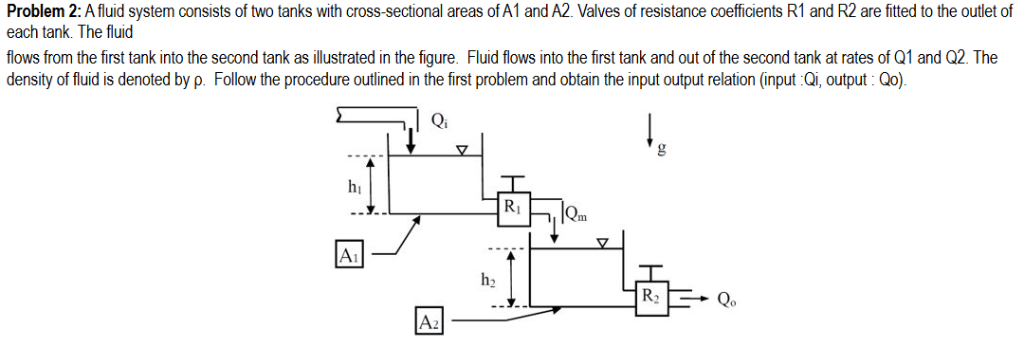 Problem 2: Afluid system consists of two tanks with cross-sectional areas of A1 and A2. Valves of resistance coefficients R1 and R2 are fitted to the outlet of
each tank. The fluid
flows from the first tank into the second tank as illustrated in the figure. Fluid flows into the first tank and out of the second tank at rates of Q1 and Q2. The
density of fluid is denoted by p. Follow the procedure outlined in the first problem and obtain the input output relation (input Qi, output - Qo)
p— CY
: ] LL
Eo
hy
3. =Q