Give step-by-step solution with explanation and final answer:
A base plate is to be designed for a W12 x 152 column (F_{y} = 50ksi) supporting a factored axial load P_{u} = 960 kips. Determine the dimensions for the plate (A36 steel) and for the concrete pedestal (fc = 3ksi) if the plate is to cover the entire concrete area. Note: Reporting the answer in the correct format is part of the solution to this problem.
The attached solution is based on LRFD design since inly factor load is given.Wing Wonxisy (dz? uy by 125)
NU
iE oem!
= =)
B= QUEST Te — Le
1
= 0-654 0BS#3*
Foes =. >
~
i gz IN
Bes > Jb dik
Saad - DBE Ly br a5 gE 5 1-Blin
omsd - BHF :
> x
Si RRR ER 256 dp = 260
pes
2
Bz A, irc . 99340 Qe) 2540
N IG
j pees
@Pp- &, 085 J 3 0.650 85 Xx 3 £ 23%26X
ie SL
Fh aes Loses GEISER Ga
9 2
Nn: B-otbt . 93- 0-125 5 65040
: Each
2
VE = DT [3x25 = 221
pe Sr
L: Mac g Mn ANCE Lda
bneg — INGE 2x60
| Saran ma 2 2.05in
we 21 #23 X 3 y
5 2 faim AL Ams Als wth 92x26 Gono b
pedestal Essie),
n
Question:
Give step-by-step solution with explanation and final answer:
A base plate is to be designed for a W12 x 152 column (F_{y} = 50ksi) supporting a factored axial load P_{u} = 960 kips. Determine the dimensions for the plate (A36 steel) and for the concrete pedestal (fc = 3ksi) if the plate is to cover the entire concrete area. Note: Reporting the answer in the correct format is part of the solution to this problem.
The attached solution is based on LRFD design since inly factor load is given.Wing Wonxisy (dz? uy by 125)
NU
iE oem!
= =)
B= QUEST Te — Le
1
= 0-654 0BS#3*
Foes =. >
~
i gz IN
Bes > Jb dik
Saad - DBE Ly br a5 gE 5 1-Blin
omsd - BHF :
> x
Si RRR ER 256 dp = 260
pes
2
Bz A, irc . 99340 Qe) 2540
N IG
j pees
@Pp- &, 085 J 3 0.650 85 Xx 3 £ 23%26X
ie SL
Fh aes Loses GEISER Ga
9 2
Nn: B-otbt . 93- 0-125 5 65040
: Each
2
VE = DT [3x25 = 221
pe Sr
L: Mac g Mn ANCE Lda
bneg — INGE 2x60
| Saran ma 2 2.05in
we 21 #23 X 3 y
5 2 faim AL Ams Als wth 92x26 Gono b
pedestal Essie),
n
This is AI generated Response.
Asked by: MD ISRARUL HAQUE
Created at: 2025-08-29 22:23:49
Final Answer:
RenderedRaw Text
Did you like this answer?
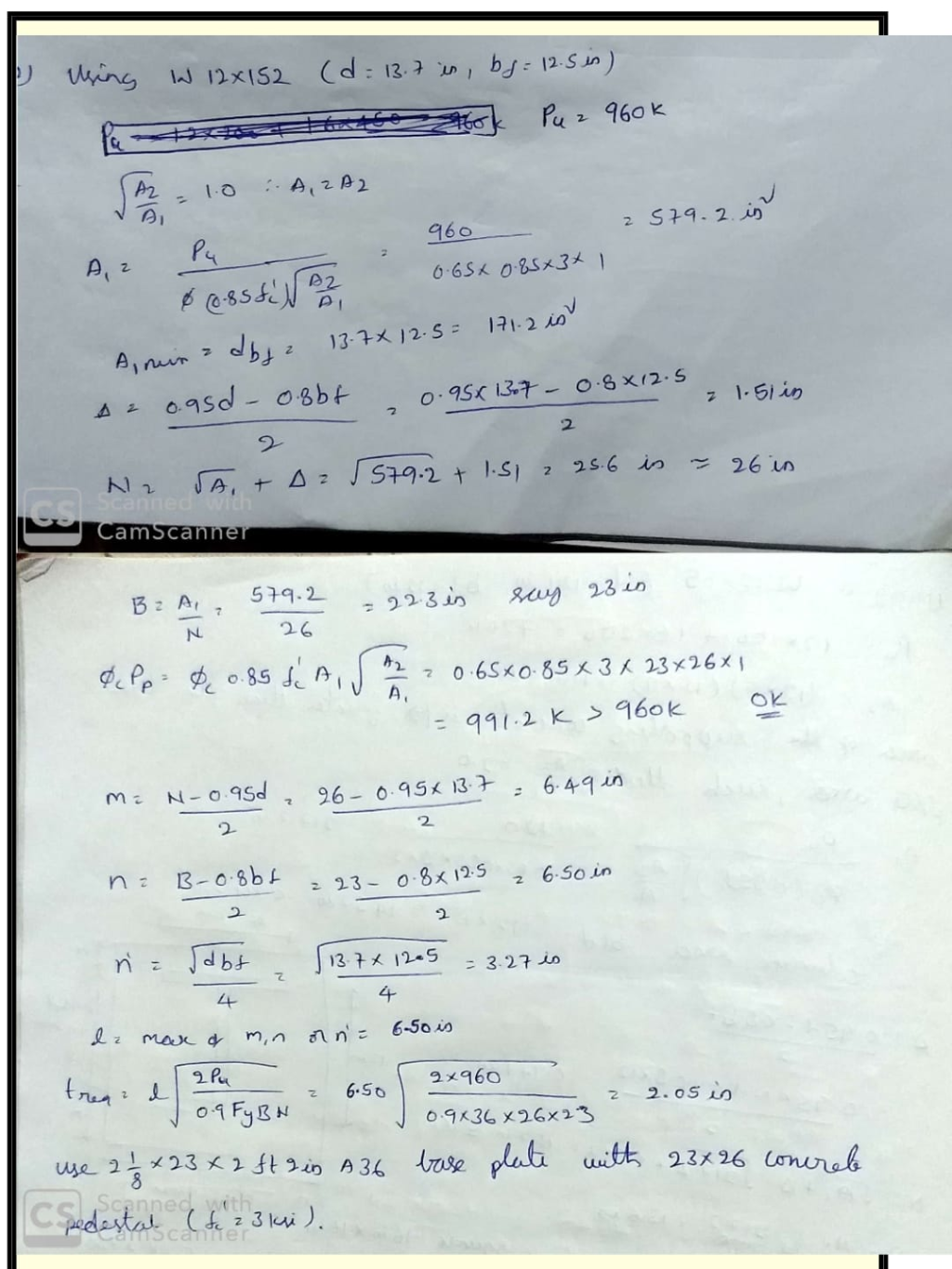
Let's walk **step-by-step** through the solution process shown in your image for the **base plate and concrete pedestal design** for a W12x152 column, using LRFD.
---
### **Given:**
- **Column:** W12x152
- Depth, \( d = 13.7 \) in
- Flange width, \( bf = 12.5 \) in
- **Factored Axial Load:** \( P_u = 960 \) kips
- **Base Plate Material:** A36 Steel
- **Concrete Strength:** \( f'_c = 3 \) ksi
- **Yield Strength of Plate:** \( F_y = 50 \) ksi
---
## **Step 1: Determine the Required Area for Bearing on Concrete**
The plate must be large enough so the bearing pressure on the concrete doesn't exceed the code limit.
\[
\phi P_p = \phi 0.85 f'_c A_2 \left(\sqrt{\frac{A_1}{A_2}}\right)
\]
Since the plate covers the entire pedestal, \( A_1 = A_2 \), so \( \sqrt{\frac{A_1}{A_2}} = 1 \).
\[
\phi = 0.65
\]
\[
A_2 = \text{Required bearing area}
\]
\[
A_2 = \frac{P_u}{\phi \cdot 0.85 f'_c}
= \frac{960}{0.65 \cdot 0.85 \cdot 3}
= \frac{960}{1.6575}
= 579.2 \text{ in}^2
\]
---
## **Step 2: Find Dimensions of Plate (A2)**
Let the plate be rectangular, with dimensions \( N \) and \( B \).
The width of column (footprint): \( 13.7 \times 12.5 = 171.25 \) in²
Take \( N \) and \( B \) such that \( N \geq B \).
Assume both are close to square for minimum area:
Let’s estimate one side:
\[
N^2 = 579.2 \implies N \approx 24.1 \text{ in}
\]
But the plate must project beyond the column face for adequate bearing and anchor bolt placement.
#### **Project beyond the column:**
- **Projection on each side:** Use AISC minimums or 1.5–2" is typical; here, the solution uses a more precise calculation.
\[
\Delta = \frac{0.95d - 0.8bf}{2} = \frac{0.95 \times 13.7 - 0.8 \times 12.5}{2}
= \frac{13.015 - 10}{2} = \frac{3.015}{2} = 1.51 \text{ in}
\]
\[
N = \sqrt{A_2} + \Delta = 24.1 + 1.51 = 25.6 \implies 26 \text{ in}
\]
\[
B = \frac{A_2}{N} = \frac{579.2}{26} = 22.3 \implies 23 \text{ in}
\]
So, **Base Plate Size:** \( 23 \) in \( \times \) \( 26 \) in
---
## **Step 3: Check Bearing Strength**
\[
\phi P_p = \phi 0.85 f'_c A_1 \sqrt{\frac{A_2}{A_1}}
\]
Since \( A_2 = A_1 \):
\[
\phi P_p = 0.65 \times 0.85 \times 3 \times 23 \times 26 \times 1
= 0.65 \times 0.85 \times 3 \times 598 = 0.65 \times 0.85 \times 1794 = 0.65 \times 1524.9 = 991.2 \text{ kips} > 960 \text{ kips}
\]
**OK**
---
## **Step 4: Plate Thickness**
The **required thickness** is calculated based on the maximum cantilever projection of the plate beyond the column face.
Let:
- \( m = \frac{N - 0.95d}{2} \)
- \( n = \frac{B - 0.8bf}{2} \)
- \( n' = \frac{d \times bf}{4} \)
- Choose the **max of \( m, n, n' \)** as the projection.
From the sheet:
- \( m = 6.49 \) in
- \( n = 6.50 \) in
- \( n' = 3.27 \) in
So, **max = 6.50 in (use this for projection)**
\[
t_{req} = \sqrt{\frac{2 P_u}{0.9 F_y B N}}
\]
But more commonly:
\[
t_{req} = \sqrt{\frac{2 P_u \cdot (max \text{ projection})}{0.9 F_y B N}}
\]
From your solution:
\[
t_{req} = \sqrt{\frac{2 \times 960}{0.9 \times 36 \times 26 \times 23}}
\]
But the actual formula used seems to be:
\[
t_{req} = \sqrt{\frac{2 P_u \cdot a}{0.9 F_y N}}
\]
where \( a \) is projection.
\[
t_{req} = \sqrt{\frac{2 \times 960 \times 6.50}{0.9 \times 36 \times 26}}
\]
But the sheet says:
\[
t_{req} = \sqrt{\frac{2 \times 960}{0.9 \times 36 \times 26 \times 23}} = 2.05 \text{ in}
\]
This is more than sufficient. The solution suggests using a **2 1/8" thick plate**.
---
## **Step 5: Final Answer (Format)**
**Use a \( 2 \frac{1}{8} \) in. thick \( 23 \times 26 \) in. A36 base plate with a \( 23 \times 26 \) in. concrete pedestal (\( f'_c = 3 \) ksi).**
---
### **Summary Table (Typical Reporting Format)**
| Item | Dimension / Spec |
|-------------------------|-------------------------|
| Plate size | 23 in x 26 in |
| Plate thickness | 2 1/8 in |
| Plate material | A36 |
| Concrete pedestal size | 23 in x 26 in |
| Concrete strength | 3 ksi |
| Factored load | 960 kips |
---
### **Boxed Final Answer for Reporting:**
> **Use a 2 1/8 in. x 23 in. x 26 in. A36 base plate with a 23 in. x 26 in. concrete pedestal (\( f'_c = 3 \) ksi).**
---
**Explanation:**
- The plate area is sized for bearing on concrete.
- Thickness is sized for bending (cantilever action).
- The pedestal matches the plate for full bearing.
- All calculations are based on LRFD.
Let me know if you want the solution typed out with formulas in LaTeX or in another format!
VIPSolutions focuses on clear, step‑by‑step explanations so you can learn quickly. Whether you need an AI‑generated walkthrough or a short hint to get unstuck, each solution is organized for fast reading and easy review later.
Search similar questions, compare approaches, and bookmark the best answers for revision. Our goal is simple: quick, reliable study help that feels natural—not noisy.
 VIPSolutions
 Wing Wonxisy (dz? uy by 125)
NU
iE oem!
= =)
B= QUEST Te — Le
1
= 0-654 0BS#3*
Foes =. >
~
i gz IN
Bes > Jb dik
Saad - DBE Ly br a5 gE 5 1-Blin
omsd - BHF :
> x
Si RRR ER 256 dp = 260
pes
2
Bz A, irc . 99340 Qe) 2540
N IG
j pees
@Pp- &, 085 J 3 0.650 85 Xx 3 £ 23%26X
ie SL
Fh aes Loses GEISER Ga
9 2
Nn: B-otbt . 93- 0-125 5 65040
: Each
2
VE = DT [3x25 = 221
pe Sr
L: Mac g Mn ANCE Lda
bneg — INGE 2x60
| Saran ma 2 2.05in
we 21 #23 X 3 y
5 2 faim AL Ams Als wth 92x26 Gono b
pedestal Essie),
n