 VIPSolutions
Give step-by-step solution with explanation and final answer:a Find the ranster fncion (5), for the SFG in gure below: on a , A ~~ [AS 5 H, p> )
Question:
Give step-by-step solution with explanation and final answer: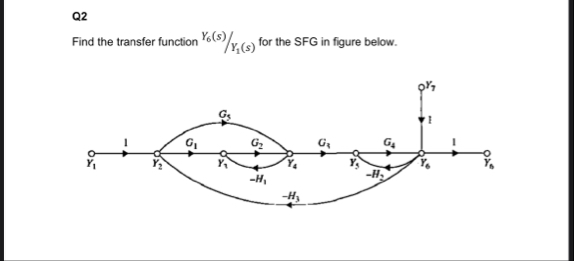 a
Find the ranster fncion (5), for the SFG in gure below:
on
a ,
A ~~ [AS 5
H, p>
)
This is AI generated Response.
Asked by: M Murali
Created at: 2025-08-29 12:19:19
Asked by: M Murali
Created at: 2025-08-29 12:19:19
Final Answer:
Rendered
Raw Text
Did you like this answer?
Let's solve the problem step by step using **Mason's Gain Formula** for the Signal Flow Graph (SFG):
### Step 1: **Identify the Forward Paths**
A **forward path** is a path from the input (\( Y_1 \)) to the output (\( Y_6 \)) without going through any node more than once.
#### Forward Path 1:
\( Y_1 \rightarrow Y_2 \rightarrow Y_3 \rightarrow Y_4 \rightarrow Y_5 \rightarrow Y_6 \)
- Gain: \( 1 \cdot G_1 \cdot G_2 \cdot G_3 \cdot G_4 \cdot 1 = G_1 G_2 G_3 G_4 \)
#### Forward Path 2:
\( Y_1 \rightarrow Y_2 \rightarrow Y_4 \rightarrow Y_5 \rightarrow Y_6 \)
- Gain: \( 1 \cdot G_5 \cdot G_3 \cdot G_4 \cdot 1 = G_5 G_3 G_4 \)
### Step 2: **Identify Individual Loops and their Gains**
A **loop** starts and ends at the same node without passing through any node twice.
#### Loop 1:
\( Y_3 \rightarrow Y_2 \rightarrow Y_3 \)
- Gain: \( -H_1 G_1 \)
#### Loop 2:
\( Y_5 \rightarrow Y_4 \rightarrow Y_5 \)
- Gain: \( -H_2 G_3 \)
#### Loop 3:
\( Y_6 \rightarrow Y_1 \rightarrow Y_2 \rightarrow Y_3 \rightarrow Y_4 \rightarrow Y_5 \rightarrow Y_6 \)
- Gain: \( -H_3 G_1 G_2 G_3 G_4 \)
### Step 3: **Identify Non-touching Loops**
Let's check if there are any pairs of non-touching loops:
- Loop 1 involves \( Y_2, Y_3 \)
- Loop 2 involves \( Y_4, Y_5 \)
- Loop 3 involves all nodes
**Loop 1 and Loop 2 are non-touching.**
- Combined Gain: \( (-H_1 G_1)(-H_2 G_3) = H_1 H_2 G_1 G_3 \)
### Step 4: **Calculate the Determinant (Δ)**
\[
\Delta = 1 - (\text{sum of individual loop gains}) + (\text{sum of gain products of all pairs of non-touching loops}) - \ldots
\]
\[
\Delta = 1 - [(-H_1 G_1) + (-H_2 G_3) + (-H_3 G_1 G_2 G_3 G_4)] + [H_1 H_2 G_1 G_3]
\]
\[
\Delta = 1 + H_1 G_1 + H_2 G_3 + H_3 G_1 G_2 G_3 G_4 + H_1 H_2 G_1 G_3
\]
### Step 5: **Calculate \(\Delta_k\) for each forward path**
For **Path 1** (\( G_1 G_2 G_3 G_4 \)):
- It touches all loops except possibly itself; let's check:
- Path passes through all points in Loop 3, so all loops touch the path.
- So, \( \Delta_1 = 1 \)
For **Path 2** (\( G_5 G_3 G_4 \)):
- It passes through \( Y_2, Y_4, Y_5, Y_6 \)
- Loop 1: \( Y_2, Y_3 \) — Path 2 does not go through \( Y_3 \), so **Loop 1 does not touch Path 2**.
- Loop 2: \( Y_4, Y_5 \) — Path 2 goes through both, so **Loop 2 touches Path 2**.
- Loop 3: Passes through all, so touches.
- So, **only Loop 1 is non-touching**:
- \( \Delta_2 = 1 - (\text{loop gains not touching}) = 1 - (-H_1 G_1) = 1 + H_1 G_1 \)
### Step 6: **Apply Mason's Gain Formula**
\[
T(s) = \frac{Y_6(s)}{Y_1(s)} = \frac{\sum_{k} P_k \Delta_k}{\Delta}
\]
Where \( P_k \) is the gain of the \( k \)-th forward path, and \( \Delta_k \) is the determinant for that path.
\[
T(s) = \frac{G_1 G_2 G_3 G_4 \cdot 1 + G_5 G_3 G_4 \cdot (1 + H_1 G_1)}{\Delta}
\]
\[
\Delta = 1 + H_1 G_1 + H_2 G_3 + H_3 G_1 G_2 G_3 G_4 + H_1 H_2 G_1 G_3
\]
### **Final Answer**
\[
\boxed{
\frac{Y_6(s)}{Y_1(s)} = \frac{G_1 G_2 G_3 G_4 + G_5 G_3 G_4 (1 + H_1 G_1)}{1 + H_1 G_1 + H_2 G_3 + H_3 G_1 G_2 G_3 G_4 + H_1 H_2 G_1 G_3}
}
\]
Question:
Each Step Give ME 100 Words Explanation only Theory
This is AI generated Response.
Asked by: M Murali
Created at: 2025-08-29 12:37:18
Asked by: M Murali
Created at: 2025-08-29 12:37:18
Final Answer:
Rendered
Raw Text
Did you like this answer?
Certainly! Here's a brief 100-word explanation for each step, focusing on the theory:
**Step 1:**
Identify all forward paths from input to output in the signal flow graph, ensuring no node is revisited. Forward paths represent the direct transfer functions contributing to overall system behavior. They are essential for applying Mason's Gain Formula as they form the primary routes through which signals propagate.
**Step 2:**
Locate all individual loops in the graph—closed paths starting and ending at the same node without passing through any node twice. Loop gains are crucial because they influence the system's feedback and stability, and their combined effects are considered when calculating the overall transfer function.
**Step 3:**
Determine non-touching loops—loops that do not share any common nodes. Non-touching loops can simultaneously affect the system without interference. Their gains are multiplied when calculating higher-order terms in Mason’s formula, accounting for interactions between independent feedback loops.
**Step 4:**
Calculate the determinant Δ using Mason's Gain Formula, which combines the effects of all loops and their non-touching combinations. Δ accounts for the total feedback influence in the system, with positive and negative terms representing the constructive and destructive effects of loops and their interactions.
**Step 5:**
Compute Δ_k for each forward path, representing the system's feedback excluding loops that touch that particular path. This isolates the influence of feedback loops independent of the specific path, enabling calculation of each path's contribution to the overall transfer function.
**Step 6:**
Apply Mason's Gain Formula, summing the products of each forward path gain and its corresponding Δ_k, then dividing by the overall Δ. This combines all pathways and feedback effects to yield the system's transfer function, reflecting how input signals are transformed to output signals through the entire network.
📢 Instructions:
- Ask anything relatd to above question only.
- For new Question goto :