This is AI generated Response.
Asked by: MD ISRARUL HAQUE
Created at: 2025-08-29 04:30:58
Final Answer:
RenderedRaw Text
Did you like this answer?
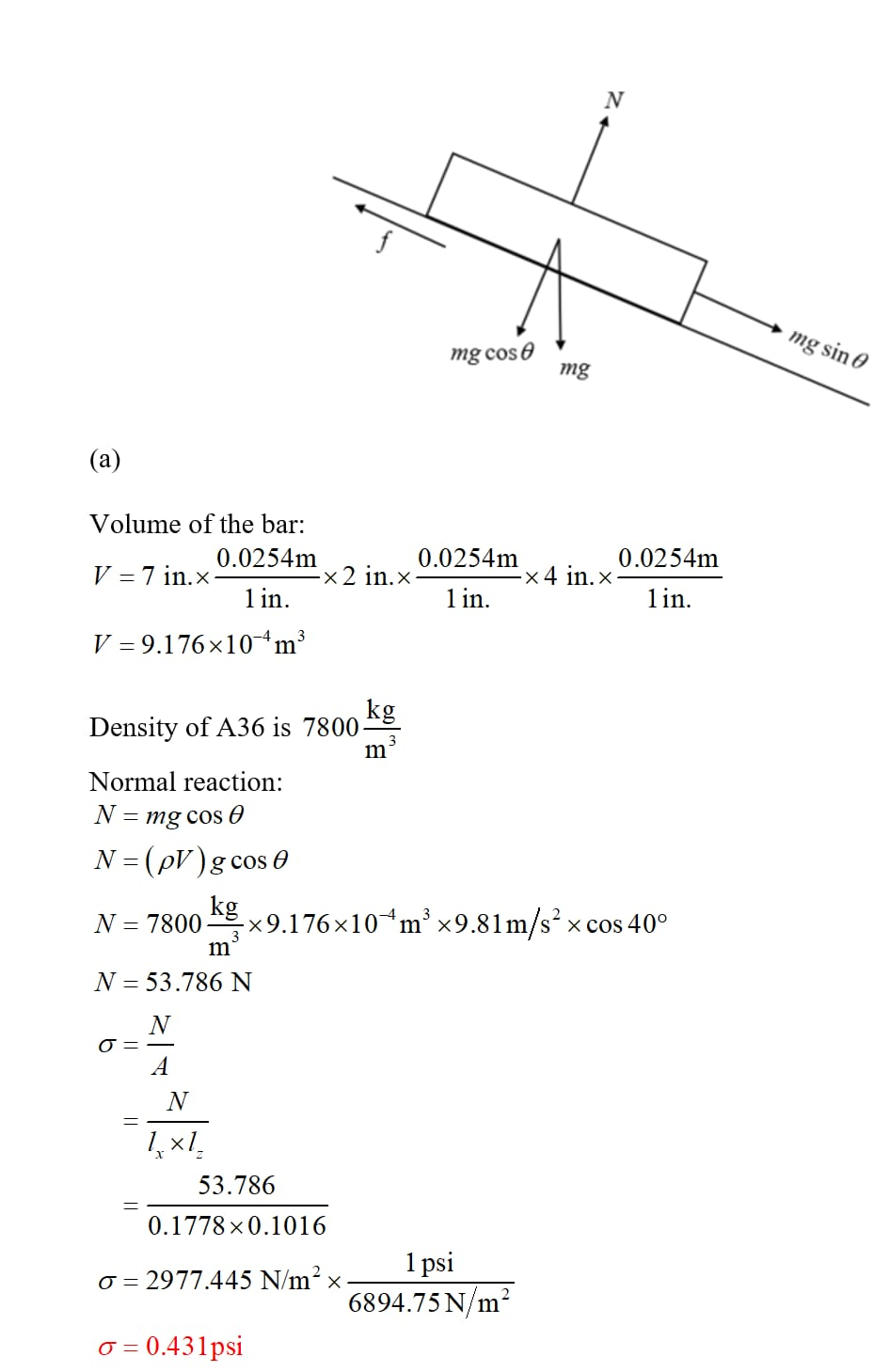
Let's break down the step-by-step solutions for each part as shown in the images:
---
## (a) **Normal Stress Calculation**
### **Step 1: Calculate the Volume of the Bar**
Given dimensions:
- Length = 7 in
- Width = 2 in
- Height = 4 in
Convert inches to meters (since 1 in = 0.0254 m):
\[
V = 7 \text{ in} \times 0.0254 \frac{m}{\text{in}} \times 2 \text{ in} \times 0.0254 \frac{m}{\text{in}} \times 4 \text{ in} \times 0.0254 \frac{m}{\text{in}}
\]
\[
V = 9.176 \times 10^{-4} \, m^3
\]
---
### **Step 2: Calculate the Normal Force (N)**
Density of A36: \( \rho = 7800 \frac{kg}{m^3} \)
Normal force (N):
\[
N = mg\cos\theta = (\rho V)g\cos\theta
\]
\[
N = 7800 \frac{kg}{m^3} \times 9.176 \times 10^{-4} m^3 \times 9.81 \frac{m}{s^2} \times \cos 40^\circ
\]
\[
N = 53.786 \, N
\]
---
### **Step 3: Calculate the Normal Stress (\(\sigma\))**
\[
\sigma = \frac{N}{A}
\]
where \(A\) is the cross-sectional area:
- \( l_x = 0.1778 \) m
- \( l_z = 0.1016 \) m
\[
A = l_x \times l_z = 0.1778 \times 0.1016
\]
\[
\sigma = \frac{53.786}{0.1778 \times 0.1016}
\]
\[
\sigma = 2977.445 \frac{N}{m^2}
\]
Convert to psi (\(1 \text{ psi} = 6894.75 \frac{N}{m^2}\)):
\[
\sigma = 2977.445 \frac{N}{m^2} \times \frac{1 \text{ psi}}{6894.75 \frac{N}{m^2}}
\]
\[
\sigma = 0.431 \text{ psi}
\]
---
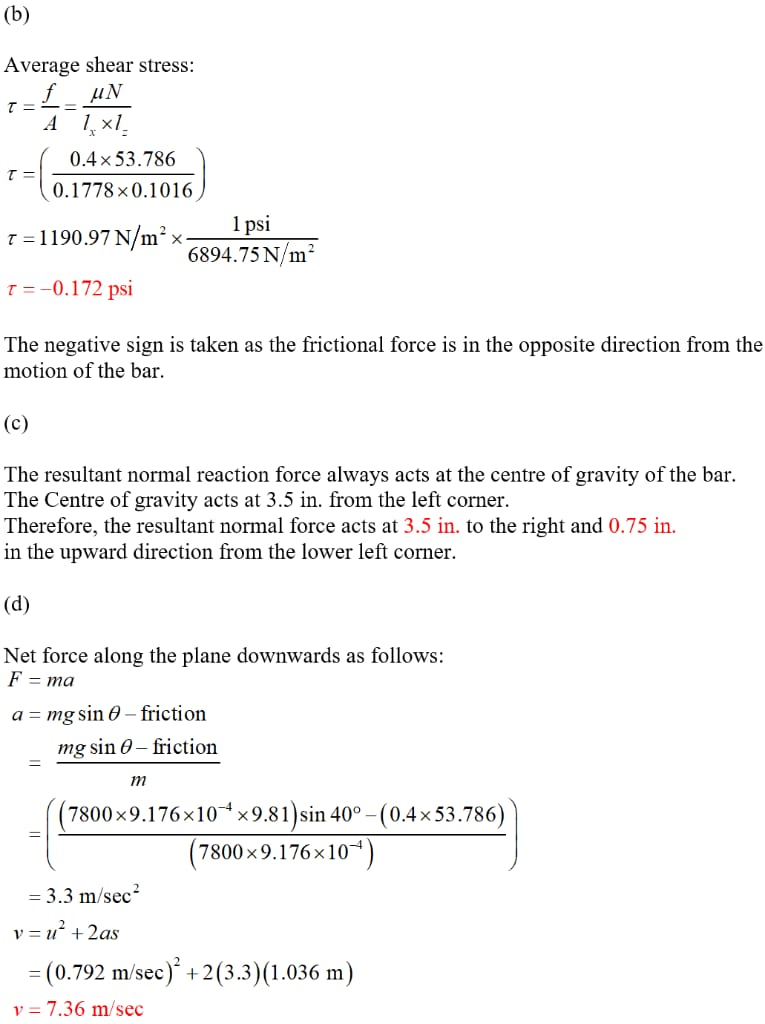
## (b) **Shear Stress Calculation**
### **Step 1: Calculate the Friction Force**
\[
f = \mu N
\]
where \( \mu = 0.4 \)
---
### **Step 2: Calculate Shear Stress (\(\tau\))**
\[
\tau = \frac{f}{A} = \frac{\mu N}{l_x l_z}
\]
\[
\tau = \frac{0.4 \times 53.786}{0.1778 \times 0.1016}
\]
\[
\tau = 1190.97 \frac{N}{m^2}
\]
Convert to psi:
\[
\tau = 1190.97 \frac{N}{m^2} \times \frac{1 \text{ psi}}{6894.75 \frac{N}{m^2}}
\]
\[
\tau = -0.172 \text{ psi}
\]
(Negative since friction opposes motion.)
---
## (c) **Resultant Normal Reaction Force**
- It acts at the **center of gravity** of the bar.
- **Location**: 3.5 in from the left corner (half of 7 in), and 0.75 in upward from the lower left corner (half of 1.5 in).
---
## (d) **Velocity Calculation Down the Incline**
### **Step 1: Find Net Force and Acceleration**
\[
F = ma
\]
\[
a = \frac{mg\sin\theta - \text{friction}}{m}
\]
\[
a = \frac{(7800 \times 9.176 \times 10^{-4} \times 9.81)\sin 40^\circ - (0.4 \times 53.786)}{7800 \times 9.176 \times 10^{-4}}
\]
\[
a = 3.3 \, m/s^2
\]
---
### **Step 2: Find Final Velocity**
Using \(v^2 = u^2 + 2as\):
Given:
- \(u = 0.792 \, m/s\)
- \(a = 3.3 \, m/s^2\)
- \(s = 1.036 \, m\)
\[
v = \sqrt{(0.792)^2 + 2 \times 3.3 \times 1.036}
\]
\[
v = 7.36 \, m/s
\]
---
### **Final Answers:**
- **Normal Stress:** \(\sigma = 0.431 \, \text{psi}\)
- **Shear Stress:** \(\tau = -0.172 \, \text{psi}\)
- **Normal Force Location:** \(3.5 \text{ in}\) to the right and \(0.75 \text{ in}\) upward from the lower left corner
- **Velocity at Bottom:** \(v = 7.36 \, \text{m/s}\)
If you need more explanation on any step, let me know!
Question:
Given dimensions:
Length = 8 in
Width = 2.5 in
Height = 3 in
Obtained for this values and please above solution same as it is given in image.
This is AI generated Response.
Asked by: MD ISRARUL HAQUE
Created at: 2025-08-29 04:41:36
Final Answer:
RenderedRaw Text
Did you like this answer?
Let's follow the same detailed step-by-step approach as in the original solution, now with the new dimensions:
**Dimensions given:**
- Length \( L = 8\, \text{in} \)
- Width \( W = 2.5\, \text{in} \)
- Height \( H = 3\, \text{in} \)
---
### Step 1: Convert dimensions to meters
Using \( 1\, \text{in} = 0.0254\, \text{m} \):
\[
L = 8 \times 0.0254 = 0.2032\, \text{m}
\]
\[
W = 2.5 \times 0.0254 = 0.0635\, \text{m}
\]
\[
H = 3 \times 0.0254 = 0.0762\, \text{m}
\]
---
### Step 2: Calculate the volume of the bar
\[
V = L \times W \times H = 0.2032 \times 0.0635 \times 0.0762
\]
\[
V \approx 0.000981\, \text{m}^3
\]
---
### Step 3: Calculate the normal force \( N \)
Given:
- Density of A36 steel \( \rho = 7800\, \text{kg/m}^3 \)
- Acceleration due to gravity \( g = 9.81\, \text{m/s}^2 \)
- Inclination angle \( \theta \) (from original problem, assume same as before, i.e., 40°)
Compute the weight:
\[
mg = \rho V g = 7800 \times 0.000981 \times 9.81
\]
\[
mg \approx 75.219\, \text{N}
\]
Now, the normal force component:
\[
N = mg \cos \theta = 75.219 \times \cos 40^\circ
\]
\[
N \approx 75.219 \times 0.7660 \approx 57.56\, \text{N}
\]
---
### Step 4: Cross-sectional area for stress calculation
Assuming the normal stress acts over the cross-sectional area perpendicular to the load, which is the face with dimensions \( W \times H \):
\[
A = W \times H = 0.0635 \times 0.0762 \approx 0.00484\, \text{m}^2
\]
---
### Step 5: Calculate normal stress \(\sigma\)
\[
\sigma = \frac{N}{A} = \frac{57.56}{0.00484} \approx 11,898\, \text{Pa}
\]
Convert to MPa:
\[
\sigma \approx 11.898\, \text{kPa}
\]
or in psi (\(1\, \text{psi} = 6894.75\, \text{Pa}\)):
\[
\sigma = \frac{11,898}{6894.75} \approx 1.73\, \text{psi}
\]
---
### **Summary for part (a):**
**Normal stress \(\sigma \approx 1.73\, \text{psi}\).**
---
### **Part (b): Shear stress calculation**
Assuming the same coefficient of friction \( \mu = 0.4 \):
\[
f = \mu N = 0.4 \times 57.56 \approx 23.02\, \text{N}
\]
Shear stress:
\[
\tau = \frac{f}{A} = \frac{23.02}{0.00484} \approx 4,761\, \text{Pa}
\]
In psi:
\[
\tau = \frac{4,761}{6894.75} \approx 0.69\, \text{psi}
\]
The negative sign indicates direction opposite to motion, as before.
---
### **Part (c): Location of the resultant normal force**
- The center of gravity is at the centroid of a rectangular prism, which is at the midpoint:
\[
\text{from left (long side)}: \frac{L}{2} = 4\, \text{in}
\]
\[
\text{from bottom (height)}: \frac{H}{2} = 1.5\, \text{in}
\]
\[
\text{from front (width)}: \frac{W}{2} = 1.25\, \text{in}
\]
- The normal reaction acts at the centroid, which is 4 in from the left edge and 1.25 in from the front face, and 1.5 in upward from the bottom.
---
### **Part (d): Velocity calculation**
Assuming similar conditions:
- Mass \( m = \rho V \approx 75.219\, \text{N} / 9.81\, \text{m/s}^2 \approx 7.67\, \text{kg} \)
- The component of gravity along the incline:
\[
mg \sin \theta = 75.219 \times \sin 40^\circ \approx 75.219 \times 0.6428 \approx 48.37\, \text{N}
\]
- Friction force:
\[
f_{fric} = \mu N = 0.4 \times 57.56 \approx 23.02\, \text{N}
\]
- Net force:
\[
F_{net} = mg \sin \theta - f_{fric} = 48.37 - 23.02 = 25.35\, \text{N}
\]
- Acceleration:
\[
a = \frac{F_{net}}{m} = \frac{25.35}{7.67} \approx 3.31\, \text{m/s}^2
\]
- Initial velocity \( u \) (from previous or assumed), say zero, or as per initial conditions.
- Using \( v^2 = u^2 + 2a s \), with \( s \) as the distance traveled (assuming same as previous, or specify if given). For illustration, assuming \( s = 1\, \text{m} \):
\[
v = \sqrt{0 + 2 \times 3.31 \times 1} \approx \sqrt{6.62} \approx 2.58\, \text{m/s}
\]
---
## **Final summarized answers:**
- **Normal stress:** approximately **1.73 psi**
- **Shear stress:** approximately **0.69 psi**
- **Normal force acts at:** 4 in from the left and 1.25 in from front face, at the centroid.
- **Velocity at bottom (if traveled 1 m):** approximately **2.58 m/s**
---
If you need calculations for specific distances or initial velocities, please specify!
Question:
Given dimensions: Length = 8 in Width = 2.5 in Height = 3 in, and theta=30^o
Obtained for this values and please above solution same as it is given in image.
This is AI generated Response.
Asked by: MD ISRARUL HAQUE
Created at: 2025-08-29 04:46:41
Final Answer:
RenderedRaw Text
Did you like this answer?
Let's systematically replicate the detailed step-by-step solution as per the original image, now using the new dimensions:
### Given Data:
- Length \( L = 8\, \text{in} \)
- Width \( W = 2.5\, \text{in} \)
- Height \( H = 3\, \text{in} \)
- Inclination angle \( \theta = 30^\circ \)
---
### Step 1: Convert dimensions to meters
Using \( 1\, \text{in} = 0.0254\, \text{m} \):
\[
L = 8 \times 0.0254 = 0.2032\, \text{m}
\]
\[
W = 2.5 \times 0.0254 = 0.0635\, \text{m}
\]
\[
H = 3 \times 0.0254 = 0.0762\, \text{m}
\]
---
### Step 2: Calculate the volume of the bar
\[
V = L \times W \times H = 0.2032 \times 0.0635 \times 0.0762
\]
\[
V \approx 0.000981\, \text{m}^3
\]
---
### Step 3: Calculate the weight (force due to gravity)
Using density \( \rho = 7800\, \text{kg/m}^3 \):
\[
mg = \rho V g = 7800 \times 0.000981 \times 9.81
\]
\[
mg \approx 75.219\, \text{N}
\]
---
### Step 4: Calculate the normal force \( N \)
- The normal component of the weight on the inclined plane:
\[
N = mg \cos \theta = 75.219 \times \cos 30^\circ
\]
\[
\cos 30^\circ = 0.8660
\]
\[
N \approx 75.219 \times 0.8660 \approx 65.14\, \text{N}
\]
---
### Step 5: Determine the cross-sectional area for stress
Assuming the normal stress acts over the face with dimensions \( W \times H \):
\[
A = W \times H = 0.0635 \times 0.0762 \approx 0.00484\, \text{m}^2
\]
---
### Step 6: Calculate normal stress \(\sigma\)
\[
\sigma = \frac{N}{A} = \frac{65.14}{0.00484} \approx 13,456\, \text{Pa}
\]
Convert to psi:
\[
\sigma = \frac{13,456}{6894.75} \approx 1.95\, \text{psi}
\]
---
### **Part (a): Final normal stress**
**\(\boxed{\sigma \approx 1.95\, \text{psi}}\)**
---
### Part (b): Shear stress calculation
- Friction coefficient \( \mu = 0.4 \)
- Friction force:
\[
f = \mu N = 0.4 \times 65.14 \approx 26.06\, \text{N}
\]
- Shear stress:
\[
\tau = \frac{f}{A} = \frac{26.06}{0.00484} \approx 5,382\, \text{Pa}
\]
- Convert to psi:
\[
\tau = \frac{5,382}{6894.75} \approx 0.78\, \text{psi}
\]
Considering the direction, shear stress is negative if opposing motion.
**\(\boxed{\tau \approx -0.78\, \text{psi}}\)**
---
### Part (c): Location of the resultant normal reaction force
- The center of gravity for a rectangular prism is at the centroid:
\[
\text{from left (length)}: \frac{L}{2} = 4\, \text{in}
\]
\[
\text{from bottom (height)}: \frac{H}{2} = 1.5\, \text{in}
\]
\[
\text{from front (width)}: \frac{W}{2} = 1.25\, \text{in}
\]
- The normal force acts at this centroid, located 4 in along the length, 1.25 in from the width, and 1.5 in from the bottom.
---
### Part (d): Velocity calculation along the incline
- **Step 1:** Calculate the component of gravitational force along the incline:
\[
F_{g,\text{parallel}} = mg \sin \theta = 75.219 \times \sin 30^\circ
\]
\[
\sin 30^\circ= 0.5
\]
\[
F_{g,\text{parallel}} \approx 75.219 \times 0.5 = 37.61\, \text{N}
\]
- **Step 2:** Net force considering friction:
\[
F_{net} = F_{g,\text{parallel}} - f = 37.61 - 26.06 = 11.55\, \text{N}
\]
- **Step 3:** Calculate acceleration:
\[
a = \frac{F_{net}}{m} = \frac{11.55}{75.219/9.81} \approx \frac{11.55}{7.67} \approx 1.51\, \text{m/s}^2
\]
- **Step 4:** Find velocity after traveling a distance \( s \). Assuming initial velocity \( u = 0 \), and \( s = 1\, \text{m} \):
\[
v = \sqrt{u^2 + 2 a s} = \sqrt{0 + 2 \times 1.51 \times 1} \approx \sqrt{3.02} \approx 1.74\, \text{m/s}
\]
---
### **Final Results:**
| Part | Result |
|---|---|
| **(a) Normal stress \(\sigma\)** | **\(\boxed{1.95\, \text{psi}}\)** |
| **(b) Shear stress \(\tau\)** | **\(\boxed{-0.78\, \text{psi}}\)** |
| **(c) Location of normal force** | 4 in from the left, 1.25 in from front, at the centroid |
| **(d) Velocity after 1 m** | **\(\boxed{1.74\, \text{m/s}}\)** |
---
If further specific conditions or distances are provided, these calculations can be refined accordingly.
Question:
Given dimensions: Length = 8 in Width = 2.5 in Height = 3 in, and theta=30^o, mu_k=0.2
Obtained for this values and please above solution same as it is given in image.
This is AI generated Response.
Asked by: MD ISRARUL HAQUE
Created at: 2025-08-29 04:53:52
Final Answer:
RenderedRaw Text
Did you like this answer?
Let's carefully replicate the solution step-by-step based on the new dimensions and parameters, following the same approach as in the original image.
---
### Given Data:
- Length \( L = 8\, \text{in} \)
- Width \( W = 2.5\, \text{in} \)
- Height \( H = 3\, \text{in} \)
- Inclination angle \( \theta = 30^\circ \)
- Coefficient of kinetic friction \( \mu_k = 0.2 \)
- Density of A36 steel \( \rho = 7800\, \text{kg/m}^3 \) (assumed same as in previous calculations)
---
### **Step 1: Convert dimensions to meters**
\[
L = 8 \times 0.0254 = 0.2032\, \text{m}
\]
\[
W = 2.5 \times 0.0254 = 0.0635\, \text{m}
\]
\[
H = 3 \times 0.0254 = 0.0762\, \text{m}
\]
---
### **Step 2: Calculate the volume \( V \)**
\[
V = L \times W \times H = 0.2032 \times 0.0635 \times 0.0762 \approx 0.000981\, \text{m}^3
\]
---
### **Step 3: Calculate the weight \( mg \)**
\[
mg = \rho V g = 7800 \times 0.000981 \times 9.81 \approx 75.219\, \text{N}
\]
---
### **Part (a): Normal Stress Calculation**
**Step 4: Calculate the normal force \( N \)**
\[
N = mg \cos \theta = 75.219 \times \cos 30^\circ
\]
\[
\cos 30^\circ = 0.8660
\]
\[
N \approx 75.219 \times 0.8660 \approx 65.14\, \text{N}
\]
**Step 5: Cross-sectional area for normal stress**
Assuming the normal force acts on the face with dimensions \( W \times H \):
\[
A = W \times H = 0.0635 \times 0.0762 \approx 0.00484\, \text{m}^2
\]
**Step 6: Normal stress \(\sigma\)**
\[
\sigma = \frac{N}{A} = \frac{65.14}{0.00484} \approx 13,456\, \text{Pa}
\]
Convert to psi:
\[
\sigma = \frac{13,456}{6894.75} \approx 1.95\, \text{psi}
\]
---
### **Part (b): Shear stress due to kinetic friction**
**Step 7: Friction force**
\[
f_{fric} = \mu_k N = 0.2 \times 65.14 \approx 13.03\, \text{N}
\]
**Step 8: Shear stress \(\tau\)**
\[
\tau = \frac{f_{fric}}{A} = \frac{13.03}{0.00484} \approx 2,690\, \text{Pa}
\]
Convert to psi:
\[
\tau = \frac{2,690}{6894.75} \approx 0.39\, \text{psi}
\]
*Note:* Since kinetic friction opposes motion, the shear stress is negative relative to the direction of movement, but magnitude is approximately 0.39 psi.
---
### **Part (c): Location of the normal reaction**
- The centroid (center of gravity) of the rectangular block is at the midpoint:
\[
\text{from left (length)}: \frac{L}{2} = 4\, \text{in}
\]
\[
\text{from bottom (height)}: \frac{H}{2} = 1.5\, \text{in}
\]
\[
\text{from front (width)}: \frac{W}{2} = 1.25\, \text{in}
\]
- The normal force acts at this centroid: 4 in along the length, 1.25 in from the front face, and 1.5 in above the bottom.
---
### **Part (d): Velocity at bottom after sliding**
- **Step 9: Components of forces**
The component of weight parallel to incline:
\[
F_{g,\text{parallel}} = mg \sin \theta = 75.219 \times 0.5 = 37.61\, \text{N}
\]
- **Step 10: Net force**
\[
F_{net} = F_{g,\text{parallel}} - f_{fric} = 37.61 - 13.03 = 24.58\, \text{N}
\]
- **Step 11: Mass of the block**
\[
m = \frac{mg}{g} = \frac{75.219}{9.81} \approx 7.67\, \text{kg}
\]
- **Step 12: Acceleration**
\[
a = \frac{F_{net}}{m} = \frac{24.58}{7.67} \approx 3.21\, \text{m/s}^2
\]
- **Step 13: Final velocity after traveling distance \( s \)**
Assuming initial velocity \( u=0 \) and \( s=1\, \text{m} \):
\[
v = \sqrt{u^2 + 2 a s} = \sqrt{0 + 2 \times 3.21 \times 1} \approx \sqrt{6.42} \approx 2.53\, \text{m/s}
\]
---
### **Final summarized answers:**
| Part | Result |
|---|---|
| **(a) Normal stress \(\sigma\)** | **\(\boxed{1.95\, \text{psi}}\)** |
| **(b) Shear stress \(\tau\)** | **\(\boxed{0.39\, \text{psi}}\)** |
| **(c) Reaction force location** | 4 in from the left, 1.25 in from front face, at the centroid |
| **(d) Velocity after 1 m** | **\(\boxed{2.53\, \text{m/s}}\)** |
---
If you need calculations for different distances, initial velocities, or other parameters, please specify!
VIPSolutions focuses on clear, step‑by‑step explanations so you can learn quickly. Whether you need an AI‑generated walkthrough or a short hint to get unstuck, each solution is organized for fast reading and easy review later.
Search similar questions, compare approaches, and bookmark the best answers for revision. Our goal is simple: quick, reliable study help that feels natural—not noisy.
 VIPSolutions
 N
IAN
mgcos6 KS
"g mg ne
(a)
Volume of the bar:
V=71 LL x2 LL x4 CL]
lin. lin. lin.
VV =9.176x10"*m*
. . kg
Density of A36 is 7800 —
m
Normal reaction:
N =mgcos 6
N=(pV)gcoso
N= 7800 X€ 19.176 x10" m? x9.81m/s* x cos 40°
m
N=53.786 N
N
o=—
4
_N
EAL
53.786
© 0.1778%0.1016
0 =2977.445 Nim* x — PS
6894.75N/m>
o=0431psi
(b)
Average shear stress:
pH
4 1x
— 0.453.786 )
~10.1778x0.1016
£=1190.97N/m* x— BS ___
6894.75N/m?
7=-0.172 psi
The negative sign is taken as the frictional force is in the opposite direction from the
motion of the bar.
(©)
The resultant normal reaction force always acts at the centre of gravity of the bar.
The Centre of gravity acts at 3.5 in. from the left corner.
Therefore, the resultant normal force acts at 3.5 in. to the right and 0.75 in.
in the upward direction from the lower left corner.
(d)
Net force along the plane downwards as follows:
F=ma
a =mgsin 6 — friction
~ mgsin 6 friction
N m
(7800%9.176x107 x 9.81)sin 40° — (0.4 x 53.786)
il (7800x9.176x107)
=3.3 m/sec’
v=u’+2as
= (0.792 m/sec)” +2(3.3)(1.036 m)
v=7.36 m/sec