 VIPSolutions
Give step-by-step solution with explanation and final answer:a a 1. (a)-(d) Identify the Miller indices of the ” (a ’ (®) crystallographic planes shown on the right on a cube. (e) Which direction is perpendicular to the = = plane in (b). Draw on the picture and identify the Miller indices of that direction. + - In © w @ ; x a a " 2. Ifthe lattice constant or the unit cell side length in Si is a=5.43x10-* cm. what is the nearest neighbor distance? Show all your work. 3. Germanium crystallizes in the diamond lattice and contains 4.42x10?2 atoms /cm’. Determine the unit cell length for this semiconductor. Show all your work.
Question:
Give step-by-step solution with explanation and final answer: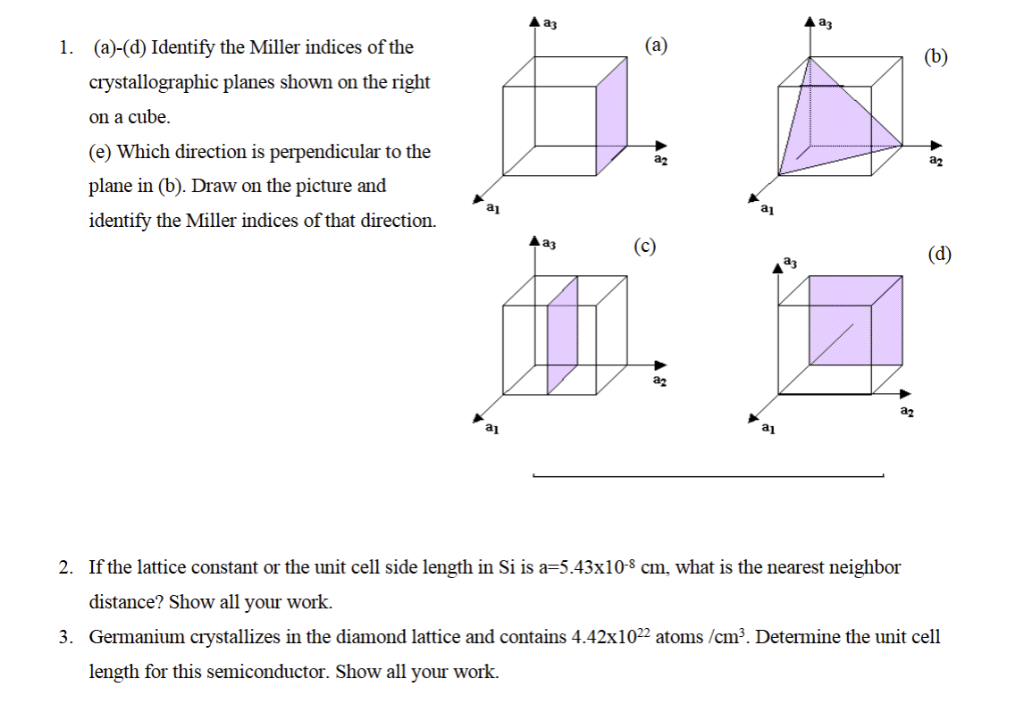 a a
1. (a)-(d) Identify the Miller indices of the ” (a ’ (®)
crystallographic planes shown on the right
on a cube.
(e) Which direction is perpendicular to the = =
plane in (b). Draw on the picture and
identify the Miller indices of that direction. + -
In © w @
; x
a a "
2. Ifthe lattice constant or the unit cell side length in Si is a=5.43x10-* cm. what is the nearest neighbor
distance? Show all your work.
3. Germanium crystallizes in the diamond lattice and contains 4.42x10?2 atoms /cm’. Determine the unit cell
length for this semiconductor. Show all your work.
This is AI generated Response.
Asked by: M Murali
Created at: 2025-08-28 09:57:59
Asked by: M Murali
Created at: 2025-08-28 09:57:59
Final Answer:
Rendered
Raw Text
Did you like this answer?
Let's solve each part step by step:
---
## 1. (a)-(d) Identify the Miller indices of the crystallographic planes shown.
### **General Method for Finding Miller Indices (hkl):**
1. **Find the intercepts of the plane with the axes** in terms of the lattice constants (a1, a2, a3).
2. **Take reciprocals** of the intercepts.
3. **Clear fractions** to get the smallest set of integers.
4. **Enclose in parentheses:** (h k l).
---
### **(a)**
- The plane cuts the **a3** axis at 1, and is parallel to the **a1** and **a2** axes (never intersects).
- Intercepts: (∞, ∞, 1)
- Reciprocals: (0, 0, 1)
**Miller index:** **(001)**
---
### **(b)**
- The plane cuts all axes at 1: intercepts at (1, 1, 1).
- Reciprocals: (1, 1, 1)
**Miller index:** **(111)**
---
### **(c)**
- The plane cuts the **a1** axis at 1, is parallel to the **a2** and **a3** axes (never intersects).
- Intercepts: (1, ∞, ∞)
- Reciprocals: (1, 0, 0)
**Miller index:** **(100)**
---
### **(d)**
- The plane cuts the **a2** axis at 1, is parallel to the **a1** and **a3** axes.
- Intercepts: (∞, 1, ∞)
- Reciprocals: (0, 1, 0)
**Miller index:** **(010)**
---
### **(e) Which direction is perpendicular to the plane in (b)?**
- The normal to the (111) plane is the [111] direction, i.e., the direction with direction cosines (1,1,1).
**Draw an arrow from the origin to the point (1,1,1), and label it as the [111] direction.**
---
## **Summary Table:**
| Part | Intercepts | Reciprocals | Miller Index |
|------|--------------|-------------|-------------|
| (a) | (∞, ∞, 1) | (0, 0, 1) | (001) |
| (b) | (1, 1, 1) | (1, 1, 1) | (111) |
| (c) | (1, ∞, ∞) | (1, 0, 0) | (100) |
| (d) | (∞, 1, ∞) | (0, 1, 0) | (010) |
**(e) The direction perpendicular to (b) is [111].**
---
### **2. Nearest Neighbor Distance in Si (diamond cubic), a = 5.43×10⁻⁸ cm**
In diamond cubic structure:
- Nearest neighbor distance, \( d = \frac{a\sqrt{3}}{4} \)
**Calculation:**
\[
d = \frac{5.43 \times 10^{-8} \times \sqrt{3}}{4}
\]
\[
d = \frac{5.43 \times 10^{-8} \times 1.732}{4}
\]
\[
d = \frac{9.406 \times 10^{-8}}{4}
\]
\[
d = 2.35 \times 10^{-8} \text{ cm}
\]
---
### **3. Germanium: Diamond lattice, 4.42×10²² atoms/cm³. Find unit cell length \(a\).**
- Each unit cell contains 8 atoms (for diamond structure).
- Number of unit cells per cm³: \( N_{uc} = \frac{4.42 \times 10^{22}}{8} = 5.525 \times 10^{21} \) unit cells/cm³
- Volume of each unit cell: \( V_{uc} = \frac{1}{N_{uc}} = \frac{1}{5.525 \times 10^{21}} = 1.81 \times 10^{-22} \) cm³
- \( a^3 = V_{uc} \)
- \( a = (V_{uc})^{1/3} = (1.81 \times 10^{-22})^{1/3} \)
Calculate:
\[
a = 1.21 \times 10^{-7} \text{ cm}
\]
---
## **Final Answers:**
1. **Miller indices:**
- (a) (001)
- (b) (111)
- (c) (100)
- (d) (010)
- (e) [111]
2. **Nearest neighbor distance in Si:** \(2.35 \times 10^{-8}\) cm
3. **Unit cell length for Ge:** \(1.21 \times 10^{-7}\) cm
---
If you need the solution with more detail or any diagram, let me know!
📢 Instructions:
- Ask anything relatd to above question only.
- For new Question goto :