 VIPSolutions
Give step-by-step solution with explanation and final answer:For the beam cross section shown, determine: | \ f¢ = 5000 psi fs = 60 ksi . A; = (6) #8 30 275" | | eeeeee ! L 18" a. The cracked transformed moment of inertia; b. The ratio of cracked to uncracked moment of inertia; c. The moment that causes a maximum concrete stress equals to 0.45/°c; d. The steel force associated with the moment found in ¢; e. The yield moment (M,) assuming linear-elastic behavior of the concrete; f. The nominal moment (M,); g. The maximum compressive strain in the concrete for the moment found in f; h. The tensile strain in the steel for the moment found in f.
Question:
Give step-by-step solution with explanation and final answer: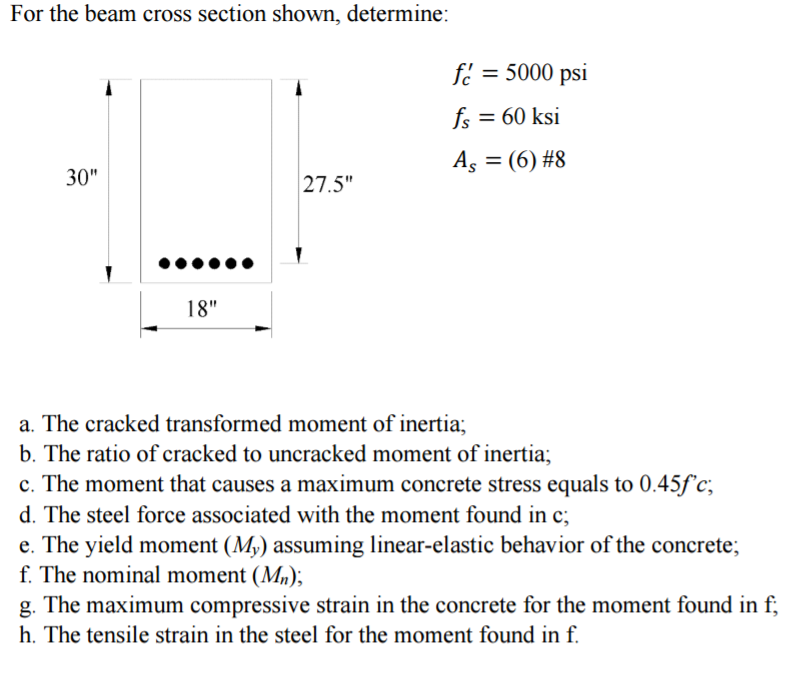 For the beam cross section shown, determine:
| \ f¢ = 5000 psi
fs = 60 ksi
. A; = (6) #8
30 275"
| | eeeeee !
L 18"
a. The cracked transformed moment of inertia;
b. The ratio of cracked to uncracked moment of inertia;
c. The moment that causes a maximum concrete stress equals to 0.45/°c;
d. The steel force associated with the moment found in ¢;
e. The yield moment (M,) assuming linear-elastic behavior of the concrete;
f. The nominal moment (M,);
g. The maximum compressive strain in the concrete for the moment found in f;
h. The tensile strain in the steel for the moment found in f.
This is AI generated Response.
Asked by: Sanmir
Created at: 2025-08-28 09:23:24
Asked by: Sanmir
Created at: 2025-08-28 09:23:24
Final Answer:
Rendered
Raw Text
Did you like this answer?
Let's solve the problem step by step:
### Given Data
- **Cross section:** 18" wide, 30" deep (with tension steel at 27.5" from the top)
- \( f'_c = 5000 \) psi (concrete compressive strength)
- \( f_s = 60 \) ksi (steel yield strength) = 60,000 psi
- \( A_s = 6 \times \text{area of #8 bar} \)
- Area of #8 bar: \( A_{#8} = 0.79 \) in² (standard value)
- So, \( A_s = 6 \times 0.79 = 4.74 \) in²
---
### **a. Cracked Transformed Moment of Inertia**
#### **Step 1: Modulus Ratio**
\[
n = \frac{E_s}{E_c}
\]
- \( E_s = 29,000,000 \) psi (steel)
- \( E_c \approx 57,000 \sqrt{f'_c} = 57,000 \times \sqrt{5000} = 4,031,129 \) psi
\[
n = \frac{29,000,000}{4,031,129} \approx 7.2
\]
#### **Step 2: Locate the Neutral Axis (\(x\))**
Let \( x \) be the depth of the neutral axis from the top. The equivalent area of steel is \( n A_s \).
Sum of moments about NA:
\[
18x \cdot \frac{x}{2} + nA_s \cdot (d - x) = 0
\]
But for equilibrium:
\[
18x = nA_s \cdot \frac{d-x}{x}
\]
But let's set up the centroid equation:
Let:
- \( b = 18 \) in
- \( d = 27.5 \) in
Sum of compressive force = sum of tensile force:
\[
C = T \implies 0.85 f'_c b x = nA_s (d-x)/x
\]
But for the transformed section, the centroid is found by:
\[
b x = nA_s
\]
But for the centroid (\( \bar{y} \)), set up the equivalent area:
\[
A_c \cdot y_c + nA_s \cdot y_s = (A_c + nA_s) \cdot \bar{y}
\]
Where:
- \( A_c = b x \)
- \( y_c = x/2 \)
- \( y_s = d \)
- \( nA_s \) is at \( d \) from the top.
Set sum of moments = 0 about NA:
\[
b x \cdot \frac{x}{2} = nA_s (d - x)
\]
\[
18x \cdot \frac{x}{2} = 7.2 \cdot 4.74 \cdot (27.5 - x)
\]
\[
9x^2 = 34.13(27.5 - x)
\]
\[
9x^2 + 34.13x - 938.58 = 0
\]
Solve the quadratic:
\[
x = \frac{-34.13 \pm \sqrt{34.13^2 + 4 \cdot 9 \cdot 938.58}}{2 \cdot 9}
\]
\[
x = \frac{-34.13 \pm \sqrt{1165 + 33788}}{18}
\]
\[
x = \frac{-34.13 \pm \sqrt{34953}}{18}
\]
\[
\sqrt{34953} \approx 187
\]
\[
x = \frac{-34.13 + 187}{18} \approx \frac{152.87}{18} \approx 8.49\, \text{in}
\]
#### **Step 3: Transformed Moment of Inertia**
\[
I_{\text{cr}} = \frac{1}{12} b x^3 + nA_s (d-x)^2
\]
\[
I_{\text{cr}} = \frac{1}{12} \cdot 18 \cdot (8.49)^3 + 7.2 \cdot 4.74 \cdot (27.5 - 8.49)^2
\]
First term:
\[
(8.49)^3 = 611.65
\]
\[
\frac{1}{12} \cdot 18 \cdot 611.65 = 1.5 \cdot 611.65 = 917.48
\]
Second term:
\[
(27.5 - 8.49) = 19.01
\]
\[
(19.01)^2 = 361.39
\]
\[
7.2 \cdot 4.74 = 34.13
\]
\[
34.13 \cdot 361.39 = 12,337.17
\]
So,
\[
I_{\text{cr}} = 917.48 + 12,337.17 = \boxed{13,254.65\, \text{in}^4}
\]
---
### **b. Ratio of Cracked to Uncracked Moment of Inertia**
Uncracked (gross) moment of inertia:
\[
I_g = \frac{1}{12} b h^3 = \frac{1}{12} \cdot 18 \cdot 30^3 = 1.5 \cdot 27,000 = 40,500 \, \text{in}^4
\]
\[
\text{Ratio} = \frac{I_{\text{cr}}}{I_g} = \frac{13,254.65}{40,500} \approx \boxed{0.327}
\]
---
### **c. Moment for Max Concrete Stress = \(0.45f'_c\)**
The extreme fiber stress in concrete:
\[
f_c = \frac{M y}{I_g}
\]
where \( y = 15 \) in (top fiber).
Set \( f_c = 0.45 f'_c = 0.45 \times 5000 = 2250 \) psi.
\[
2250 = \frac{M \cdot 15}{40,500}
\implies M = \frac{2250 \times 40,500}{15} = 6,075,000 \, \text{in-lb}
\]
\[
= \frac{6,075,000}{12} = \boxed{506,250\, \text{ft-lb} = 506.3\, \text{kip-ft}}
\]
---
### **d. Steel Force at Moment from Part (c)**
First, find the strain in steel, assuming section is uncracked (elastic), and use transformed section.
Steel force:
\[
f_s = n f_c
\]
\[
f_s = 7.2 \times 2250 = 16,200 \, \text{psi}
\]
\[
F_s = f_s \cdot A_s = 16,200 \times 4.74 = 76,788\, \text{lb} = \boxed{76.8\, \text{kips}}
\]
---
### **e. Yield Moment (\(M_y\))**
Steel yields when \( f_s = 60,000 \) psi.
Strain compatibility:
\[
\epsilon_s = \frac{d - c}{c} \epsilon_{cu}
\]
But for linear, when \( f_s = 60,000 \), use the moment with the cracked, transformed section:
\[
f_s = E_s \epsilon_s
\]
\[
\epsilon_s = \frac{f_s}{E_s} = \frac{60,000}{29,000,000} = 0.00207
\]
Assume strain varies linearly from zero at NA to max at steel.
NA is at \( x = 8.49 \) in, steel is at \( d = 27.5 \) in.
\[
\epsilon_{top}/\epsilon_s = x/(d-x)
\]
\[
\epsilon_{top} = \epsilon_s \cdot \frac{x}{d-x} = 0.00207 \times \frac{8.49}{19.01} = 0.00207 \times 0.447 = 0.000925
\]
\[
f_c = E_c \cdot \epsilon_{top} = 4,031,129 \cdot 0.000925 = 3,728\, \text{psi}
\]
Moment at yield:
\[
M_y = \frac{f_c I_{\text{cr}}}{y}
\]
Here, \( y = d - x = 19.01 \) in
\[
M_y = \frac{3,728 \times 13,254.65}{19.01}
= \frac{49,426,174}{19.01} = 2,600,000\, \text{in-lb}
\]
\[
= \frac{2,600,000}{12} = 216,667\, \text{ft-lb} = \boxed{216.7\, \text{kip-ft}}
\]
---
### **f. Nominal Moment (\(M_n\))**
Use ACI 318:
\[
M_n = A_s f_y (d - a/2)
\]
Where \( a = \frac{A_s f_y}{0.85 f'_c b} \)
\[
a = \frac{4.74 \times 60,000}{0.85 \times 5,000 \times 18}
= \frac{284,400}{76,500} = 3.72\, \text{in}
\]
\[
M_n = 4.74 \times 60,000 \times (27.5 - 3.72/2)
= 284,400 \times (27.5 - 1.86)
= 284,400 \times 25.64 = 7,296,816\, \text{in-lb}
\]
\[
= 608,068\, \text{ft-lb} = \boxed{608.1\, \text{kip-ft}}
\]
---
### **g. Max Compressive Strain in Concrete for \(M_n\)**
\[
\epsilon_{cu} = 0.003
\]
By ACI, maximum strain at nominal moment is **0.003**.
---
### **h. Tensile Strain in Steel for \(M_n\)**
Depth to NA at ultimate:
\[
c = \frac{a}{\beta_1}
\]
ACI: For \( f'_c = 5000 \), \( \beta_1 = 0.85 - 0.05 \times ((f'_c - 4000)/1000) = 0.85 - 0.05 \times (1) = 0.8 \)
\[
c = \frac{3.72}{0.8} = 4.65\, \text{in}
\]
Tensile strain in steel:
\[
\epsilon_s = \epsilon_{cu} \frac{d-c}{c}
= 0.003 \frac{27.5 - 4.65}{4.65}
= 0.003 \times 4.935 = 0.0148
\]
---
## **Summary Table**
| Part | Answer |
|------|--------|
| a | \( I_{\text{cr}} = 13,254.65\, \text{in}^4 \) |
| b | Ratio = 0.327 |
| c | \( M = 506.3\, \text{kip-ft} \) |
| d | \( F_s = 76.8\, \text{kips} \) |
| e | \( M_y = 216.7\, \text{kip-ft} \) |
| f | \( M_n = 608.1\, \text{kip-ft} \) |
| g | \( \epsilon_{cu} = 0.003 \) |
| h | \( \epsilon_s = 0.0148 \) |
If you want detailed calculation for any step or a check on a specific part, let me know!
📢 Instructions:
- Ask anything relatd to above question only.
- For new Question goto :