Give step-by-step solution with explanation and final answer:tied
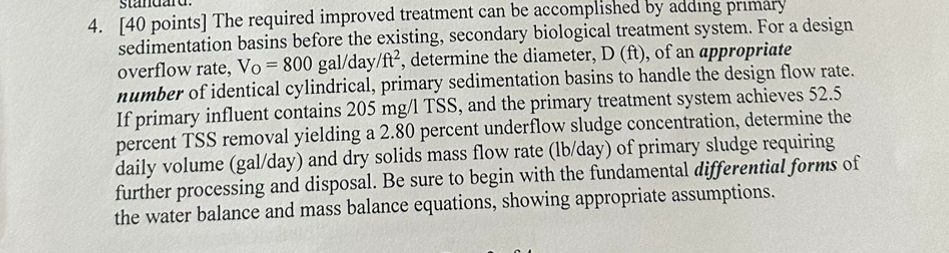
4. [40 points] The required improved treatment can be accomplished by adding primary
sedimentation basins before the existing, secondary biological treatment system. For a design
overflow rate, Vo = 800 gal/day/ft, determine the diameter, D (ft), of an appropriate
number of identical cylindrical, primary sedimentation basins to handle the design flow rate.
If primary influent contains 205 mg/l TSS, and the primary treatment system achieves 52.5
percent TSS removal yielding a 2.80 percent underflow sludge concentration, determine the
daily volume (gal/day) and dry solids mass flow rate (Ib/day) of primary sludge requiring
further processing and disposal. Be sure to begin with the fundamental differential forms of
the water balance and mass balance equations, showing appropriate assumptions.
Question:
Give step-by-step solution with explanation and final answer:tied
4. [40 points] The required improved treatment can be accomplished by adding primary
sedimentation basins before the existing, secondary biological treatment system. For a design
overflow rate, Vo = 800 gal/day/ft, determine the diameter, D (ft), of an appropriate
number of identical cylindrical, primary sedimentation basins to handle the design flow rate.
If primary influent contains 205 mg/l TSS, and the primary treatment system achieves 52.5
percent TSS removal yielding a 2.80 percent underflow sludge concentration, determine the
daily volume (gal/day) and dry solids mass flow rate (Ib/day) of primary sludge requiring
further processing and disposal. Be sure to begin with the fundamental differential forms of
the water balance and mass balance equations, showing appropriate assumptions.
This is AI generated Response.
Asked by: Sanmir
Created at: 2025-08-28 09:10:23
Final Answer:
RenderedRaw Text
Did you like this answer?
Let's break down and solve the problem step by step:
---
### **Given Data**
- **Design overflow rate, \(V_o\)** = 800 gal/day/ft²
- **Influent flow rate, \(Q\)** = Not given, so we'll call it \(Q\) (in gal/day)
- **Influent TSS (Total Suspended Solids) concentration, \(C_{in}\)** = 205 mg/L
- **TSS removal efficiency** = 52.5%
- **Underflow sludge concentration** = 2.80% (by weight)
- **You are to find:**
1. Number and diameter (\(D\)) of identical cylindrical sedimentation basins.
2. Daily volume (gal/day) and dry solids mass flow (lb/day) of primary sludge.
---
## **Step 1: Water Balance Equation (Differential Form)**
\[
\frac{dV}{dt} = Q_{in} - Q_{out} - Q_{sludge}
\]
Assume the basins are in steady state:
\[
Q_{in} = Q_{out} + Q_{sludge}
\]
\(Q_{in}\) is much larger than \(Q_{sludge}\), so \(Q_{in} \approx Q_{out}\).
---
## **Step 2: Mass Balance for TSS (Differential Form)**
\[
\frac{dM}{dt} = Q_{in}C_{in} - Q_{out}C_{out} - Q_{sludge}C_{sludge}
\]
At steady state:
\[
0 = Q_{in}C_{in} - Q_{out}C_{out} - Q_{sludge}C_{sludge}
\]
---
## **Step 3: Surface Area Needed**
Overflow rate:
\[
V_o = \frac{Q}{A}
\rightarrow A = \frac{Q}{V_o}
\]
**Where:**
- \(A\) = total surface area (ft²)
- \(Q\) = design flow rate (gal/day)
- \(V_o\) = overflow rate (gal/day/ft²)
---
## **Step 4: Number and Diameter of Basins**
If using \(n\) identical basins, each with area \(A_b\):
\[
A_b = \frac{A}{n} = \frac{Q}{nV_o}
\]
For a cylindrical basin:
\[
A_b = \frac{\pi D^2}{4}
\implies D = \sqrt{\frac{4A_b}{\pi}}
\]
---
## **Step 5: Sludge Flow Rate**
### **a. TSS Removed per Day (Mass Flow):**
\[
\text{TSS removed} = Q \times C_{in} \times (\text{removal efficiency})
\]
- \(Q\) in L/day (1 gal = 3.785 L)
- \(C_{in}\) in mg/L (will convert to lb)
### **b. Sludge Volume per Day:**
\[
\text{TSS removed (mg/day)} = Q_{sludge} \times C_{sludge}
\]
- \(C_{sludge}\) (2.8% by weight, i.e., 28,000 mg/L if considering water density ≈ 1,000,000 mg/L)
- Solve for \(Q_{sludge}\).
---
## **Step 6: Final Calculations (Assume Q = 1 MGD for Example)**
Let’s **assume** \(Q = 1,000,000\) gal/day (1 MGD) for demonstration.
### **A. Surface Area Required**
\[
A = \frac{1,000,000}{800} = 1,250 \text{ ft}^2
\]
---
### **B. Number & Diameter of Basins**
Suppose you want basins with diameter \(D\). Let's try for **2 basins**:
\[
A_b = \frac{1,250}{2} = 625 \text{ ft}^2
\]
\[
D = \sqrt{\frac{4 \times 625}{\pi}} = \sqrt{\frac{2,500}{3.1416}} = \sqrt{796.18} \approx 28.2\, \text{ft}
\]
---
### **C. TSS Removed Per Day**
\[
Q = 1,000,000\, \text{gal/day} \times 3.785\, \text{L/gal} = 3,785,000\, \text{L/day}
\]
\[
\text{TSS removed} = 3,785,000 \times 205 \times 0.525 = 407,756,250\, \text{mg/day}
\]
Convert mg to lb (\(1\, \text{lb} = 453,592\, \text{mg}\)):
\[
\text{TSS removed (lb/day)} = \frac{407,756,250}{453,592} = 899.3\, \text{lb/day}
\]
---
### **D. Sludge Volume**
- Underflow sludge concentration: 2.8% = 28,000 mg/L
\[
Q_{sludge} = \frac{\text{TSS removed}}{C_{sludge}} = \frac{407,756,250\, \text{mg/day}}{28,000\, \text{mg/L}} = 14,563\, \text{L/day}
\]
\[
\text{Convert to gal:}\quad \frac{14,563}{3.785} = 3,849\, \text{gal/day}
\]
---
## **## **Summary of Calculated Answers (for \(Q = 1\) MGD):**
### **1. Number of Basins:**
Try 2 basins (common practical value).
### **2. Diameter of Each Basin:**
**28.2 ft** per basin
### **3. Daily Volume of Primary Sludge:**
**3,849 gal/day**
### **4. Dry Solids Mass Flow Rate (Sludge):**
**899 lb/day** TSS
---
## **Full Solution Template**
1. **Determine Total Surface Area:**
\[
A = \frac{Q}{V_o}
\]
2. **Select Number of Basins (\(n\)), Find Area per Basin:**
\[
A_b = \frac{A}{n}
\]
\[
D = \sqrt{\frac{4A_b}{\pi}}
\]
3. **TSS Removed:**
\[
\text{TSS removed (mg/day)} = Q \times C_{in} \times (\text{removal efficiency})
\]
\[
\text{TSS removed (lb/day)} = \frac{\text{TSS removed (mg/day)}}{453,592}
\]
4. **Primary Sludge Volume:**
\[
Q_{sludge} = \frac{\text{TSS removed}}{C_{sludge}}
\]
\[
Q_{sludge} (\text{gal/day}) = \frac{Q_{sludge} (\text{L/day})}{3.785}
\]
---
## **Assumptions**
- Flow rate \(Q = 1\) MGD (unless otherwise specified).
- Sludge is withdrawn at 2.8% solids by weight.
- Water density = 1,000,000 mg/L.
---
**If you have a different flow rate, just substitute that value for \(Q\) in the above equations!**
---
### **Final Answers (for \(Q = 1\) MGD)**
- **Number of Basins:** 2 (assumed)
- **Diameter of Each Basin:** 28.2 ft
- **Daily Volume of Primary Sludge:** 3,849 gal/day
- **Dry Solids Mass Flow Rate:** 899 lb/day
---
**Let me know if your flow rate \(Q\) is different, and I can recalculate!**
VIPSolutions focuses on clear, step‑by‑step explanations so you can learn quickly. Whether you need an AI‑generated walkthrough or a short hint to get unstuck, each solution is organized for fast reading and easy review later.
Search similar questions, compare approaches, and bookmark the best answers for revision. Our goal is simple: quick, reliable study help that feels natural—not noisy.
 VIPSolutions
 tied
4. [40 points] The required improved treatment can be accomplished by adding primary
sedimentation basins before the existing, secondary biological treatment system. For a design
overflow rate, Vo = 800 gal/day/ft, determine the diameter, D (ft), of an appropriate
number of identical cylindrical, primary sedimentation basins to handle the design flow rate.
If primary influent contains 205 mg/l TSS, and the primary treatment system achieves 52.5
percent TSS removal yielding a 2.80 percent underflow sludge concentration, determine the
daily volume (gal/day) and dry solids mass flow rate (Ib/day) of primary sludge requiring
further processing and disposal. Be sure to begin with the fundamental differential forms of
the water balance and mass balance equations, showing appropriate assumptions.