 VIPSolutions
Give step-by-step solution with explanation and final answer:a) When the signal current is given for a 340uF capacitor as shown below, define the waveform ve(t) for the voltages across the capacitor if it is assumed to be initially charged. (30 pts) i) (mA) 10 — o 1 2 £(ms)
Question:
Give step-by-step solution with explanation and final answer: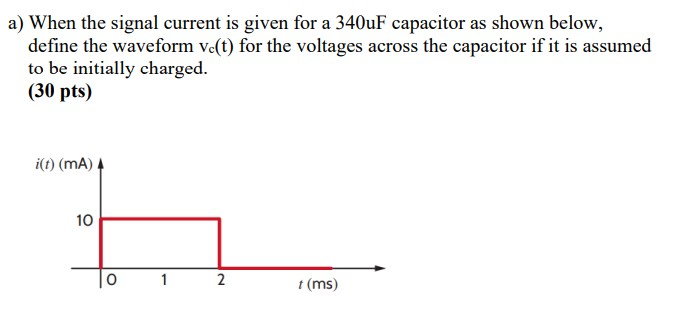 a) When the signal current is given for a 340uF capacitor as shown below,
define the waveform ve(t) for the voltages across the capacitor if it is assumed
to be initially charged.
(30 pts)
i) (mA)
10 —
o 1 2 £(ms)
This is AI generated Response.
Asked by: ronak
Created at: 2025-08-28 03:34:18
Asked by: ronak
Created at: 2025-08-28 03:34:18
Final Answer:
Rendered
Raw Text
Did you like this answer?
Let's solve the problem step by step.
### **Given:**
- Capacitance, \( C = 340 \mu F = 340 \times 10^{-6} \) F
- Signal current, \( i(t) \) (in mA):
\[
i(t) =
\begin{cases}
10 \text{ mA} & 0 < t < 2 \text{ ms} \\
0 & t > 2 \text{ ms}
\end{cases}
\]
- The capacitor is **initially charged** (let's denote the initial voltage as \( V_0 \)).
---
### **Step 1: Capacitor Voltage-Current Relationship**
The relationship between the current and voltage across a capacitor is:
\[
i(t) = C \frac{dv_c(t)}{dt}
\]
So:
\[
\frac{dv_c(t)}{dt} = \frac{i(t)}{C}
\]
---
### **Step 2: Integrate to Find \( v_c(t) \)**
\[
v_c(t) = V_0 + \frac{1}{C} \int_0^t i(\tau) d\tau
\]
---
### **Step 3: Piecewise Calculation**
#### **For \( 0 < t < 2 \) ms:**
\[
i(t) = 10 \text{ mA} = 10 \times 10^{-3} \text{ A}
\]
\[
v_c(t) = V_0 + \frac{1}{340 \times 10^{-6}} \int_0^t 10 \times 10^{-3} d\tau
\]
\[
= V_0 + \frac{1}{340 \times 10^{-6}} \left[10 \times 10^{-3} \tau \right]_0^t
\]
\[
= V_0 + \frac{10 \times 10^{-3}}{340 \times 10^{-6}} t
\]
\[
= V_0 + \left(\frac{10}{340}\right) \times 10^3 t
\]
\[
= V_0 + 0.02941 \times 10^3 t
\]
\[
= V_0 + 29.41 t \quad (\text{with } t \text{ in seconds})
\]
But since \( t \) is in ms, \( t \) (ms) \( = t \times 10^{-3} \) seconds:
\[
v_c(t) = V_0 + 29.41 \times (t \times 10^{-3})
\]
\[
= V_0 + 0.02941 t \quad \text{(for } 0 < t < 2 \text{ ms)}
\]
---
#### **For \( t > 2 \) ms:**
For \( t > 2 \) ms, \( i(t) = 0 \):
\[
v_c(t) = v_c(2 \text{ ms})
\]
First, find \( v_c(2 \text{ ms}) \):
\[
v_c(2 \text{ ms}) = V_0 + 0.02941 \times 2
\]
\[
= V_0 + 0.05882
\]
So for \( t > 2 \) ms:
\[
v_c(t) = V_0 + 0.05882
\]
---
### **Step 4: Final Piecewise Answer**
\[
\boxed{
v_c(t) =
\begin{cases}
V_0 + 0.02941\,t, & 0 < t < 2 \text{ ms} \\
V_0 + 0.05882, & t > 2 \text{ ms}
\end{cases}
}
\]
where \( t \) is in ms.
---
### **Explanation**
- While the current is 10 mA (for \( 0 < t < 2 \) ms), the capacitor voltage increases linearly.
- After \( t = 2 \) ms, the current stops, so the voltage remains constant at \( V_0 + 0.05882 \) V.
- The initial voltage \( V_0 \) is the voltage across the capacitor at \( t = 0 \).
If you know the value of \( V_0 \), you can substitute it in the final answer.
📢 Instructions:
- Ask anything relatd to above question only.
- For new Question goto :