 VIPSolutions
Give step-by-step solution with explanation and final answer: explain the terms used in formula and add explanation in steps if needed and which help to understnd ansThe kettle's heating element acts as resistor. We will find the magnitude of the current using electric power formula. P=V-I —_P 1b 15a 10V Step 2: We will find the kettle's resistance. V=IR Vv H - fy =2Q0=1067Q BA 3 . Now we will find the battery capacity. E=P-t t = 30 minutes x 60 22% — 1800 E =150W x 1800s = 270,000J = 270kJ In Watt-hours: t = 30 minutes = 0.5 hours E=150W x 0.5h = 75 Wh The battery needs a minimum capacity of 75 Wh or 270 kJ to run the kettle for 30 minutes.
Question:
Give step-by-step solution with explanation and final answer:
explain the terms used in formula and add explanation in steps if needed and which help to understnd ans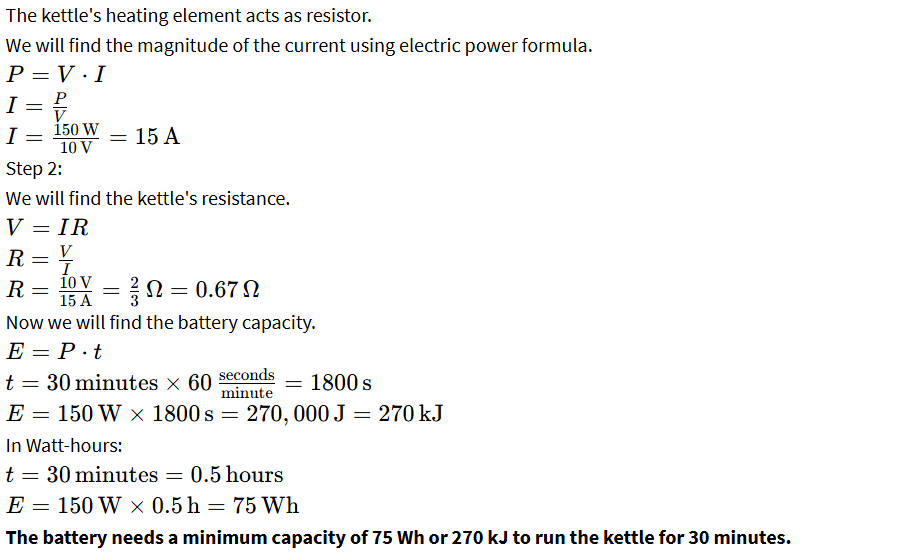 The kettle's heating element acts as resistor.
We will find the magnitude of the current using electric power formula.
P=V-I
—_P
1b 15a
10V
Step 2:
We will find the kettle's resistance.
V=IR
Vv
H - fy =2Q0=1067Q
BA 3 .
Now we will find the battery capacity.
E=P-t
t = 30 minutes x 60 22% — 1800
E =150W x 1800s = 270,000J = 270kJ
In Watt-hours:
t = 30 minutes = 0.5 hours
E=150W x 0.5h = 75 Wh
The battery needs a minimum capacity of 75 Wh or 270 kJ to run the kettle for 30 minutes.
This is AI generated Response.
Asked by: ronak
Created at: 2025-08-28 03:09:47
Asked by: ronak
Created at: 2025-08-28 03:09:47
Final Answer:
Rendered
Raw Text
Did you like this answer?
Let's break down and explain each step from the solution in the image:
---
### **Step 1: Finding the Magnitude of the Current**
**Formula Used:**
\[ P = V \cdot I \]
Where:
- \( P \) = Power (in Watts, W)
- \( V \) = Voltage (in Volts, V)
- \( I \) = Current (in Amperes, A)
**Rearrange to find current:**
\[ I = \frac{P}{V} \]
**Substitute the values:**
- \( P = 150\, \text{W} \)
- \( V = 10\, \text{V} \)
\[ I = \frac{150\, \text{W}}{10\, \text{V}} = 15\, \text{A} \]
---
### **Step 2: Finding the Kettle's Resistance**
**Formula Used:**
\[ V = I \cdot R \]
Where:
- \( R \) = Resistance (in Ohms, Ω)
**Rearrange to find resistance:**
\[ R = \frac{V}{I} \]
**Substitute the values:**
- \( V = 10\, \text{V} \)
- \( I = 15\, \text{A} \)
\[ R = \frac{10\, \text{V}}{15\, \text{A}} = \frac{2}{3}\, \Omega = 0.67\, \Omega \]
---
### **Step 3: Finding the Battery Capacity Required**
#### **(a) In Joules (J) or Kilojoules (kJ):**
**Formula Used:**
\[ E = P \cdot t \]
Where:
- \( E \) = Energy (in Joules, J)
- \( t \) = Time (in seconds, s)
**Convert time:**
- \( 30\, \text{minutes} = 30 \times 60 = 1800\, \text{seconds} \)
**Substitute the values:**
- \( P = 150\, \text{W} \)
- \( t = 1800\, \text{s} \)
\[ E = 150\, \text{W} \times 1800\, \text{s} = 270,000\, \text{J} = 270\, \text{kJ} \]
(\( 1\, \text{kJ} = 1000\, \text{J} \))
---
#### **(b) In Watt-hours (Wh):**
**Convert time:**
- \( 30\, \text{minutes} = 0.5\, \text{hours} \)
**Substitute the values:**
- \( P = 150\, \text{W} \)
- \( t = 0.5\, \text{h} \)
\[ E = 150\, \text{W} \times 0.5\, \text{h} = 75\, \text{Wh} \]
---
### **Final Answer**
**The battery needs a minimum capacity of 75 Wh or 270 kJ to run the kettle for 30 minutes.**
---
## **Explanation of Terms:**
- **Power (P):** The rate at which energy is used or produced, measured in Watts (W).
- **Voltage (V):** The potential difference or 'pressure' that pushes electric current around a circuit, measured in Volts (V).
- **Current (I):** The flow of electric charge, measured in Amperes (A).
- **Resistance (R):** The opposition that a substance offers to the flow of electric current, measured in Ohms (Ω).
- **Energy (E):** The capacity to do work, measured in Joules (J), kilojoules (kJ), or Watt-hours (Wh).
- **Time (t):** The duration for which the device operates, measured in seconds (s) or hours (h).
---
**Summary:**
To operate the kettle for 30 minutes, your battery should be able to supply at least **75 Wh** or **270 kJ** of energy.
📢 Instructions:
- Ask anything relatd to above question only.
- For new Question goto :